 By admin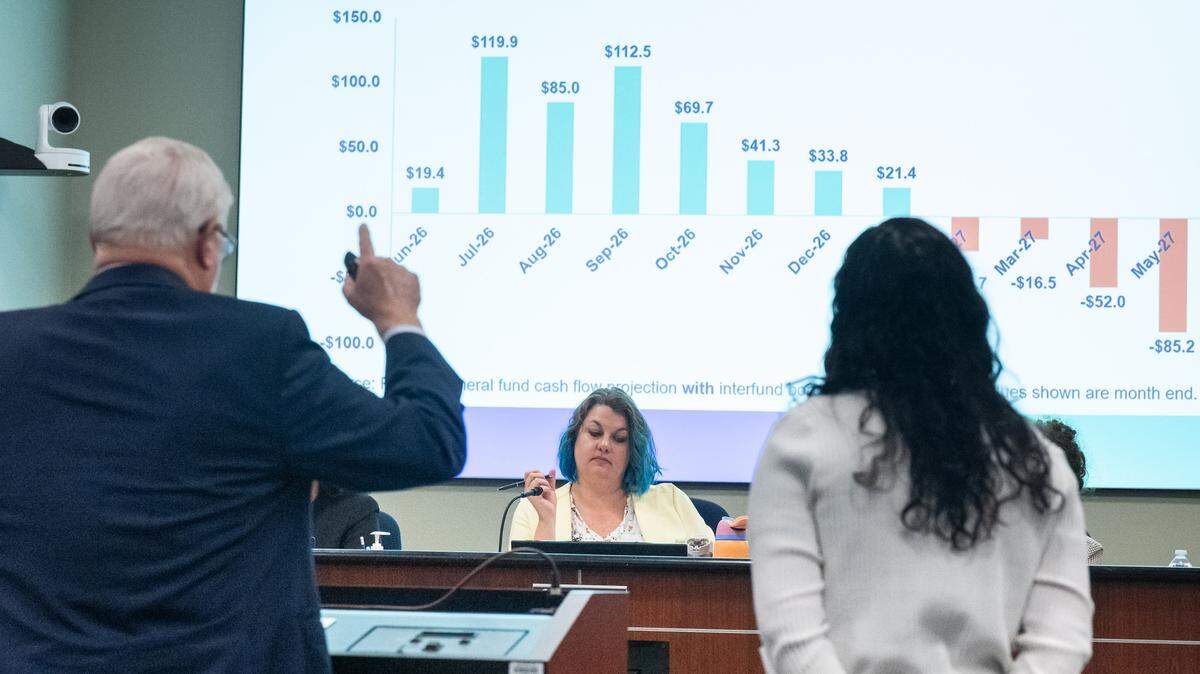
Sacramento City Unified School District’s multiyear projections to address its fiscal crisis relied on revenue assumptions that alarmed fiscal overseers. One of those assumptions counted on about $31 million a year from a state grant, which the district received this school year.
Read more What essential California services are open or closed for Indigenous Peoples’ Day?
Under Proposition 98, the state estimates each year how much of its revenue it must allocate to schools statewide. After underestimating that amount in the previous two years, the state included the Student Support and Professional Development Discretionary Block Grant in a package of one-time funding this year to make up the difference.
SCUSD said it included its $31 million share of the grant money as recurring revenue in each of the next two years based in part on advice from a member of the state superintendent’s team, who told the district it was reasonable to assume the funding would continue.
But on Wednesday, the California Department of Education said the state superintendent’s office takes a different position, conflicting with the advice SCUSD said it received.
“Superintendent (Tony) Thurmond has been consistent and clear on the following: One, one-time funding is not guaranteed in subsequent years and should not be relied upon to balance an ongoing budget,” Julie Lautsch, a spokesperson for the California Department of Education, told The Sacramento Bee.
“Two, that sound fiscal planning requires contingency plans in case anticipated one-time funding doesn’t materialize. And three, that his priority remains ensuring that Sac City has a credible path to long-term solvency.”
The pushback comes amid a continuing back-and-forth in recent months between Sacramento City Unified, the county education office and the state education department on how best to address the district’s dire financial situation.
On Sept. 10, Chief Business Officer Gerardo Castillo told the board the assumption about the grant reflected a recent funding trend and “the analysis from the state” as he presented the district’s long-term plan, which the board approved that day.
The fiscal adviser appointed by the Sacramento County Office of Education said the district’s assumptions raised “grave concerns” and urged the district to revise them, while asking the district to identify the state officials who had advised the district.
In an Oct. 1 response letter to the fiscal adviser, the district superintendent Cancy McArn rejected the fiscal adviser’s concerns, saying a member of Thurmond’s team had said it was “reasonable to assume” the grant would continue to be funded. McArn did not identify the official in the letter.
Sacramento City Unified School District said Thursday that discussions with state officials have included potential funding sources to address the district’s fiscal crisis.
“As part of those discussions, there is an emerging discussion about the ability to rely on various funding sources to meet both long-term budgetary and cash-flow projections, including the need to have in place contingency plans if one-time funding doesn’t materialize,” Brian Heap, a spokesperson for the district, wrote in an email.
Heap added that the district plans to release an updated fiscal recovery plan addressing questions from the state education department.
Why the grant assumption carries risks
Budget summaries from the Department of Finance, the State Superintendent’s office, the Assembly and the Senate all describe the block grant as one-time funding. None say the state has committed to fund it in future years.
The district, however, argued that recent funding trends supported including the grant in its projections, despite warnings from financial experts — including its own chief business officer, who acknowledged the assumption carried risks.
Kenneth Kapphahn, a Legislative Analyst’s Office analyst who focuses on Prop. 98 and school district budgets, cautioned Wednesday that there are risks in counting the block grant as ongoing revenue.
Read more Jets rule out RB Breece Hall (quad), WR Adonai Mitchell (finger)
“Previous underestimates don’t necessarily mean that school funding will grow quickly enough to support large discretionary grants in the future,” Kapphahn said.
Some school funding comes from taxes on investments and stock market gains, which could fall and reduce the money available for schools, Kapphahn explained. And those revenues could remain strong for the next year, but “they could just as easily weaken and reduce school funding,” he continued.
California’s post-pandemic revenue downturn shows how quickly state tax collections can change. After surging for two years during the pandemic, tax revenues fell sharply in 2022-23, reflecting several factors including stock market losses that weakened capital gains income and related tax payments.
The state’s “big three” tax revenues — personal income, corporate and sales taxes — fell 21% in 2022-23. Revenues that turned out lower than expected led the state to reduce the Prop. 98 minimum guarantee for that year by $9.8 billion.
Even if school funding keeps growing, future increases may go to other state priorities, with no guarantee of additional discretionary grants, Kapphahn added.
“It might decide to fund programs that schools must use to hire staff, or add services, or something else instead of addressing local budget deficits,” Kapphahn said.
Sac City Unified in the spotlight
A $222 million structural deficit has put Sacramento City Unified at the center of an unprecedented fiscal crisis that has drawn attention from leaders of other financially distressed districts.
During Tuesday’s Los Angeles Unified School District board meeting, the Fiscal Crisis and Management Assistance Team presented an analysis that rated the district’s overall solvency risk as high. A board member asked the team’s staff about SCUSD’s fiscal crisis and how the district was responding.
Michael Fine, who retired as FCMAT’s CEO at the end of September, offered a bleak assessment. Fine cited SCUSD’s declining enrollment and high health costs as long-standing challenges and criticized the board for being “unwilling to make the tough decisions.”
The district has emphasized its commitment to cut spending and reduce operating costs. For 2025-26, it said it had identified about $82 million in “actionable savings,” but it remains unclear how much of that translated into actual cost reductions.
Under its current budget, the district projects $137.5 million in expenditure reductions this year.
On Tuesday, Fine said he believes the district can make additional adjustments to have enough cash to get through this school year.
At the same time, Fine attributed the district’s situation to years of delayed corrective action and reiterated one-time grant money should not be counted as a recurring source of revenue.
“One-time is meant to be one time,” Fine said.
This story was originally published October 8, 2026 at 12:06 PM with the headline “Sac City Unified cited state advice in long-term plan. CA superintendent disputes that.”
Read more Broncos Linked to 164-Tackle LB Who Lost His Every-Down Role With the Titans After a Concussion