 By admin
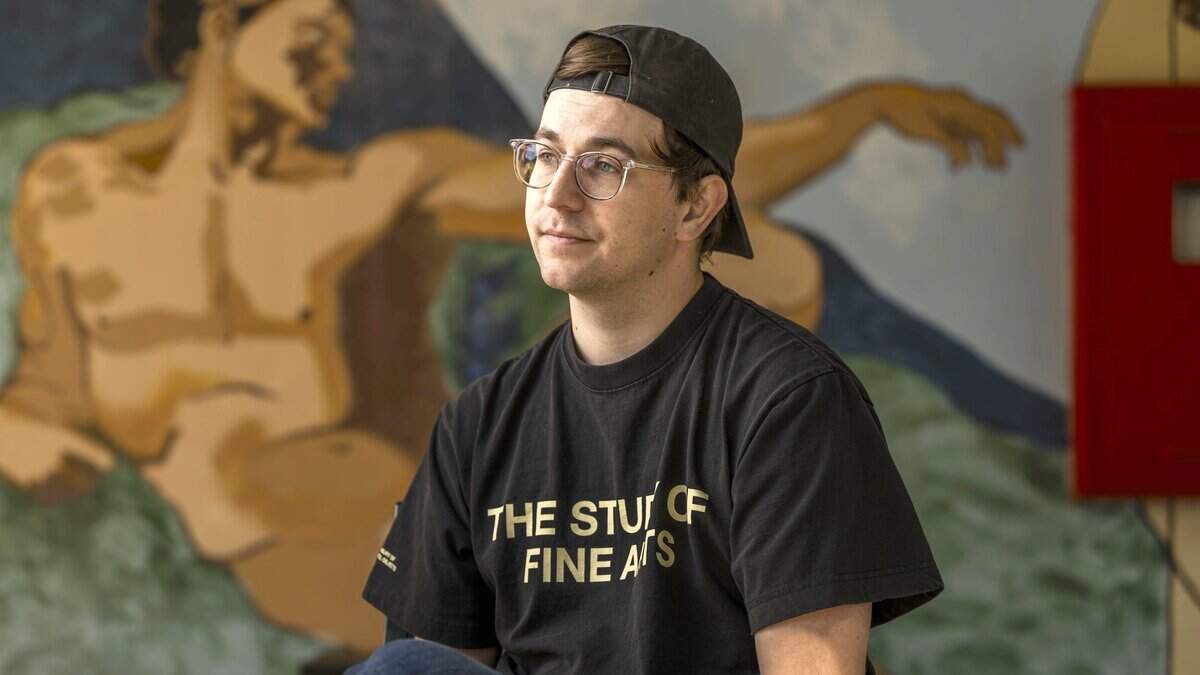
Weeks before graduation, on the day his solo exhibition at Sacramento State opened, studio art major Tyler Mickschl found himself fielding questions from a top administrator about an alleged disciplinary violation.
Read more Week in photos: CA state workers strike + ICE under scrutiny + illegal voting
Mickschl had been accused of chalking on the walls of an aging campus building as a silent protest against the art department’s neglected facilities needs. Chalking, per university rules that dictate when, where and how students can protest, is not allowed on walls and vertical surfaces. If proven guilty, 28-year-old Mickschl could be liable for thousands of dollars in repair costs, the administrator told him. A disciplinary notice said he could be denied access to campus, suspended or even expelled.
Mickschl said he did not do it. He was singled out, he said, because he gave the student newspaper The State Hornet an interview in which he affiliated himself with the cause. After this experience, he will think twice before speaking up for something he believes in, he said. Another student in the art department, Stefani Figueroa, said she was now afraid of voicing her opinion and paranoid about punitive action from the administration.
“They dragged me through the process to send a message,” Mickschl said. “It took a huge toll on my nervous system. I have this new chapter coming up. I had my show that I was setting up for. I’m still within a really rigorous art program, making tons of work and meeting deadlines. And I know that the administration sometimes doesn’t play by the rules, so I wasn’t sure if my diploma was going to be held. I was extremely stressed.”
For now, Mickschl’s disciplinary case remains open as the university investigates the chalk incident. His experience is unfolding against a statewide debate over “time, place and manner” policies which regulate when, where and how students can protest on California campuses and what happens if they break the rules.
The state mandated that these policies be strengthened after large rallies and encampments protesting the ongoing war in Gaza swept through universities in 2024. While supporters say this has made campuses safer for all students, critics argue it has resulted in a “chilling effect” and a culture of fear that limits freedom of speech.
This year, the issue was debated in the state Legislature and has been prioritized by the California Faculty Association, which represents CSU professors, and the University of California Student Association as one that needs urgent redress.
It’s not a conversation limited to California. Amid escalating political interference from the Trump administration, concerns have been raised over academic freedom and students’ right to dissent at higher education institutions across the nation.
‘Chilling effect’ on student protests
For decades, university campuses have been central to protest movements. In the 1960s, it was the Civil Rights Movement. In the 1970s, it was the Vietnam War protests. More recently, students were at the forefront of the Black Lives Matter demonstrations in 2020 and forced the war in Gaza to the center of national discourse in 2024.
But following intense backlash to the 2024 anti-war protests, some students, faculty and external observers say campuses have become uncharacteristically quiet. A by the American Civil Liberties Union and Amnesty International USA in September noted that fears of punishment, retribution and deportation had deterred students and faculty not only from advocating for Palestinian rights but from protesting altogether. The report noted a “steep decline in protests and a less visible protest movement on campuses across the country.”
Last year, a United Nations Human Rights Council representative drew attention to the “chilling effect” on U.S. campuses as a result of “political interference” that has “increasingly restricted access to diverse perspectives and critical inquiry.” Student protests, the UN expert said, have been met with “criminalization, deportations, surveillance and disproportionate disciplinary actions.”
The chilling effect, according to the Foundation for Individual Rights and Expression, is a phenomenon in which individuals refrain from engaging in expression for fear of getting into trouble. It usually occurs when a law or regulation is “too broad or too vague,” per FIRE.
These national reports point to what they call the Trump administration’s “coordinated pressure campaign” against higher education institutions as the major cause for the culture of fear on campus. This includes threats to withdraw federal funding and initiation of new investigations against campuses that do not comply with the federal government’s agenda on topics like antisemitism and diversity, equity and inclusion. The Trump administration has also targeted noncitizen students for detention and deportation based on their political views.
In addition, university responses to student demonstrations and new policies to restrict speech have contributed to the suppression of dissent, per the ACLU-Amnesty International report.
Is TPM to blame?
Following encampments and rallies protesting the ongoing war in Palestine that swept campuses across California, the Legislature required the University of California and California State University systems to develop uniform protest policies in 2024. Their point was to maintain an environment where work could be conducted safely without disruption while recognizing the rights of all individuals.
As Jewish groups reported increased antisemitic incidents on campuses, the state passed a law asking the CSU and UC systems to enforce those protest restrictions and “prohibit violent, harassing, intimidating or discriminatory conduct” that creates a hostile environment on campus. The UC and CSU consolidated and strengthened their policies. They prohibited encampments, restricted masking to conceal identity when violating policies and put in place disciplinary actions to be utilized against those in violation.
Meanwhile, hundreds of students and faculty members who participated in pro-Palestinian protests had already been slapped with legal and academic repercussions amid a crackdown on the movement.
Even before 2024, all UC and CSU campuses already had some version of these time, place and manner restrictions in place. But the policies are now adopted uniformly, publicized clearly and elevated to play a more central role in campus life.
Since 2024, some students say the implementation of protest policies and the disciplinary actions meted out to violators haven’t just restricted freedom of speech on campuses, but also disproportionately targeted students of color and Muslims. Others, including the CSU and UC systems, say the policies have made universities safer for all students and are keen to keep them in place.
In Mickschl’s case at Sacramento State, the chalking policy is not new. Per a , students were allowed to chalk on walkways, concrete and asphalt but at least 30 feet away from building entrances and not on walls and vertical surfaces. The chalking policy carried forward into the new time, place and manner restrictions adopted in 2024.
A close read of the 2016 and 2024 rules, however, reveals a marked shift towards enforcement and punishment. In 2016, the localized Sacramento State rule gave the vice president for student affairs broad discretion in implementing policy with no specific guidance on sanctions and discipline.
In 2024, the university set up a “response team” that includes 10 administrative leaders to handle different facets of implementation and enforcement. It also adopted a systemwide policy that laid down that violations could result in arrest, disciplinary measures for students and employees and legal action. Sanctions for students, it says, may include restitution, loss of financial aid, denial of access to campus, disciplinary probation, suspension and expulsion.
In 2024-2025, the CSU system recorded a total of 201 proven violations of “conduct that creates a hostile environment on campus” and “limits or denies a person’s ability to participate” in campus life, in a by the state. While this encompasses some aspects of the new protest rules, it does not necessarily include all TPM violations. Data for previous years is not available.
Read more Man dies after being found unconscious near state Capitol. Suspect arrested
Mickschl believes the outcome of his disciplinary case is a foregone conclusion. He said he did not chalk the building and there is, therefore, no evidence. He expects the investigation to soon be closed and his name cleared. But his experience of being investigated over an unproven allegation has already created fear in the department.
“We’re all feeling very paranoid, like the upper admin is looking for any excuse to come after us,” Stefani Figueroa, a graduate student in Mickschl’s department, said.
“It’s been a lot of anxiety and living in fear and waiting for the other shoe to drop. When the chalk protest happened, nobody thought anything of it because it was chalk. It wasn’t something that people were scared at first, but the reaction that admin had is making us question how much freedom we have. It doesn’t make us care less or want to protest less, it just makes us feel like we have to be more sneaky.”
According to Melina Abdullah, a Pan-African Studies professor and faculty advisor to the Black Student Union at Cal State LA, student and faculty organizers are constantly wondering what is permitted under the current protest policies and how to raise their voices without leaving their members vulnerable to disciplinary action.
“There’s questions about whether the BSU can even be faithful to its mission,” Abdullah said. “We are seeing a chilling effect, and we’re trying our best to figure out ways around it. Our students are extremely vulnerable. Black students especially can’t afford to have their degrees held. So students are monitoring and self-censoring what they say and do.”
A legislative challenge
In the annual campus free speech rankings conducted by the Foundation for Individual Rights and Expression, only three of the 15 California public institutions surveyed made into the top half of the 262 universities ranked this year. FIRE surveys thousands of students about their perceptions and experiences regarding free speech to rank campuses. It also takes into account campus policies and how schools respond to speech controversies.
Worried by the trends at California campuses, two major higher education interest groups prioritized the issue. The University of California Student Association, which represents 230,000 undergraduate students across the UC system, and the California Faculty Association, which covers 29,000 professors, coaches and counselors in the CSU system, drew attention to the impact of the 2024 rules on campus free speech in the recent legislative session.
The groups actively advocated for a bill that pushing for greater transparency on the implementation of campus protest rules at California’s public universities. Addressing the concern that the rules had disproportionately targeted students of color, the bill would have required the CSU and requested the UC to provide annual data on student code of conduct violations during protests disaggregated by race and gender. The measure also asked that campuses host forums before the end of 2027 to elicit student feedback on current time, place, and manner policies.
After barely clearing the Legislature, the bill was vetoed by Gov. Gavin Newsom last month. It failed to become law even after it was watered down during the legislative process from a complete rollback of current protest rules to a data collection bill. The rollback was fiercely opposed by Jewish groups, who were worried it amounted to sacrificing hard-won protections for Jewish students.
“There was a massive uptick in antisemitic intimidation, harassment, bullying, and even violence on campus in the aftermath of October 7,” Jewish California CEO David Bocarsly said in an interview with The Sacramento Bee in August.
“We know that there were mass protests, and protests are totally appropriate. The protests crossed the line into excluding students from libraries and classes, intimidating people from going to school. It created unsafe learning environments for Jewish students and others, and time, place, and manner restrictions are not new on campus.”
These policies, he said in a September statement, had made universities safer for all students, including Jewish students.
David Loy, legal director of the nonprofit First Amendment Coalition, said time, place and manner restrictions do not necessarily prevent robust freedom of speech if they are content-neutral and leave ample opportunity for protest. Even off campus, Loy said, speech and protest can be subject to time, place and manner restrictions. It is, however, a problem if the rules do not provide sufficient opportunities and locations for protests and impose unreasonable restrictions that effectively silence critical voices.
“Universities ought to be laboratories for free speech,” Loy said. “The whole point of the academic enterprise is to encourage robust and deep freedom of thought and inquiry, and people learn best when challenged with different points of view.”
“Obviously, if people go the extreme lengths of hijacking the campus and making it impossible for other people to learn through excessive moves or occupation, that’s a different matter,” he said. “But generally, if a protest is peaceful and not materially interfering with the ability of the campus to function, then my preference would be to let people protest and not be too restrictive.”
Will campus protest policies be revised again?
According to Michelle Deutchman, the executive director of the UC National Center for Free Speech and Civic Engagement, one problem is a lack of understanding of what time, place and manner regulations are and why they are in place. She said universities need to focus on educating their campus communities on this topic. They also need to ensure the policies are applied consistently, she said.
“In a moment when there are threats to our liberties and to higher education, you can’t have a discussion about these kinds of issues if people don’t know the basics,” Deutchman said. “I also think there’s a trust issue between administrators and students. On both sides of the aisle, people need to step into the breach. And it takes some courageous people to do that.”
Meanwhile, some universities are actively revisiting their protest policies. The University of Hawai’i, for example, began developing new time, place and manner restrictions last year with the goal of providing “clearer guidance that protects expressive rights while balancing the learning needs of our students.”
Less than two months after the new policy was announced in July, the university withdrew it following concerns that the rules could discourage expressive activity. Specifically, community members highlighted the 60-decibel noise threshold, 25-foot building setbacks and chalking restrictions. Now, the school is hosting listening sessions to collect ideas as it forms a new TPM policy.
At California campuses, the UC Student Association and California Faculty Association said they would continue to raise the issue, whether through internal processes or new legislation.
As for Mickschl, after he graduates this December, he wants to teach at a high school. He plans to tell his students not to be afraid to stand up for what they believe in and hold powerful people to account.
“It’s a foundational part of America,” Mickschl said. “It’s a foundational part of the world — being able to share how you feel and having that freedom to stand up for causes without fearing reprimands.”
Read more Why was Zendaya in Folsom on Friday night? Here’s who she came to see