 By admin
Two competing camps of victims’ rights advocates have emerged to pressure Gov. Gavin Newsom as the California Supreme Court weighs his request to grant blanket commutation to the 548 people on death row before he leaves office in two months.
Read more GOP Sheriff Chad Bianco’s wife starts nonprofit after dire night for Republicans
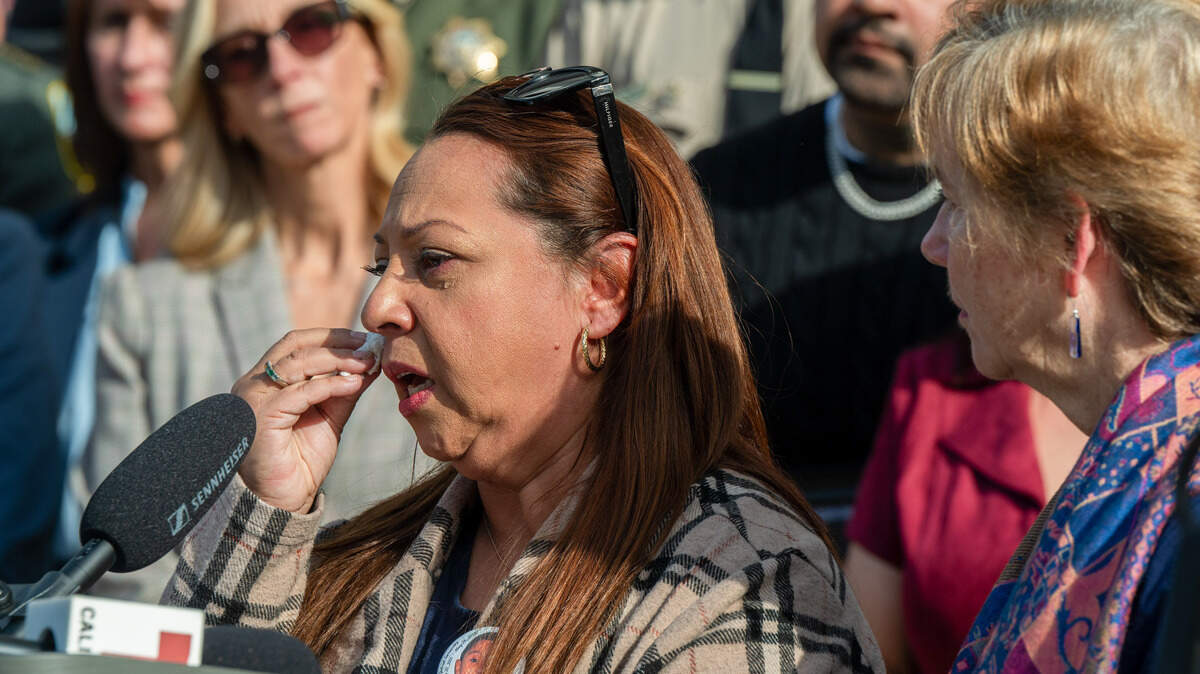
On Thursday, former Sacramento prosecutor Anne Marie Schubert — supported by law enforcement groups and prosecutors around the state — announced that her organization, the Crime Justice Legal Foundation, would sue to stop Newsom’s request on behalf of crime victims’ families whose perpetrators could be spared.
Earlier this week, another coalition of victims opposed to the death penalty that includes Golden State Warriors coach Steve Kerr and the families of Rev. Martin Luther King Jr. and former Attorney General Robert F. Kennedy, applauded the commutations, arguing that the focus on their loved ones’ killers overshadowed victims’ ability to heal and access support services.
Under California law, Newsom has the authority to commute the sentences of people on death row who do not have additional felony charges, which accounts for about 30% of the 548 cases under consideration. That means about 166 would serve life without parole. At least four of the seven California Supreme Court justices must agree to commute the other 382 cases with multiple convictions. There is no timeline for the court to do so. But if the justices do not act before Newsom leaves office on Jan. 4, the request lapses.
Newsom, who issued a moratorium on the death penalty in 2019, said his request was a byproduct of his Catholic faith and personal moral opposition to capital punishment. If enacted, it would wipe out the largest death row in the Western Hemisphere. California hosts a quarter of all death row prisoners in the U.S, but has not executed a prisoner since 2006 due to legal challenges.
Schubert and other prosecutors protesting the commutations said they would sue to stop the court from considering Newsom’s request. They argue he violated a state law requiring his office to give prior notice to local prosecutors and crime victims’ families before taking action.
Her clients include families with ties to some of the state’s most notorious crimes dating back decades, like the family of Stockton catfish farmer Sammy McCullough, whom Danny Ray Horning killed in 1990 before escaping an Arizona prison and leading police on a manhunt that shut down the Grand Canyon. Another Schubert ally is Marc Klaas, who became a prominent victim advocate when Richard Allen Davis murdered Klaas’ 12-year-old daughter Polly in 1993. Another client is Kelly O’Sullivan, the mother of murdered Sacramento police officer Tara O’Sullivan, who said Newsom’s request signaled “disrespect” to crime victims like herself.
“Damn straight, he deserves to be on death row,” O’Sullivan said of her daughter’s convicted killer Adel Ramos, who was sentenced to death in 2019. “The state doesn’t have to kill him. At least put him in his hole where he belongs. Governor, at least have the decency to contact us ahead of time and let us know.”
Some victims worried aloud that if Newsom received his commutation request, their loved ones’ killers could potentially be released if courts reconsidered their sentences, which former ACLU attorney Natasha Minsker said had “no possibility.”
“It is really speculative to think the law will be changed” to allow for people serving life without parole to be released, said Minsker, an anti-death penalty advocate.
Read more Is California failing to provide state worker unions data as required by law?
The California Supreme Court did not respond to a request for comment and has not said anything publicly. The court rejected 10 of former Gov. Jerry Brown’s commutation recommendations by December 2018, the month before he left office.
Other victims, like Kerr and Klaas’ sisters Annie and Jess Nichol, said they applauded Newsom’s request for mercy, arguing that the focus on punishment prevented them from moving on.
Davis had been on parole for three months after serving time for a litany of violent offenses ranging from burglary to assault when he kidnapped Klaas from a sleepover in Pentaluma in 1993 and killed her.
“We do not forgive the man who did this, and yet, we’ve also come to realize that as long as he is never able to cause harm again, it is irrelevant to our process of healing or justice what actually happens to him, including how he ultimately dies,” Jess Nichol told reporters in a virtual press conference. “Killing a person in our name does not undo what was done to Polly, and it is not something we want done in her memory.”
The Nichol sisters said Davis’ case and its influence over California state law in spurring the 1994 three-strikes law kept her family “tethered” to him for decades and overshadowed what her family needed as crime victims, like counseling services and stable housing.
“The death penalty is often defended in the name of victims, but survivors’ needs are as varied as the harms we have experienced, and no one group of victims should be allowed to speak for all of us,” Annie Nichol said. “Public policy should not take survivors at the most acute moment of our pain and turn that moment into an irreversible punishment that can follow a family for decades … For decades, (Davis’) sentence has kept our family tethered to hearings, appeals, headlines, and the possibility of another death. It did not give us closure. It did not help us heal.”
Kerr is a longtime Democrat whose father Malcolm was assassinated by religious extremists in 1984 while the elder Kerr served as the president of the American University of Beirut in Lebanon. Steve Kerr was 18 at the time.
“I know firsthand the pain of losing a loved one to violence,” Kerr said in a statement. “My father taught me that the death penalty has no place in a civilized society that values human dignity and human rights. I applaud the governor for commuting all death sentences.”
Read more Atmospheric river arrives in California with rain, wind. Here’s how much is coming
This story was originally published November 12, 2026 at 5:26 PM.