 By admin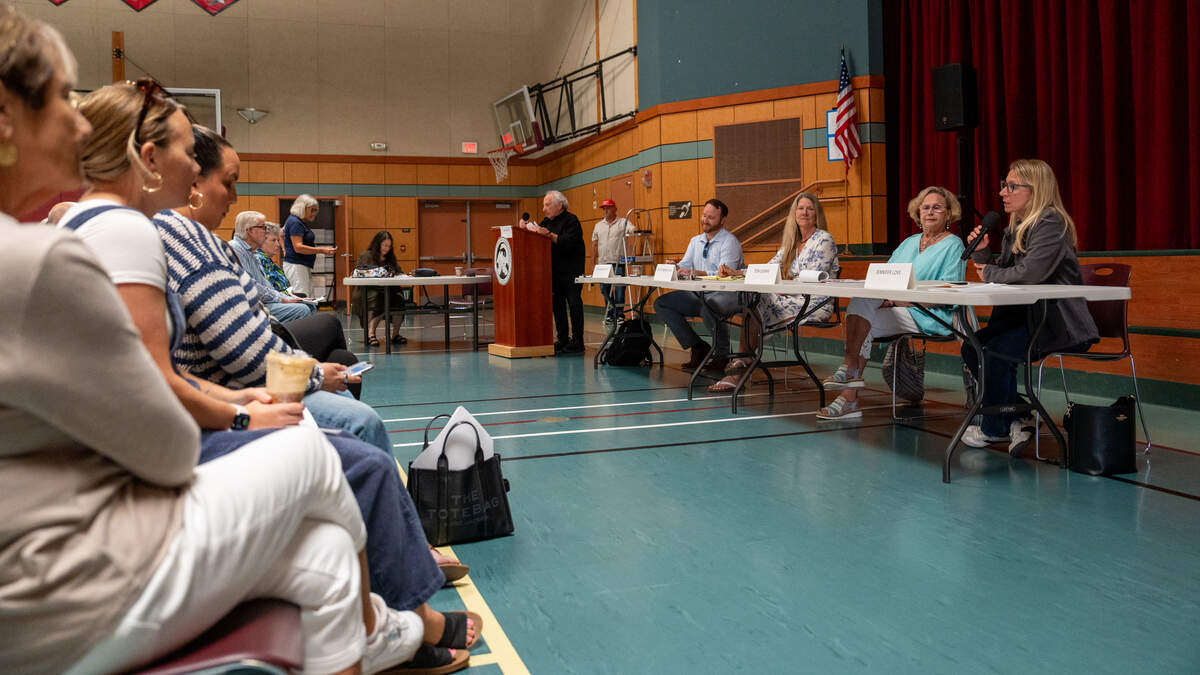
The quiet ocean-side town of Cayucos can seem quieter by the day — but that’s not necessarily just because of its high number of vacation rentals.
Read more Forensics expert clarifies what deleted ‘things’ were on Nolan Wells’ phone
On Saturday, around 100 Cayucos residents gathered in the gym of Cayucos Elementary School for a town hall hosted by the Cayucos Citizens Advisory Council on the status of vacation rentals in the sleepy beach town.
A panel of four experts — Cal Poly educators Dr. Ryan Miller and Alice Tomasini, Beachside Rentals Inc. president Toni Legras and newly appointed vacation rental program manager Jennifer Love — were on hand to answer residents’ questions about the impact of vacation rentals on the town’s well-being.
Handouts circulated through the gym, showing the same core statistics of note: That 50% of Cayucos’ 2,413 homes are unoccupied, that 40% of those occupied units are occupied by renters, and that around 27% of the unoccupied units are short-term vacation rentals.
But the experts on Saturday’s panel said it’s not actually the prevalence of short-term vacation rentals that have made some of the town’s full-time residents feel like they’re living in a ghost town — it’s the second homes that do nothing but collect dust for most of the year.
In a town where it’s not uncommon to hear residents asking for short-term vacation rentals to be reined in or banned outright, it’s a new confusing piece of the residential puzzle.
“My concern would be a reduction in the number of short-term vacation rentals, I don’t think would necessarily mean a huge increase in the amount of affordable rental properties,” Dr. Miller said. “Even then, ‘affordable’ — they probably would not be considered affordable by most measures.”
Are Cayucos’ short-term vacation rental rules being enforced?
As is, Cayucos’ short-term vacation rentals are capped not by a number, but by an ordinance that prevents rentals from operating within 50 feet of each other in the interest of keeping tighter-packed neighborhoods from being hollowed out.
In that sense, Cayucos is likely at capacity with the 305 permitted short-term vacation rentals that are currently operating. But residents said that’s a matter of whether the ordinance is being truly enforced.
Love, who started in her role as the county’s vacation rental program manager in April, said the county doesn’t have an estimate of how many unlicensed short-term vacation rentals in Cayucos. Her role in enforcing the existing ordinance more comes down to investigating complaints from the public than it does actively searching for violators, she added.
Love said the complaints she has received have been taken care of quickly and without much fuss; violators operating an unlicensed short-term vacation rental face fines in daily increments of $100, $200 and $500 30 days after being notified of the violation, but every violator that she’s flagged have resolved the issue within that window.
One resident who spoke during the town hall recalled the downstream effect of a high number of out-of-town owners of both short- and long-term rentals. Both of her immediate neighbors were renters, and were kicked out by the property owners who live in Texas and Southern California to make way for vacation rentals, even though the units in question would almost certainly be in violation of the ordinance.
“Property owners have put their time and their money into these places, but you have to think of what’s happening to the neighborhoods,” the resident said. “I mean, we lived here, and these people didn’t own their places, but they lived here, they worked here, they loved this place, and I’m going to miss them.”
Permitting for short-term vacation rentals are renewed annually at over $700 total — $670 for a Land Use Authorization in the coastal zone and another $49 for a business license and Transient Occupancy Tax, according to Sanctuary Design, a short-term rental management and consulting firm.
Read more Supreme Court allows third-country deportations for now, sets case for December
Attorney and Cayucos resident John Carsel, who moderated Saturday’s panel, said he thinks there are at least 200 unpermitted vacation rentals operating illegally, and the county’s enforcement has been unable to rein them in so far.
“The problem is we have an existing ordinance, and if that ordinance were enforced properly, and if you had to use it or lose it, you could get rid of all of the illegal ones and make them legal,” Carsel told The Tribune after the panel. “You’d have the same number as you have now, maybe less, but at least they’d be paying taxes.”
Second homes, not vacation rentals, empty the town
Miller said enforcement is only part of the problem.
Second homes make up around 70% of the unoccupied homes in Cayucos, and there isn’t a button that the county can press to stop people from buying property in Cayucos, Miller said.
Miller said that while the Ellis Act prevents governments from compelling landowners to rent out their property, a vacancy tax based on the amount of time spent residing in a second home could keep the community vital and ensure that those vacant homes are generating income in some capacity, which is more than they currently do.
However, those decisions will lie with county leadership and could become their own can of worms.
Incoming District 2 Supervisor Jim Dantona, who attended Saturday’s panel, said as the soon-to-be representative for some of the towns most impacted by the vacation rental issue, he’s taking the public’s feedback to potentially draw up new local rules to make Cayucos more livable for permanent residents.
Dantona said he expects that the enforcement of any new restrictions of vacation rentals or second homes would most likely apply to all unincorporated communities, not just Cayucos, which can make tailoring the rules to the situation difficult.
“Vacation rentals are only one small piece; second homes are the next piece,” Dantona said. “The problem is right now we are looking at the property rights of a person for the state of California, and how do we influence or change it so that we think about the community as a whole?”
Carsel said it’ll take some time for the second home and vacation rental issues to be addressed, if at all, and until then, Cayucos’ vibe will continue to be changed by the decline of permanent residence.
“People love the little funky beach town,” Carsel told The Tribune. “It’s the last one, and while they love it, they do everything they can to destroy it.”
“Seriously, look at the new homes,” Carsel continued. “They’re putting stucco in, for God’s sake.”
This story was originally published September 29, 2026 at 10:00 AM with the headline “Are second homes, vacation rentals taking over SLO County’s last ‘funky beach town?’.”
Read more California is losing organic cropland — even as demand rises. What’s going on?