 By admin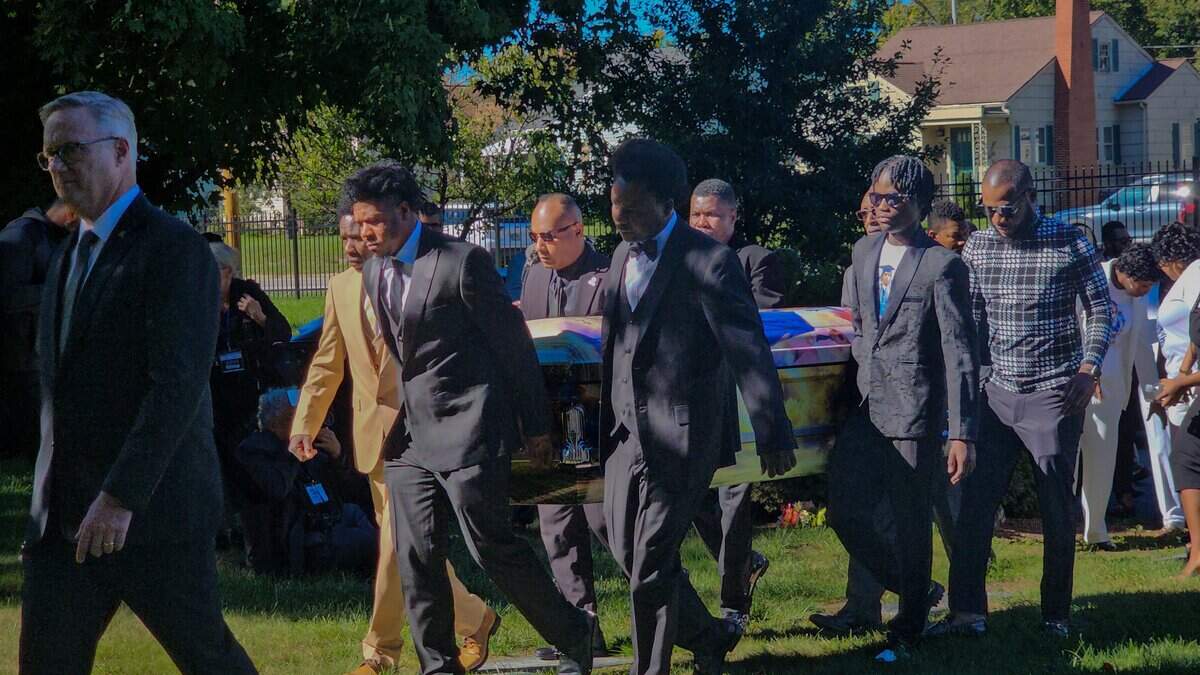
Pierre Ronal Bel stood over his son’s casket, took several steps around the grave and, after a quiet moment of reflection, reached down and grabbed a handful of dirt.
Read more Week in photos: Aftershock kicks off + new beginning for Sac State + A’s season ends
It was a final act of separation Saturday rooted in Haitian tradition for a father who lost his first-born son, as well as for a community shaken by the death of a young man whose life was tragically cut short after Immigration and Customs Enforcement fitted him with an electronic ankle monitor following the loss of his protection from deportation.
Five weeks ago Pierre Damas Bel, a 20-year-old college student and aspiring soccer player, drove onto busy Interstate 70 near Springfield, pulled his car onto the shoulder and walked into traffic — haunted, he had posted on social media, by the treatment and the mocking reaction of fellow students and his inability to play his beloved soccer.
Bel was finally laid to rest Saturday in this small southwestern Ohio city.
The emotional ceremony, held in English and Haitian Creole, was attended by his parents and two younger brothers, local community advocates and elected officials including Springfield Mayor Rob Rue, State Rep. Latyna Humphrey and Gov. Mike DeWine. Rue, who co-owns Littleton & Rue Funeral Home and Crematory, oversaw the burial. Bel’s closed casket was decorated with several photos of him, one of them in his high school cap and gown.
DeWine, who spent several minutes offering condolences to both Bel’s father and stepmother, Landy St. Juste, later took a seat in a row across from the family, though neither he nor Rue spoke at the service. Humphrey closed out the service with an impassioned speech asking attendees to call their Senator to support a bill US. 4814, that would extend Haitian TPS for three years.
“Are you willing to encourage them to say, ‘Listen, our Haitian brothers and sisters belong in this country?” We’ve had elected officials, governors, business owners say they matter, they play a part,” she said. “What’s your commitment? What you’re willing to do? What you’re willing to sacrifice? That’s the question you’ve got to ask yourself. We cannot let his death be in vain.”
The funeral service took place on the day that President Donald Trump was to speak at a midterm election rally in Vandalia, a half-hour away near Dayton. There was no mention of the president’s nearby presence during Bel’s service, but Trump did mention Springfield.
He touted his deportation policy while describing Springfield as having once been “an idyllic place” and said it would soon be that way again when Haitians are sent back home.
“Springfield, and it didn’t work out too well. And they’re being removed. Springfield, Ohio. Do you know that story? It’s a very sad story. Very sad,” Trump said. “They brought in 35,000 people to go into a town of 32,000. It was an idyllic place. Not anymore, but it will soon be. They’re all being brought back to their country.”
For Haitians, immigrant advocates and mourners, Bel’s death has become a symbol of what they describe as the cruelty and inhumanity of the Trump administration’s immigration policies, and the funeral served as a rallying call for members of the city’s Haitian community, many of whom didn’t attend for fear of ICE agents.
Throughout the service Bel, 20, was remembered as a young immigrant with dreams of building a hospital in his native Haiti. A graduate of Springfield High School, he was studying neuroscience at Wright State University after losing his full scholarship to Wittenberg University after his Temporary Protected Status ended in late July, when the Trump administration terminated the protections for more than 300,000 Haitians.
“I feel like I’ve lost everything,” his father said in reflections read during the service. “He knew everything about me, my job, my bank account information. He read my emails and replied.”
Since his son’s death, the elder Bel says he’s been practicing penitence, sleeping on the floor staring at the door of their home.
“Whenever someone opens the front door,” he said, “I have the sense that it is him coming home.”
The Rev. Carl Ruby, pastor of the Central Christian Church, officiated the service St. John Missionary Church along with Viles Dorsainvil, a co-pastor at the church and the co-founder of the Haitian Support Center here. While both lauded Bel’s intelligence, hard work and perseverance and told of his remarkable journey after only two years in the U.S., they also touched on the larger impact of his death inside Springfield and beyond.
Some of those who attended the service came because they knew Pierre Damas personally, Ruby said, either because he was family, a teammate or a coworker at Texas Roadhouse restaurant. Others were there because even though they had not known the young man personally, they “are dedicated to standing in solidarity with his family and all of the other Haitian individuals and families who have come to Springfield seeking a place of safety and of refuge,” the pastor said.
Read more Aftershock’s bars: what the Sacramento music fest offers to thirsty fans on a budget
“This group wants you and other Haitians who have come to Springfield to know that you are a blessing, not a burden, to our community. You have made our city better. You have not made it worse. You have brought life, energy, love and a renewed sense of hope to Springfield, and we not only welcome you, we also want to thank you for making Springfield your home,” he added. “This group wants you to know that you are not guests in Springfield. You are our neighbors, and we love you.”
A former manufacturing hub, Springfield had been on the decline until Haitian immigrants began moving here because of its affordable rents and jobs. The city found itself in the middle of the national debate over immigration in 2024 when Donald Trump and JD Vance, campaigning for the White House, falsely claimed that Haitians here were eating their neighbors’ pets.
When TPS ended over the summer, the city once more made headlines as Haitians started getting outfitted with electronic ankle bracelets. Pierre Damas Bel, who had arrived in the U.S. with his younger brother, Bradley, was among them.
Guerline Jozef, executive director of the Haitian Bridge Alliance, said other students bullied Bel and he was unable to play soccer. After Bel told immigration agents that he had to put a sock between his skin and the device to soothe his leg because of the burning sensation, he was told it wasn’t tight enough, Jozef told mourners. They tightened it up, she said. “That is what killed Pierre Damas Bel and that is why we do not have an open casket.”
Bel “might have died by suicide, but he was killed by the system,” she said. “This is not a political issue. This is an issue of dignity, of morality of humanity and peace and love and caring.”
Pastor Ruby said Bel “deserves to be remembered for more than the tragedy that ended his earthly journey,” but added it couldn’t be ignored. He recalled the 1955 murder of Black 14-year-old Emmett Till, who was brutally beaten, shot and killed in Mississippi in August 1955. His body was later found in the Tallahatchie River, and his death helped galvanized the civil rights movement.
“The truth is that, like Emmett Till, Pierre Damas died under the wave of a racialized system that did not provide him with equal liberty and equal justice. He died under a way of governing that did not recognize his inalienable rights to life, liberty, and happiness. And this is a story that we must continue telling,” Ruby said.
Viles spoke directly to the Haitian community, saying he knows that Bel’s death has them thinking of their own children and own challenges.
“We will not fear. Today, we may fear the future. We may feel anger and confusion and loneliness and even the winds of despair,” he said. “But Scripture tells us that when our strength is exhausted, God Himself becomes our refuge.”
Whatever difficulties Bel encountered, “his life showed us his persistence and perseverance,” Viles said. “He continued to learn, he continued to work , he continued to serve the people he loved. His life showed us that someone doesn’t need to live decades to live a huge mark.”
Yola Lamarre, a friend of Bel’s, recalled not just his journey to the U.S. from Haiti but his family’s journey from Columbus to Springfield. The family was among the victims of a scam targeting Haitians before resettling in Springfield.
“But the injustice didn’t stop there. His dreams didn’t stop there either. How he dared to optimize the opportunity of education to graduate with his diploma from Springfield High School, a cadet in JROTC, and a future neurosurgeon to give back to underprivileged societies,” she said.
“That is American. But who gets to be American? Hate disguises itself as a wicked judge that justifies dehumanization and decides who gets to be American,” she said. “With a decorated legacy and courage to overcome multiple obstacles — it still wasn’t enough”.
Bel’s legacy is true patriotism and represented grit, passion, humility, honor and kindness, she added, and it left “a mark in our lives forever” that showed “how the criminalization of Haitians can be an unnecessary death sentence”
This story was originally published October 3, 2026 at 6:48 PM with the headline “At Haitian student’s funeral, a community confronts painful immigration reality.”
Read more Prop. 37 puts California’s homeownership crisis on the ballot. Here’s our endorsement | Opinion