 By admin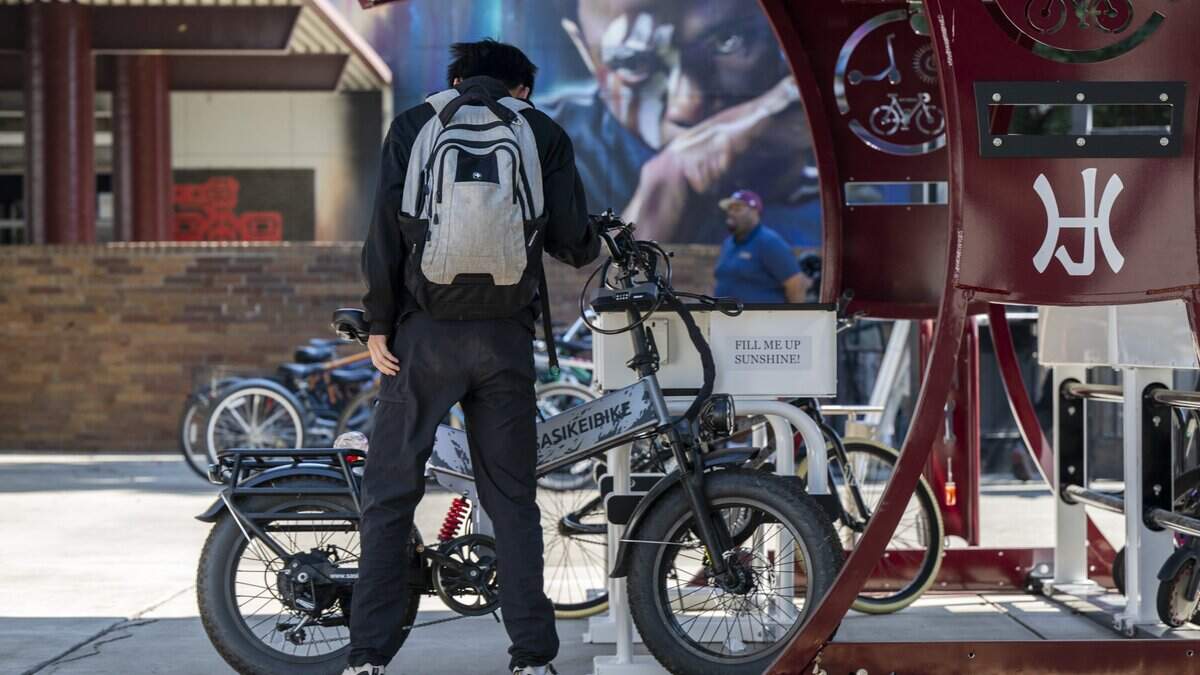
The two bike racks installed this summer at Hiram Johnson High School are different from the others.
Read more Brandon Gonzales says boxing ‘greatest analogy for life,’ mentors Sacramento youth
They have 28 spots for bikes and scooters to lock up, a roof covered with solar panels, bike maintenance tools and 28 outlets to charge e-bikes, e-scooters and other electric devices that students park at the school.
The combined bike rack and charging stations — made by EnerFusion Inc. — are the first of their kind in the capital region. They’re also a big upgrade from last school year, when about 30 students would park their electric devices along the walls of the auditorium, crowded near available outlets.
The high school is one of many in the area that have seen an increase in students riding e-bikes and e-scooters to class. The devices’ rapid rise in popularity has led to concerns about student safety, particularly because some e-bikes can legally reach 28 mph. The devices also offer students another potentially reliable and sustainable transportation option.
The school acquired the bike racks and chargers, which were open over the summer and on the first day of school, in response to student needs, said Susan Rubert, Hiram Johnson’s community school specialist.
“It’s acknowledging this is a part of our current reality, and trying to do so in a way that is supporting safety,” Rubert said about the chargers. “Transportation modes are changing.”
On the first day of school last week, the racks were full of e-bikes and e-scooters, along with some nonmotorized bikes and scooters. A few appeared to be e-motos, which resemble dirt bikes and are not legal on city streets.
Under California law, electric bicycles fall into three classes. Class 1 bikes provide pedal assistance up to 20 mph. Class 2 bikes include a throttle but also stop assisting at 20 mph. Class 3 bikes provide pedal assistance up to 28 mph and require riders to be at least 16 years old.
E-scooters, which have varying top speeds, are legal for people age 16 and older.
Roberto Guillen, 16, parked his e-bike at one of the racks Tuesday morning. His friend had sent him a photo of the bike racks earlier that morning, but he didn’t bring a charger because he consistently charges the battery overnight. He does, however, know other students who could benefit from charging at school.
“Not a lot of people charge them before (school),” Guillen said. “But now they can really charge it anywhere — here, at their house.”
Read more California Democrats rally opposition to voter ID measure, call it Trump-led effort
The school partnered with SMUD and Calstart on the project. Calstart awarded Hiram Johnson a $37,500 grant for a green energy and mobility project, which the school determined should go toward the e-bike racks and chargers after a transportation survey. The school then applied for and received matching funds from SMUD’s Shine program.
With the matching funds, the school was able to purchase the second solar-powered bike rack. Both racks were installed in late June.
Michael Kodransky, Calstart’s senior director of innovative mobility, said the bike racks are an example of how transportation expectations and routines can change when infrastructure is available.
“This is something that met the need of the most students,” Rubert said. “Anytime students feel seen and feel heard, I think that empowers them, and it helps them to engage in school more.”
The education piece
The chargers are just part of what school officials will be doing this year to help students safely use their e-bikes and e-scooters.
Access to the bike racks requires a helmet and a lock, Rubert said. The school currently has donated helmets and locks available for students who need them.
“The parents are relieved that we have the expectation of helmets in order to be able to use the charging stations,” she said. “The students aren’t super excited about this requirement.”
The school will host a series of information sessions, likely starting in early September, for students and parents to learn about e-bike rules in the city, the state and within the Sacramento City Unified School District. Before the full agenda is set for the meetings, Rubert plans to meet with parents to discuss potential topics.
The sessions will explain the differences among electric devices, including how e-scooter rules differ from e-bike regulations. They will also cover the importance of wearing a helmet, which is required under state law and district rules. The student sessions will be separate from the parent sessions. Some parent sessions may be held early in the morning, around school drop-off.
Read more At Padilla roundtable, California nonprofits warn of federal funding uncertainty
“We’re trying to make it as convenient as possible,” Rubert said.
This story was originally published August 19, 2026 at 7:00 AM.