 By admin
For too long, the streets of Sacramento have borne the disproportionate burden of accommodating the region’s homeless population, while the county government has done too little to provide people with the mental health and addiction treatment they need — through court orders if necessary.
Read more SEIU Local 1000’s one-day state worker strike is Wednesday. What to know
Compelling that treatment for people suffering from addiction flies in the face of California’s progressive politics, but maybe some local leaders are finally convinced that it’s not progressive to let addicted people die on the streets.
The current Sacramento City Council, for the first time in the memory of Mayor Kevin McCarty, spent valuable time questioning this status quo last week.
McCarty presided over an unprecedented city meeting where elected leaders focused on the most pernicious form of homelessness. McCarty invited Anne and Christopher Carlisle to speak first. They have been unable to rescue Christopher’s 32-year-old daughter, Califia, from a decade-long life of mental illness and addiction that has left her living on the streets of a city long oblivious to their desperation. The family’s plight was recently chronicled in a five-part Bee series.
In her allotted two minutes, Anne Carlisle was blunt. “Cali is dying on the streets because there is no way…to help her.” Anne fears “the tragic end that she will meet.”
Sacramento city staff explained why too many people are experiencing tragedies like Cali’s. There are an estimated 4,000 unsheltered homeless people in Sacramento County on any given night. Roughly a third of them report having behavioral health issues. Like Califia, too many people are cycling through systems that process homelessness rather than end it.
CARE Court — the city strikes out
There are two ways the judicial system can encourage or mandate mental health and addiction treatment for Californians who need it. The new and voluntary approach is the Community Assistance, Recovery, and Empowerment (CARE) Court. Implemented in 2024, CARE Court is considered one of the signature achievements of Gov. Gavin Newsom’s eight-year tenure.
Yet CARE Court can be a toothless enterprise that offers help in name only.
Brian Pedro, director of the Sacramento Department of Community Response, told council members that the city has filed 50 petitions since CARE Court was enacted in Sacramento County.
“None have been accepted to date,” Pedro said.
Christopher Carlisle suffered a similar fate in 2024 when he petitioned the court in pursuit of treatment for his daughter. Califia refused to be evaluated by a county social worker, and that was all it took to derail her case.
When he was in the California Assembly, McCarty was co-author of CARE Court legislation that initially gave judges the power to enforce an order for care. But Democrats neutered CARE Court into a purely voluntary endeavor. This happened under then-Assembly Speaker Anthony Rendon of Paramount and Senate President Pro Tempore Toni Atkins of San Diego. Then this year, state Sen. Catherine Blakespear, D-Encinitas, pushed a CARE Court reform bill (SB 1016) that would have allowed law enforcement under certain circumstances to detain anyone resisting an evaluation long enough to conduct one. The Assembly Health Committee, led by Mia Bonta, D-Fremont, on July 2 unanimously approved amendments that deleted the enforcement mechanisms from Blakespear’s bill.
“Extremist views gutted the promise of CARE Court,” said Councilmember Eric Guerra. The Democratic leadership is swayed by factions that place civil liberties and the “rights” of the disabled above all else. But what does that mean for Califia? She is unaware of her own schizophrenia and self-medicates with whatever drugs she can find. Leaving her untreated is not compassion — for her or for her toddler, Laura, whom Anne and Christopher have adopted.
The council on Tuesday vowed to pursue state legislation to give CARE Court the powers that Newsom originally intended. That’s an encouraging start.
Read more Democratic legislators push back on California voter fraud claims after charges
The county’s revolving door of mental illness
The established way to compel treatment in California is through a complex court process known as conservatorship. In Sacramento County, that process can begin when law enforcement detains someone displaying severe behavioral health problems for up to 72 hours.
City staff did the homework and came up with the numbers. Officers brought to hospitals individuals displaying major behavioral issues more than 10,000 times. Of those, a court mandated treatment on only 55 occasions.
This helps explain why Califia Carlisle has cycled through the system for a decade and why two attempts to place her under conservatorship have failed.
Even more disturbing is how the office of the Public Guardian, Sacramento County’s official arbiter of who should be pursued for conservatorship, fails in its efforts most of the time. For every court-ordered conservatorship, two cases in 2025 were rejected. Why does the Public Guardian have a losing record?
“What we haven’t had is the coordination needed to provide the Public Guardian enough information to have a strong case,” Pedro said.
Mandating care in California is the equivalent of a quadruple bank shot in billiards — law enforcement detaining someone needing care, behavioral health workers quickly making an assessment, the Public Guardian building the case and a judge issuing the order. That takes extraordinary coordination among governments.
“The system, especially in Sacramento County, is very siloed,” said Brian Morr, a captain in the Sacramento Fire Department, which is the city’s first responder to most homeless calls. “We don’t talk.”
Over the county’s objections, Newsom signed legislation in September directing the county to work toward creating a joint powers authority with Sacramento and other cities to work through problems just like this. Resisting formal collaboration is no longer an option.
The emerging face of Sacramento homelessness
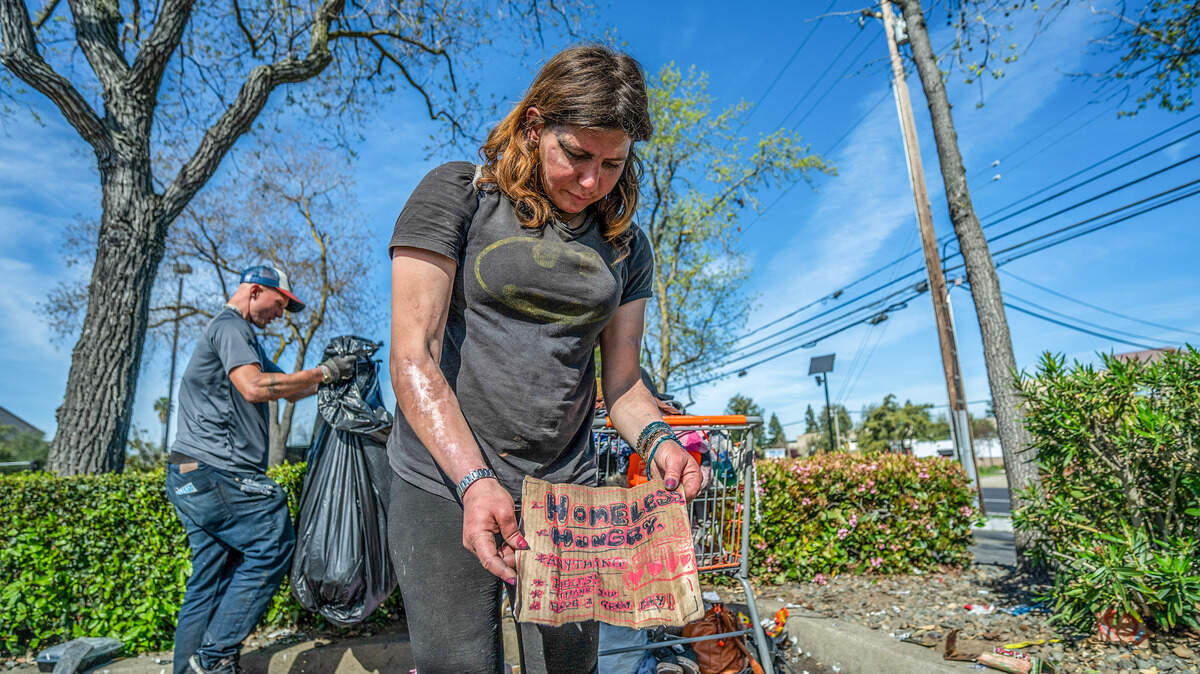
Mayor McCarty did something new and important last week by referring to Califia Carlisle repeatedly by name. By doing so, he gave mental illness and drug addiction the human face of a 32-year-old woman with sandy hair and brilliant green eyes who begs for money while holding handmade signs near the Home Depot on Folsom Boulevard.
Tom Philp is a Pulitzer Prize-winning journalist who wrote a five-part series about Califia Carlisle’s tragic life of homelessness and addiction on Sacramento’s streets
Read more As Sacramento leaders weighed her tragic story of homelessness, she was arrested again