 By admin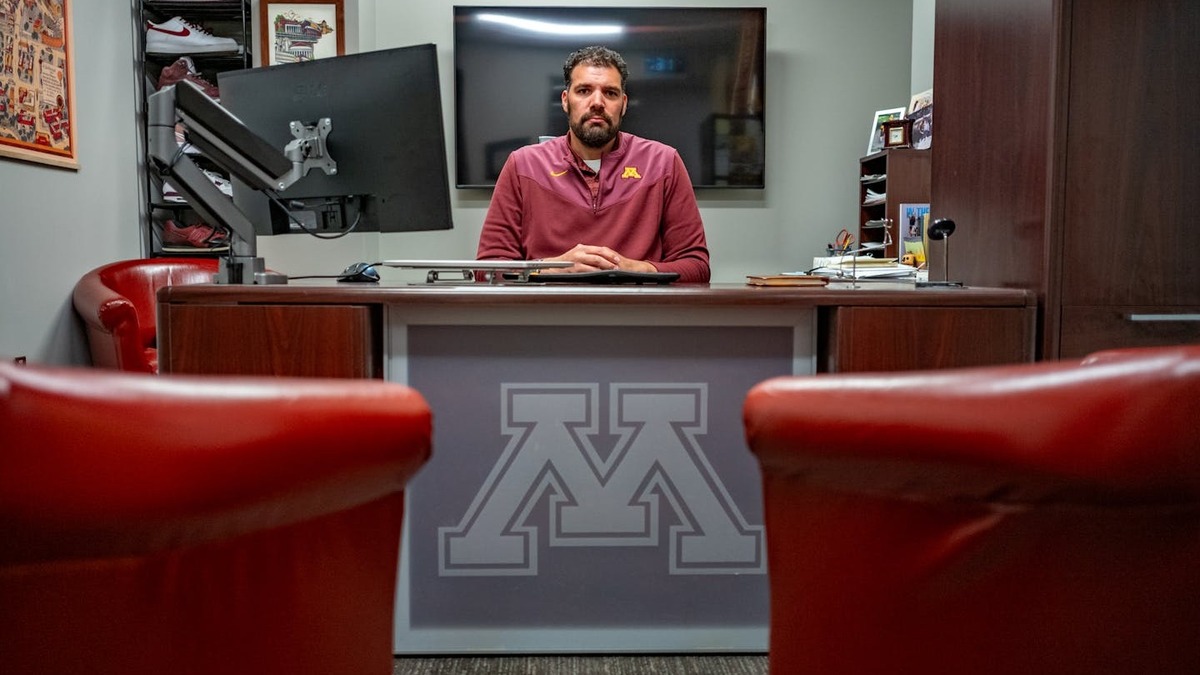
MINNEAPOLIS – Mark Coyle knew he needed guidance. College sports were barreling toward a radically new existence, one in which universities would be allowed to pay athletes directly. Athletic departments would be required to manage a salary cap in distributing millions of dollars to athletes.
Read more Ed Graney: Fernando Mendoza is where he should be in the moment
The Minnesota Gophers athletic director didn’t go far to find answers to his questions. He and his leadership team jumped in the car and drove to the offices of the Timberwolves, Wild, Vikings and United.
Coyle’s group met with executives from those professional teams to learn the art of managing a salary cap. The House v. NCAA settlement in June 2025 gave schools a $20.5 million limit in the first year, with annual increases.
Bill Guerin of the Wild, Tim Connelly of the Wolves and other leaders explained their process for managing a cap and assigning market value to players. For the Gophers, sharing space in a professional sports market had strategic benefits.
Several administrators on Coyle’s staff – executive associate ADs Jeremiah Carter and Travis Cameron – started building a data modeling system to help coaches make decisions when constructing rosters. The Gophers dug deep into the world of analytics in this new era of name, image and likeness (NIL) payments and revenue sharing.
“We’re trying to do everything we can to make that as easy as possible,” Carter said, “to support the coaches so they don’t have to be a market expert.”
Think of it as their version of “Moneyball.” The Gophers’ athletic budget ranks 15th out of 18 Big Ten schools. “We punch above our weight more than any [athletic] program in the Big Ten,” Coyle said.
Even so, Coyle recognized the need for his department to find value when signing athletes to contracts. The Gophers cannot outspend Ohio State, Michigan and their wealthiest conference rivals, so finding an edge in analytics became a priority.
“We’re not telling [coaches] who to recruit, how to recruit,” Coyle said. “We’re just trying to give them some data-driven information based on analytics from the past several years.”
Carter runs point on data. The former Gophers offensive lineman moved from his director of compliance job into a new role managing NIL (which allows players to be paid) and risk management once NCAA amateurism rules began to change.
Carter became an expert on the myriad ways college sports have changed. As much as outsiders contend that college sports have morphed into professional sports, he is quick to note fundamental differences.
College sports aren’t guided by a collective bargaining agreement because athletes are not employees. Pro teams get to draft players. Colleges recruit.
Pro leagues other than Major League Baseball operate with a salary cap. The House settlement put a cap on revenue sharing by colleges, but NIL deals that are managed by third-party entities are limitless.
Contract details for professional athletes in various sports are easily accessible in online databases. Colleges don’t make how much athletes make public, so understanding their market value is a guessing game.
Pro contracts typically have multi-year terms, allowing teams to plan over a handful of years. Most Gophers’ NIL/rev share deals cover one year, reflecting an industry standard. That essentially means athletes become unrestricted free agents every year.
Said Gophers men’s basketball coach Niko Medved: “If you were to go to a pro sports team and say, ‘Hey, what if we just made everybody an unrestricted free agent in every offseason and none of the teams have any salary cap?’ They wouldn’t survive as a league. Unfortunately, that’s kind of the road that we’re going down right now.”
A whiteboard in Carter’s office looks like something one might see at a financial firm. It’s covered with contract structure proposals, future NIL campaigns and potential valuation metrics.
Carter once asked a coach about the process in determining how much money is required to build a roster. The coach’s response: I take the pulse.
“We want to get as far away from that as possible,” said Carter, who also sought to eliminate the temptation a coach might feel to split payouts evenly among players to prevent locker room jealousy.
He admits, though, that three years ago his answer wasn’t any better than checking the pulse when he sat in meetings with Coyle and coaches and tried to calculate how much NIL revenue would be needed. A lack of transparency tied to NIL implementation across college sports muddied everything.
Said Carter: “The genesis of this [analytics model] was, I want to be able to give Mark a data-informed answer on where we think the market is going to be so we can figure out how to split it up.”
The Gophers divide revenue sharing among five programs: football, men’s and women’s basketball, volleyball and men’s hockey. Like most schools, the Gophers don’t disclose what percentage of the pie ($21.3 million this year) each of those teams receive.
Carter said “culturally, college athletics have become a lot more cards close to the chest,” which makes it impossible to know exactly how rival schools are investing their assets or for the public to know how that money is being allocated.
Read more John Romano: Freddy Peralta not as sexy as Tarik Skubal, but makes more sense for Rays
The athletic department learned some “hard lessons early on in NIL,” Carter noted. Problems get amplified if a school waits too long before recognizing that it miscalculated how much revenue is necessary to fund rosters.
Carter and Cameron, the department’s chief revenue officer, built a data system to project how much revenue their programs will need. Carter doesn’t want to give away trade secrets, but he explained the system generally to the Minnesota Star Tribune.
The Gophers used men’s basketball last season as a proof-of-concept test. The system collects player ratings from external online services using a scale of 0-100. The database included every Division I player (5,634 total) and the top 600 recruits. The system analyzes more than 1,000 data points to project an expected range for each player.
The ratings system guides the Gophers in assigning value to players. The model also projects the overall team benchmark needed to reach their goal of making it to the NCAA Tournament.
The algorithm correctly projected the teams that ultimately advanced to the Final Four and identified national champion Michigan as the best team based on the ratings. The data also showed a high degree of accuracy in projecting ratings for Gophers players.
The financial value assigned to players reflects many data points, including position. Centers command top dollar because “there are not that many seven footers in the entire world, let alone that play basketball and are good and college age,” Carter said.
Values at other positions are less static. The cost for a point guard in a certain rating range, for instance, might fluctuate from one year to the next.
The Gophers’ primary focus in distributing revenue-sharing money is retention of current players.
“In every single sport,” Carter said, “it is more expensive to get equivalent level of talent out of the portal than it is to retain.”
Assigning value is tricky, even for players already on campus. Current players typically sign contracts before the transfer portal opens, meaning the market hasn’t established their value. Those challenges become magnified when teams sign players out of the portal, which coaches compare to speed dating. Decisions sometimes must be made in a matter of hours, or quicker.
“If you’re just paying at the top of market, you’re going to end up making mistakes,” Carter said. “We’re trying to find the people who are value ascending.”
What they don’t do is pick players based off spreadsheets. The analytics model is a guide, not an edict. The goal is to help remove emotion from negotiations to stay principled in their spending.
“Ultimately, coaches are the GM of their team,” Carter said. “Our judgment is not going to replace the coaches’ judgment.”
Medved uses the analytics system as a tool. It’s valuable, he said, but doesn’t supersede his own homework.
“There is still the value of knowing what your eyes see and understanding people – ‘Is this the right kind of person?'” he said. “There is a gut feeling. There is a relationship piece. But then you have to also understand the data-informed decisions.”
Coyle described coaches as “very supportive” in implementing analytics into roster construction. Coyle personally approves every revenue sharing contract.
Variables change as roster-spending skyrockets, especially in football and men’s basketball. The market might increase 10% or 60% from one year to the next. There are reports of college football programs spending $40 to $50 million on rosters this season.
Previously, if a coach made an evaluation error in recruiting, the penalty was a sunken scholarship and roster spot. Now, the school could have hundreds of thousands of dollars (or seven figures) committed to an athlete who didn’t pan out the way coaches expected.
“Coaches have 1,000 hard decisions to make when it comes to the roster,” Carter said. “Adding how much do you pay, and whether or not we can keep them with what we have, it’s another added complication.”
Their intention is to tweak the data system so that all Gophers coaches can use it to guide decisions for their respective rosters. College sports are changing almost daily as amateurism fades like a sunset. The Gophers hope to succeed against schools with more financial resources by pairing human logic with advanced data analysis.
“It doesn’t mean we have to be right 100% of the time because it’s not going to happen,” Carter said. “But in times when you’re not right, we have to be able to go back and say, ‘Our process led us to make the right decision, and we didn’t get to the right outcome.’ We have to be able to say that we made an informed decision.”
Read more Being a Phillies fan and having an insane jersey collection helped Will Yip win a Grammy award
____
Copyright 2026 Tribune Content Agency. All Rights Reserved.
This story was originally published August 3, 2026 at 2:36 AM.