 By admin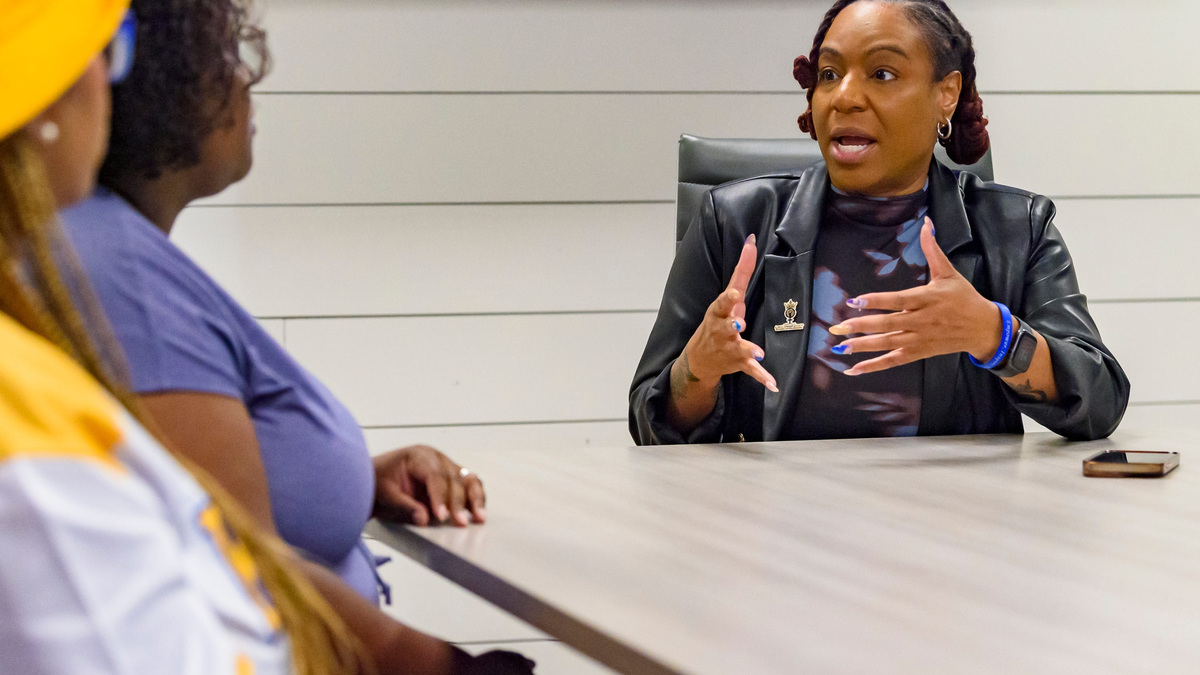
BATON ROUGE, LA – With a throaty chuckle, Laketa M. Smith informed her friends and colleagues that they would play roles in something she called “Reignite Louisiana.”
Read more Swiss voters set to reject tighter neutrality rules that would curb NATO cooperation
Phones down, the activist commanded. No photos. No social media. Just a respectful conversation in an office conference room between Black college students, nonprofit founders, civic leaders and community elders about the future of their state.
They began jotting down ideas on a whiteboard: create an economic plan that would inspire people to turn out at the polls, explain why voting matters and transcribe election information for deaf and blind people.
Smith asked them to assemble in the wake of the April 29 Louisiana v. Callais Supreme Court decision, which threw out their state’s voting map and effectively gutted section 2 of the Voting Rights Act. The following month, Louisiana’s Republican-controlled Legislature eliminated one of its two majority Black congressional districts, leaving Baton Rouge and Shreveport – both major cities with majority Black populations – with little chance of electing Black House members.
Alabama, Florida and Tennessee also quickly drew new maps that dilute Black voting power, raising fears among Smith and the other activists that 60 years of civil rights gains are being destroyed. After the Voting Rights Act became law in 1965, Black representation in the U.S. House rose rapidly.
As the country heads into its first elections following the court’s Louisiana v. Callais decision, USA TODAY traveled to the state to talk with more than a dozen people about how organizers are adapting Civil Rights Movement tactics for a new fight. They are among thousands of organizers across the South who are working to build a wave of Black voters they hope will drive home their outrage over the court’s decision and the state’s quick move to redraw districts that reduce Black voting power.
“Our state needs us. Our legacy – our family – needs us,” said Smith, whose relatives served on the frontlines of the Civil Rights Movement. That movement, Smith added, “has never been over. This is just round two. The blood of my ancestors says, ‘I have to do this work.'”
Supporters of the court’s decision say it backs a “colorblind” approach to the Constitution that views consideration of race as discriminatory.
Louisiana Gov. Jeff Landry’s office, the Republican National Committee and state GOP leaders did not respond to requests for comment.
“Low voter turnout is one of our biggest problems in America today and especially in Louisiana. We applaud all efforts to inform and turn out voters Nov. 3, whether they be Republicans, Democrats, or no party voters. Voting is our right and obligation as Americans,” former state Rep. Woody Jenkins, chairman of the Republican Party of East Baton Rouge Parish, told USA TODAY.
‘I have to do this work’
Smith comes from a family with a long history of activism. Her great uncle Jerome “Big Duck” Smith and great aunt Doratha “Dodie” Smith served as Freedom Riders. In 1961, they were chased and beaten when they attempted to integrate a waiting room at a Greyhound bus station in McComb, Mississippi, according to news media reports at the time. A white mob attacked them, yelling “Kill ‘em!”
Her late mother, Fannie L. Johnson, served as an original plaintiff in an ongoing class-action suit filed against New Orleans for building a neighborhood on a landfill.
Drawing on her work in emergency management, Smith created A Bella LaFemme Society, a nonprofit focused on mental health, advocacy and disaster relief.
“The work has to continue,” she said. “We’re all intertwined… We cannot sit this one out.”
Smith pointed out that Baton Rouge – the state’s second-most populous Black city – still features reminders of its 1861 secession from the United States and the racial divisions that have endured since. The state Capitol, Smith’s favorite place in the city, houses statues of two Confederate generals, both of whom served as governor. Ten minutes southeast of Smith’s office, a largely white and more affluent section of Baton Rouge left after a lengthy legal battle to create the city of St. George.
On a tour of the city, Smith headed through a maze of strip malls and neighborhoods to the poorer and most heavily Black area on the northern side of the city where her mother grew up. At one intersection, she pulled over to greet Second District Councilman Anthony Kenney Jr., who she helped elect when he was just 27. Fluffy white clouds filled the blue sky. Refineries lined the right side of the road, a high school on the left.
Smith paused in the parking lot of the Triple S Food Mart, where in 2016 two Baton Rouge police officers shot and killed Alton Sterling, a 37-year-old Black man. Smith said she rushed to the scene, pleading with the crowd to remain calm and avoid arrest. Neither officer faced charges. Protests continued for months. A mural marks the place where Sterling died. Unexpectedly, she said, that tragedy “sparked community.”
Southern coalition
The Supreme Court decision has created a similar sense of community among Smith and a broad coalition of organizers across the South. They are determined to turn anger over the court’s ruling into votes in the 2026 midterms.
They got a taste of how strong that voter anger was in the spring. Thousands attended legislative committee hearings about changing the congressional maps. Thousands more protested outside state capitols. Voter turnout surged in multiple states that redrew their district boundaries.
After Tennessee lawmakers redrew maps to eliminate the state’s only majority Black district, they witnessed Democratic turnout in the primary surge in Shelby County. That county is home to Memphis, which was split among three House districts.
Georgia lawmakers considered redrawing their state’s congressional maps but opted not to after voters turned out in numbers not seen in more than 20 years.
Republicans largely aren’t talking about redistricting ahead of the midterms. But after the court’s decision, Louisiana’s prominent Republican congressmen argued that Democrats wielded the Voting Rights Act to hold onto Democratic seats in largely Republican states while drawing districts in blue states that Republicans cannot win.
Asked for comment, the office of House Speaker Mike Johnson of Louisiana referred USA TODAY to what he said after the court’s decision.
“Yes, the Constitution protects every American equally, and that’s a very important concept for us to maintain,” he sad. “Democrats spent decades trying to engineer electoral maps that divided Americans and this decision from the Supreme Court hopefully ends that terrible practice once and for all.”
Proportional representation
Louisiana is 32% Black and for decades has had one Black majority district. Local organizers worked for years to get proportional representation or a chance of electing two members of the state’s six-person congressional delegation.
States redraw congressional district boundaries after each 10-year U.S. Census to account for how population has changed over time. Louisiana lawmakers approved a map with one Black majority congressional district in 2022.
Read more The true history of Phoenix’s iconic ‘Wedding Cake Castle’
The map was challenged in court, and in 2024, the Legislature drew a map with a second majority-Black district ahead of a deadline to avoid a federal trial. Shortly after, a group of self-described “non-African American voters” challenged the map as a racial gerrymander. That case became Louisiana v. Callais.
Meanwhile, the Callais plaintiffs continue their legal challenge over the existence of the state’s remaining Black majority district.
Ashley Shelton is the founder and president of the nonprofit Power Coalition for Equity and Justice, an original plaintiff in the case that led to Louisiana’s second Black-majority district. She said she wishes now that she had celebrated that brief win more.
“I always thought I would be on the right side of history in every way,” she told USA TODAY, adding she is focusing on making Louisiana a better place for her children. “Our message to the young people is that you currently now have less rights than your grandparents.”
Shelton and Smith were at a conference of Southern organizing groups in Louisiana when the Callais decision was announced. They said it felt like the air was sucked from the room. Smith said they took a 10-minute break for Shelton and others to process what had happened, and then pressed on.
Power Coalition has become the pivot point for get-out-the-vote efforts in Louisiana and across the South, with Shelton as its face. Over the summer, it led voter education with 11 townhall meetings with Black state lawmakers. To boost voter turnout, it has coordinated activist groups and nonprofits normally focused on a variety of other topics, including housing and reproductive rights.
“I am so full of rage, and I was like, ‘Ok, so you want to play games?’ We’re going to – I’m committed to – getting as many Black voters out to vote as possible,” she said. “The only response to people taking something from you is to show up in the ways in which they can’t.”
Seeing the thousands of Louisianans who waited hours to speak against the new legislative maps was healing, Shelton said. Voters of color have an opportunity to flex their power in this moment, Shelton added, “which is to say you can screw around with my voice at many levels of government, except when it comes to statewide.”
While congressional and state legislative districts can be redrawn to limit Black voting power, she said, there is nothing lawmakers can do to keep Black voters from having an impact on who wins statewide office. Black Louisiana voters, she said, have risen to the occasion in past elections.
“I think they miscalculated,” Shelton said.
‘Let my people vote’
Shelton recently pulled together leaders of a half dozen community organizations to talk about how to increase Black voter turnout to 50% this year. In a sprawling room at the New Orleans headquarters of Voice of the Experienced, they ate plates of red beans and rice, greens and baked chicken as they listened to a Power Coalition presentation on what it would take. Over the past three midterms, Black voter turnout averaged 44% or lower, they said.
A hand-painted sign in their meeting room declared, “Let my people vote.”
“This is a Black people and an every-other-minority problem,” Shelton told the group.
They studied a corridor of Black voters stretching from Shreveport through Baton Rouge to New Orleans. The focus, they agreed, needs to be on the suburban sprawl along that corridor, particularly in Baton Rouge. They underscored the importance of intensifying their efforts during the state’s early voting period from Oct. 20 to Oct. 27. The number of Black candidates on the ballot could help, they added, including the Democrat running for U.S. Senate, Jamie Davis.
Fatigue from the redistricting decision and the elections that have already taken place could make their job harder, they said.
Next, they broke into smaller groups and began taking notes on large pieces of paper taped to the blue walls. They mapped events. They discussed reaching out to community college students, shift workers and retirees. They explored identifying precinct captains, scheduling candidate forums and block parties and offering transportation to early-voting sites.
“The ecosystem around voting, particularly in this state, is complicated. So the more of us that have our hands in it, the easier the task becomes,” said Norris Henderson, executive director of Voice of the Experienced, a New Orleans nonprofit that works to restore the voting rights of formerly incarcerated people.
Henderson expects record turnout among Black Louisianians.
“People got good memories,” he said. “I tell people every day, ‘Elections have consequences.’ We’re feeling the consequences of not showing up for the previous elections. People are starting to see now that, yeah, that single vote of yours actually counts, but you got to show up.”
Reignite Louisiana
Jacquelyn Germany was among those Smith “voluntold” to show up in Baton Rouge for her “Reignite Louisiana” campaign. Germany, a community organizer, joined the others in musing about what they love and hate about the state and what ultimately keeps them from leaving.
This is her home, Germany said. She’s lived on the same street her whole life. Why should she have to leave when the state could improve, she asked.
She has spent decades working to help Baton Rouge as a civil servant. Her grandfather got her involved in community organizing at age 9. She snuck out of the house to march for civil rights when she was 15 and got a whipping for possibly drawing opponents back to the house, she said.
Since the Supreme Court issued its decision, Germany said, she sometimes visits four churches and a Bible study each Sunday, encouraging people to vote. She has also arranged voting information events at local churches and has recruited a group of women to make calls urging others to vote.
At 76, she has more years behind her than before her, she said. All her work cannot be in vain.
“I’m back to where I started from. I thought I would see more progress,” she said. “I can’t believe that I’m back to this.”
Smith asked Germany and the others assembled in Baton Rouge that day to take ownership of the ideas they had drafted on their whiteboard. Would they work on an economic plan? Would they coordinate voter outreach at college football games? Would they reach out to the high school students?
“When you think about all of the things that we have endured, this too shall pass. This is not the end,” she said. “We’re still in the ring.”
This article originally appeared on USA TODAY: In Louisiana, a new voting rights fight takes shape as midterms loom
Read more UPDATE: Coastal flood advisory for San Diego County Coastal Areas and Orange County Coastal
Reporting by Sarah D. Wire, USA TODAY / USA TODAY
USA TODAY Network via Reuters Connect
Copyright Reuters or USA Today Network via Reuters Connect
This story was originally published September 27, 2026 at 3:02 AM.