 By admin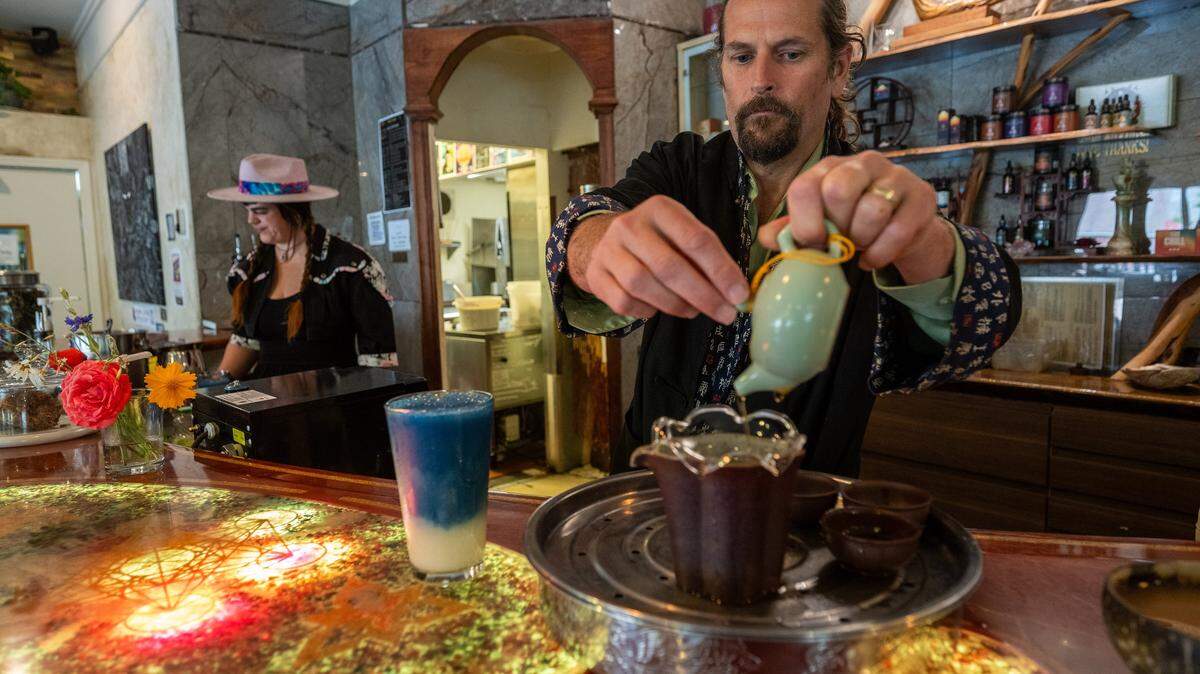
Elixart is not your typical bar. The Nevada City hangout has a laid-back, hippie-ish vibe. Around the bar, at tables and on couches, customers enjoy housemade non-alcoholic drinks.
Read more Who is leading the El Dorado County Board of Supervisors race? What to know
The menu is sprawling and eclectic, teeming with esoteric functional ingredients. In one of their top sellers, jun, a fermented drink related to kombucha, pairs up with kava, a root from the Pacific Islands that’s used for its calming effects.
They use adaptogenic mushrooms chaga, reishi and lion’s mane, as well as Shilajit, a naturally occurring resin used in Ayurvedic practice to boost energy and combat fatigue. There’s even a drink made with Changbai ants, which are used to boost the immune system due to their high zinc content.
However, there’s one ingredient you won’t find on the menu, at least not anymore: kratom.
Kratom is a supplement that’s derived from a tree native to Southeast Asia, where the leaves have traditionally been chewed or brewed into a tea by the local population.
The leaves contain a compound called mitragynine. In small doses, mitragynine has a mild stimulant effect. In higher doses, it can have an analgesic effect.
Co-owners Colter Merrick and Brett Bold have run the bar since 2012. According to Merrick, kratom has always been a big draw for Elixart’s customer base, offering them the opportunity to enjoy a beneficial beverage in a social environment, without alcohol.
“It makes you feel amazing. It’s like a revved up cup of coffee that can also make you feel relaxed while giving you the motivation to overcome any obstacle, emotional or physical. Compared to alcohol it is safer, more enjoyable and makes you feel better while you are drinking it and the next day,” Merrick said.
The crackdown stems from a specific kratom-derived product called 7-hydroxymitragynine, or 7-OH for short, which is one of the other compounds in kratom leaf. In its natural state, it comprises a small amount of the total alkaloids, but in recent years has been synthesized into a concentrate.
Dr. James Chenoweth is an associate professor of emergency medicine and medical toxicology at UC Davis, where he runs an addiction medicine consult service. According to him, high concentrations of 7-hydroxymitragynine bind with the body’s mu opioid receptors much more effectively than mitragynine, which can cause dependency.
“MItragynine has activity at the mu opioid receptor, which is the same receptor that’s active that things like oxycodone, hydromorphone, and other opioid agonists have activity, 7-hydroxymitragynine usually makes up less than two percent of the active alkaloids, but more recently we’ve seen purified versions, which is more potent at the mu opioid receptor,” he said.
The compounds in kratom show promise for their analgesic properties. In animal testing, mitragynine was shown to have one quarter the potency of morphine; 7-hydroxymitragynine was 13 times more potent than morphine. It is its effectiveness in bonding with the receptors that also cause dependency.
“It has what’s known as partial agonist activity, which means that it doesn’t fully activate, like oxycodone or fentanyl. This is probably why we don’t see as many overdoses with 7-hydroxymitragynine, even though they can happen, but we definitely see withdrawal,” Chenoweth said.
Kratom sits in a liminal space: It is neither approved nor illegal, and has been commonly marketed as a healthier alternative to alcohol and narcotics. As the prevalence of 7-hydroxymitragynine has grown, so too, have overdoses. In the period between 2015 and 2025, there has been a 1,200 percent increase in exposure reports, according to the CDC.
For that reason, the FDA has recommended a scheduling action to control certain 7-hydroxymitragynine products under the Controlled Substances Act.
Read more Sacramento election results: Here’s what we know and when the next count will come
However, FDA Commissioner Dr. Marty Makary has also repeatedly underscored that this applies only to the concentrated product, and not the natural leaf.
“To be clear, the kratom plant leaf, which contains trace amounts of 7-OH and has been consumed for centuries, is not our focus at the FDA,” he stated in an op-ed in the New York Post.
Nevertheless, the FDA’s official position is that, “kratom is not appropriate for use as a dietary supplement … and cannot be lawfully added to conventional foods.”
In January, the California Department of Public Health issued a warning to businesses that “kratom-derived and 7-OH products are not legally approved for sale for consumption online or in stores.”
The justification is, according to California Health & Safety Code 110555, “any food is adulterated if it is, bears or contains any food additive that is unsafe within the meaning of Section 110445.” Consequently, foods containing kratom are considered to be adulterated.
Nevada County Public Health forced Elixart to stop serving kratom, cratering its business.
Merrick encouraged his customer base to send testimonials to the county, and they did so in droves. They expressed how kratom has helped them stay sober, alleviated chronic pain, quelled anxiety and balanced their emotional wellbeing.
They also emphasized the importance of Elixart as a community hub and safe space for the sober curious to explore functional beverages.
When he brews his kratom leaf tea, Merrick uses about one to two grams of leaf per shot, which he estimates yields around 10 to 15 mg of mitragynine, a dosage that should have only mild sedative effects. However, he notes that the kratom leaf contains dozens of alkaloids, and that they may act synergistically.
In this way kratom has parallels to another once-illegal botanical product that is now normalized and ubiquitous in California.
“Many of us remember when cannabis was demonized before it was legalized. Our plant allies have always been on the front lines of social and cultural evolution,” Merrick said in a note to his customers.
Since the blanket ban, a few California counties, including Fresno County, have between naturally derived kratom and synthetic 7-hydroxymitragynine, leaving the door open for the sale of kratom leaf product. No one from Nevada County Public Health was available to comment whether they will enact similar measures. Merrick is hopeful things will return to as they were before.
“I would say what Elixart is most known for is a celebration of life and connecting with community. People come to recreate, dance and have fun,” he said.
Read more CA governor primary: Becerra, Hilton lead as Steyer chases late-count surge
This story was originally published June 3, 2026 at 10:55 AM.