 By admin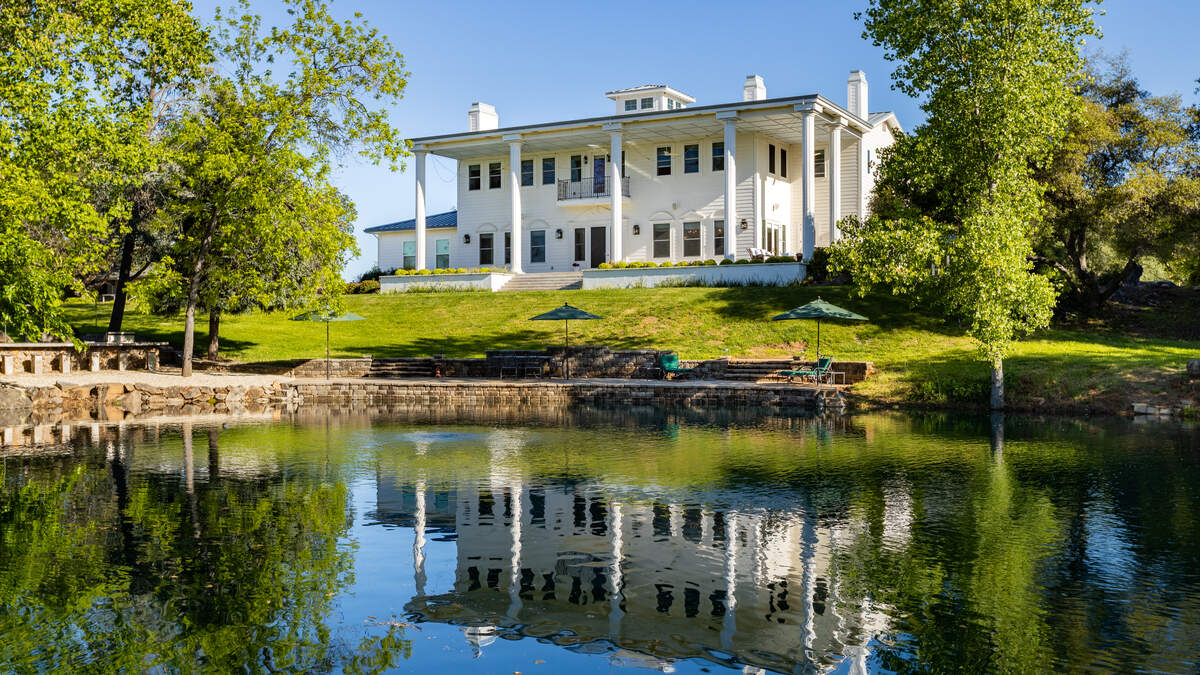
AI-generated summary reviewed by our newsroom.
Read our AI Policy.
- Susie and Carlos Rodriguez built a Mount Vernon–inspired Colonial on roughly 6.6 acres.
- The 5,985-square-foot home, completed in 2012, includes an 11-car garage and ADU.
- The property uses geothermal linked to a 22-foot-deep pond and a 22-kilowatt generator.
Susie Rodriguez can still place herself on Mount Vernon’s front porch, a kid on a family trip, leaning against a pillar and staring at George Washington’s house.
Read more Healthcare advocates praise Legislature for resisting Gavin Newsom’s budget cuts
“We went to Mount Vernon, and I was just taken aback by the simple elegance of it,” Rodriguez said. “I remember leaning up against one of the pillars at Mount Vernon and saying to my mom, ‘One of these days I’m going to have my own Mount Vernon.’ ”
Decades later, that childhood vow made during a visit to the estate of the nation’s first president took shape in the Sierra foothills, 30 miles northeast of Sacramento.
The estate of Susie and Carlos Rodriguez at 3100 Newcastle Road in Newcastle is for sale for $4.2 million. The 5,985-square-foot, three-bedroom, seven-bathroom Colonial-style residence on roughly 6.6 acres includes garage space for 11 vehicles, a four-person elevator, a 22-kilowatt backup generator, geothermal heating and air conditioning linked to the property’s large pond, and additional living space in an accessory dwelling unit and studio totaling 1,077 square feet.
But what sets the property apart is that it was built not as a modern mansion styled to resemble a colonial home, but as a personal West Coast homage to Mount Vernon, shaped by one woman’s long memory and a couple’s fascination with early American history.
Simple, elegant home
“It’s just a simple, elegant house,” Susie Rodriguez said.
Carlos and Susie Rodriguez bought the land in 1989. The property held a modest 1,900-square-foot house surrounded by wild blackberries. He was born in Havana and raised in New York City; she grew up on acreage in Napa, so the move marked a return to open land that felt familiar. Both built careers as national political consultants.
For years, the couple left the property largely unchanged. Then, in 2010, they tore down the original house and began building the Mount Vernon-inspired residence. The project took about two years and was completed in 2012.
Susie oversaw every detail of construction, working closely with mechanical engineer Ken Cooper. She sourced all the home’s antiques and presidential artifacts. Many pieces were acquired through chance discoveries, including a portrait of George Washington, presidential seal carpet and a horse statue at the pond modeled after Washington’s mount, according to marketing materials.
Listing agent Susan Richards-Slavik of Coldwell Banker Realty said the result is transportive, especially in a foothill luxury market where Tuscan-style and contemporary homes dominate.
“We’re in a sea of Mediterranean and modern, it’s none of that,” she said. “It’s classical building with classical insight.”
The driveway is gated, bending past a nearly football-field-size, 22-foot-deep pond that serves as both scenery and infrastructure. Inside, the front door opens to a tall foyer and a grand staircase, with marble floors and a cupola above.
“When you open the door, it’s just a simple elegance that grabs you,” Rodriguez said.
She said the vertical scale is part of the effect.
“The top of the cupola is about 36 feet, and the entrance foyer is 27 or 28 feet long. There are no fancy angles — just simple elegance,” she added.
It’s a good summary of the home’s approach. The architectural gestures are classic and direct — symmetry, height, proportion — while the materials and finish work do the heavy lifting. Walnut floors include custom inlays; moldings and trim turn corners with the crispness of furniture. Richards-Slavik said the detail work is so extensive it can be measured in miles.
“Everything about it has been really thought out — from the details of the doorknobs with the little dog heads on them, to the type of flooring, the marquetry. There’s over three miles of trim in this house,” she said.
Rodriguez points to the main staircase as a kind of thesis statement for how the home was built — not as a set of shortcuts, but as something meant to last.
“The staircase is solid walnut, not engineered — solid wood, sand-in-place,” she said. “In the dining room, around the edge, there’s a simple maple inlay.”
Staging ‘living history’
The floor plan is designed for hosting, the way older estates were: formal rooms for gathering, service areas for moving food and drinks, and quieter corners where conversations can peel off into smaller groups.
A formal living room looks out toward the pond, anchored by a fireplace. Off that sits a library with custom cherry shelving and a bar. The formal dining room is set up for big dinners, with a service hall that acts like a behind-the-scenes runway: an extra dishwasher, sink, ice maker, storage and buffet space, plus a dedicated china room.
That kind of layout matters in a house where the point isn’t only to entertain, but to do it with a theme. Rodriguez said the home’s early-American inspiration isn’t confined to a few framed prints — it becomes part of the calendar.
“In honor of George Washington’s birthday, we have birthday parties every year,” she said. “People are assigned characters and come dressed as those characters. They have to know the character. I wish more people would do it, because it’s like a living-history dinner. You learn about (historical) people.”
In other words, the house doesn’t just nod to the Founding Fathers. It invites them to dinner.
Read more Looking for LGBT+ food businesses? Check our database of over 40 in the region
“I do research through numerous cookbooks and get menus and cook food from back in the day,” she said. “Of course, ham was very popular back then. And George Washington, believe it or not, liked ice cream, so I make homemade ice cream … and the hot chocolate, which is a hard way to make hot chocolate, but I make it every year — grated chocolate and cream. It’s very good. It’s very rich.”
Rodriguez said the naming and storytelling runs through the rooms themselves.
There’s the George Washington living room, the Thomas Jefferson library, the John Adams breakfast room — “an early riser” — the Abigail Adams sitting room — “she would sit and write to John — they wrote 1,500 letters … during their marriage” — the Lady Washington dining room, the Abraham Lincoln stairway, the Eisenhower loft, the Nixon wing, the Ronald Reagan and Teddy Roosevelt guest rooms, the Gerald Ford garage — “which makes sense” — and the Bush elevator “because they both had their ups and downs.”
She summed up the collecting and curating in one line: “Everything in this house has a story.”
Modern side of old house
The house may be designed to evoke the 18th century, but it’s built with systems that speak to 21st-century concerns: energy efficiency, redundancy and comfort.
“It has a two-inch metal cool roof — and SIP panels (Structural Insulated Panels), which are super energy efficient, for exterior walls. All interior walls are insulated, and they used a DRICORE floor underneath their flooring. Everything was very well thought out,” Richards-Slavik said.
Rodriguez said the pond plays a role beyond the view, anchoring the geothermal system.
“We have geothermal, so our heating and air conditioning are at the bottom of the pond. The water down there is a constant 57 degrees,” she said. “Even if it’s 30 degrees outside, the system thinks it’s 57. If you want to heat the house to 70, it only has to go from 57 to 70.”
Richards-Slavik put it almost like a riddle: “The pond is year-round. The geothermal is under it.”
There are also practical touches for day-to-day living in a large home: laundry rooms on both levels, a walk-through pantry, wine storage and the elevator tucked off the main hallway.
Upstairs, the primary suite is arranged like a private wing, with a fireplace, views, two walk-in dressing rooms and two separate primary bathrooms connected by their own hallway, according to the listing. Two additional bedrooms are en suite.
For all its scale, the house was sited for discretion. Rodriguez said that was intentional.
“You can’t see the house from the road, which we like,” she said. “We like the privacy.”
That privacy can also create a moment of cognitive dissonance for visitors who assume the home must be older than it is.
“People will come up and ask, ‘When was this house built? It looks like a museum inside.’ I tell them, ‘No, it’s new, and it’s ours,’ ” she said.
Outside, the listing highlights a pool, veranda and barbecue island, plus the pond and waterfall. Richards-Slavik said the acreage stays unusually green for foothill country and is dotted with mature oaks.
The listing includes a barn and a 2,400-square-foot insulated shop geared toward car, boat or RV storage — a nod to the owners’ hobbies, including vintage wooden boats, according to background and the agent.
“It has a 2,400-square-foot workshop that’s fully insulated, and (Susie Rodriguez) used to restore wood boats,” Richards-Slavik said.
And while the home’s theme is rooted in the East Coast, its location is unmistakably Northern California. Newcastle sits between the Sacramento region and the Sierra. The home offers quick access to Folsom Lake.
For Rodriguez, the property represents the realization of a childhood dream that shaped not only the architecture of the home but also how the couple entertains and lives.
“In some people’s eyes it’s big, but everybody says it’s very welcoming and very warm,” she said.
Read more How long can someone be detained by immigration? Judge asked to weigh in on Haiti case
This story was originally published June 12, 2026 at 2:40 PM.