 By admin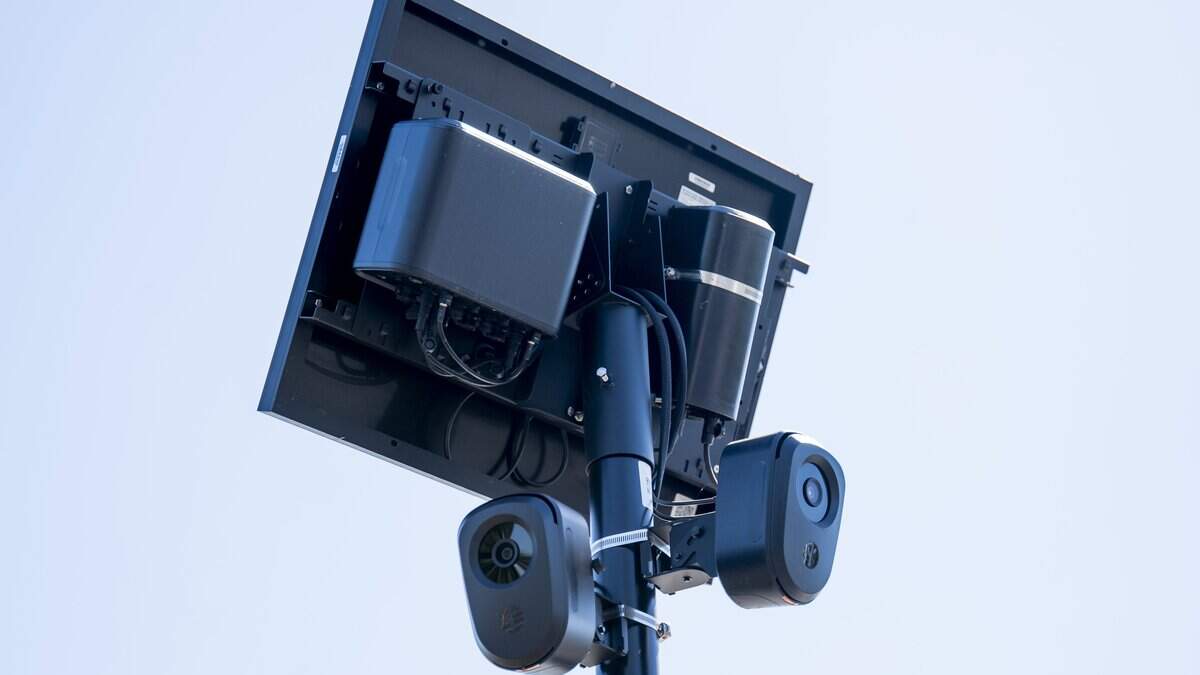
Days before Christmas in 2024 at an Elk Grove shopping center, police captured a retail theft in progress from the air. It would soon become part of a promotional campaign for an emerging surveillance technology.
Read more Newsom calls on Trump to deliver federal funding for Los Angeles wildfire recovery
Elk Grove officers tracked the man from a previous theft that had occurred minutes earlier, using Flock traffic cameras that identified the vehicle and captured a partial license plate as the suspect drove to the shopping center. An overhead police drone and officers on the ground were waiting when he returned from a second store with more stolen goods.
Video showed officers chasing down the suspect, with merchandise falling from his pockets. Police later connected the man to thefts totaling $7,000 worth of merchandise from four Elk Grove stores.
“Planning on coming to Elk Grove to steal?” the department’s X post warned. “Better think twice.”
Capital-area cameras cast a wide net
The technology has quietly become part of everyday policing across Sacramento area. Police departments and sheriff’s offices have installed automated license plate readers, commonly known as ALPRs, throughout the capital region, creating a network that authorities increasingly rely on to track vehicles linked to crimes — whether across town or across the country.
Here’s a rundown of where it’s used:
• The Sacramento County Sheriff’s Office and police departments in Sacramento, Elk Grove, Folsom and Galt use the technology. All but Sacramento employs Flock Safety systems; the capital city uses a system built by Motorola Solutions.
• In Yolo County, the Davis, West Sacramento and Woodland police departments use Flock cameras. The Yolo County Sheriff’s Office also uses them. The city of Woodland in February extended its two-year contract with Flock for its network of 36 license plate readers and five surveillance cameras, despite concerns over data-sharing.
• In Placer County, police in Auburn, Lincoln and Roseville employ Flock cameras. The city of Rocklin is working to install its own system. Officials filed paperwork in March for the installation project.
• Other agencies across the capital region and points farther north also utilize ALPR technology, according to Bee research, including El Dorado County Sheriff’s Office in El Dorado County, Yuba County Sheriff’s Office and Marysville Police Department in Yuba County, Yuba City Police Department in Sutter County; and Colusa Police Department in Colusa County. Lassen County Sheriff’s Office also uses the system.
It’s an increasingly broad surveillance network that encompasses hundreds of square miles and roughly 2.2 million people in Sacramento County and its cities alone.
Law enforcement agencies say automated license plate readers manufactured by Flock, Axon, Motorola and others have become valuable tools for fighting crime. But cities, residents and California lawmakers are calling for limits on the technology over concerns about accuracy and abuse.
How license plate-reading cameras work
Cameras are mounted on poles near intersections, shopping centers and neighborhood entrances. Cameras are also mounted on patrol vehicles.
What they do, step-by-step:
• The cameras photograph moving vehicles. Software converts license plate numbers, vehicle make, model, color and other characteristics into information stored in a searchable database. Dates, times and locations are also recorded.
• The camera captures an image of the passing vehicle.
• Software attempts to identify the vehicle and read its license plate. The information is compared with “hot lists” of stolen or wanted vehicles.
• Law enforcement can receive an immediate alert if the vehicle matches a hot list.
• Police can search previously recorded images while investigating crimes. The information is stored for a period of time. In West Sacramento, for instance, data from the city’s 39 license plate readers is stored for a minimum of one year.
Read more California’s Latino voters matter — and some insiders want to shut them out | Opinion
‘Safety, safeguards,’ insist police
That’s the issue for the technology’s critics. All vehicles and their information are recorded, creating records of people who have done no wrong.
Reporting across the country has highlighted the technology’s potential for abuse. The Washington Post reported that a police chief in suburban Atlanta used Flock Safety technology in 2024 to stalk a former girlfriend. He was one of at least 50 law enforcement officers charged or accused of improperly using license plate readers, according to a Washington Post analysis.
In perhaps the Sacramento region’s strongest example, recent reporting has rekindled concerns over the accuracy of license plate-reading technology.
Roseville police found that Flock misread license plates in 1,012 — or 71% — of 1,427 stolen-vehicle and felony alerts issued during 2023 and 2024, Business Insider reported in late July. The system’s cameras produced blurred images or missed vehicles altogether, confused similar characters and misread the states where license plates were issued.
Agencies have stressed that the technology focuses only on vehicles, not facial recognition, and have sought to address concerns about misuse, overreach and data sharing between agencies.
“I also understand why people have questions. Concerns about access, sharing, and misuse are legitimate,” West Sacramento Police Chief Robert Strange said in an open letter to residents explaining his department’s use of the technology, saying it is subject to audits, regular oversight and requires documented justification for its use.
“Our community should expect both safety and safeguards—and that is the standard we will continue to uphold,” Strange said.
Critics raise abuse, accuracy concerns
But advocates ranging from the local advocacy group DeFlock Elk Grove to leaders in the East Bay city of El Cerrito and California legislators are pushing back.
The Elk Grove group released an audit of the Police Department’s use of Flock cameras that found thousands of organizations searched Elk Grove license plate data more than 8.3 million times over five years. The report said most of those searches were conducted by outside agencies, including some without formal data-sharing agreements and others identified as federal and out-of-state entities.
Elk Grove police said they are reviewing the audit and contend some of its conclusions lack important context. Officials have defended the system as an effective investigative tool, saying it operates under oversight policies and has helped make hundreds of arrests while aiding investigations into stolen vehicles, hit-and-run crashes and missing persons.
In Contra Costa County, police in El Cerrito are pulling down its cameras over the next several weeks after the City Council last week ended its contract with Flock following public outcry over the technology, NBC Bay Area reported. Flock and El Cerrito police, in statements to NBC Bay Area, said no images have been collected since early June, when the city’s agreement with Flock expired and the cameras officially shut down.
At the state Capitol, Sen. Sabrina Cervantes, D-Riverside, introduced Senate Bill 1013, which would limit law enforcement agencies to retaining license plate data for 30 days except during active investigations or searches for missing people. The bill also would limit who can access the data, according to CalMatters.
California police and sheriff’s agencies would also be barred under Cervantes’ bill from contracting with camera companies that allow out-of-state and federal law enforcement agencies to search California license plate databases, CalMatters reported.
“This bill is about one simple principle: Protecting the privacy and safety of Californians while ensuring law enforcement tools are used responsibly before it’s too late,” said Cervantes, speaking before the Assembly’s privacy committee in June, CalMatters reported.
Read more Billionaire tax, Prop 40, wins Labor Federation endorsement in ‘overwhelming’ vote