 By admin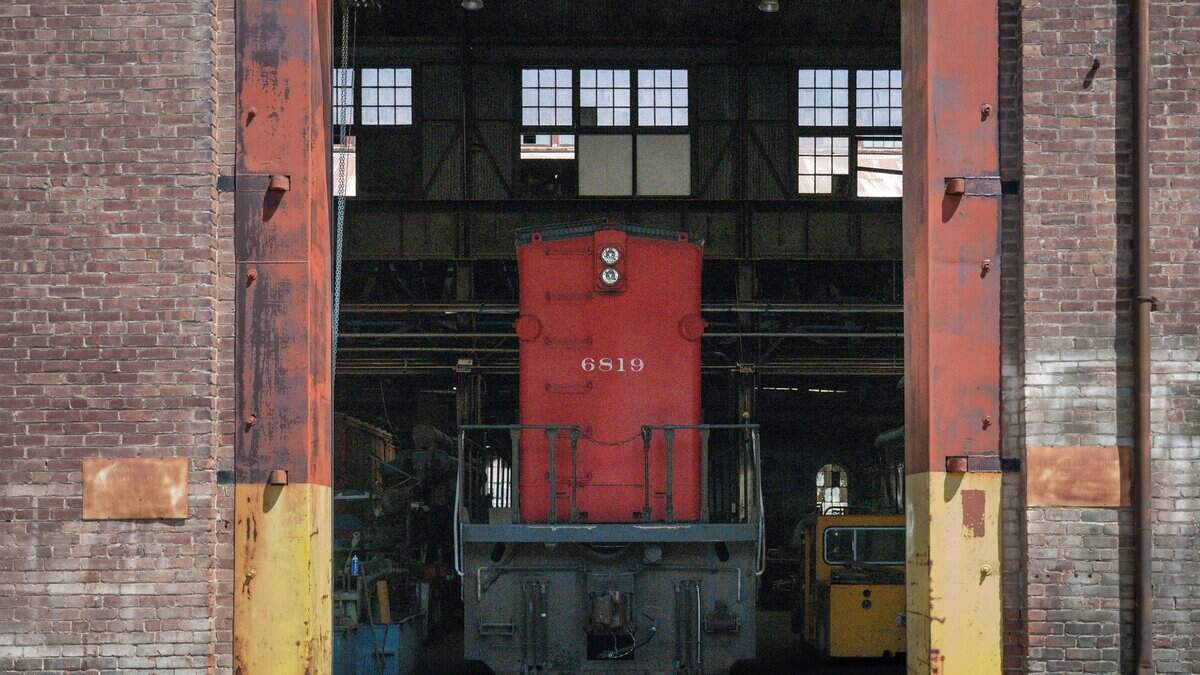
Sacramento’s most well-known holiday train wasn’t due to run for three months, but Robert Smith was busy doing an electrical upgrade for it.
Read more Goats on the beach. Dogs in the restaurants. Has ‘woke California’ gone too far? | Opinion
Smith, a California State Railroad Museum Foundation employee, was inside the Southern Pacific Railway Workshops at the Sacramento Railyards. The foundation and California State Parks employees use the former boiler and erecting shops for maintenance and storage of historic trains, including ones that Smith had been tasked to work on.
“We run these cars on the Polar Express and everything is fed electrically off the last car on the train,” Smith said. “So we’re upgrading the connections to make it a little more reliable.”
The boiler and erecting shop buildings are part of the roughly 244-acre Railyards, the largest redevelopment project west of the Mississippi River. The two buildings are the westernmost and largest of the historic shop buildings at the site. The smaller historic structures are controlled by LDK Ventures, which has been handling the redevelopment in recent years.
Like much of the Railyards, the boiler and erecting shop buildings have long needed attention. A $23.7 million project funded by the Proposition 68 and Proposition 84 bond measures kicked off Aug. 17 to replace the boiler shop’s roof. But the state of the buildings also underscores that they have been in use for more than 150 years. They remain an important hub of railroad-related activity, now helping serve the nearby California State Railroad Museum.
What the boiler and erecting shops are used for
Albert Di Paolo paused by a 1948 General Motors F7 locomotive inside the boiler shop.
Di Paolo, 60, is the restoration and maintenance lead worker for the California State Railroad Museum. He’s one of about 5-6 people on a given day who work on engines like this one, which he said had 1,500 horsepower, ran on diesel and was “basically the locomotive that ended the steam engine.”
The locomotive’s engine cylinders have been removed, and its crankcase was bare. Di Paolo estimated it will cost at least $200,000 to get the engine running again. But he expressed hope it would eventually pull the museum’s excursion line trains along the Sacramento River to Sutterville Road.
“That silver-and-red paint scheme is called the warbonnet paint scheme,” Di Paolo said. “It was famous for the Santa Fe Railroad.”
Packed into the two buildings, during a tour Aug. 17 given by Di Paolo and other California State Parks representatives, was a fascinating amount of history the public only rarely sees.
These included a 1911 gasoline-powered car made by Hall-Scott Motor Car Company in Berkeley; a 1929 diesel-electric Ingersoll Rand, which Di Paolo described as one of the earliest extant diesel locomotives; and the first diesel locomotive for Southern Pacific, dating to 1939.
The buildings themselves are history, too. The current boiler shop building dates to 1882. Its wooden predecessor was built in 1869 as the Transcontinental Railroad was being finished with Sacramento as its western terminus. The erecting shop, where the engines were put together, also dates to the 1860s, with space originally for 10 locomotives and, eventually, 25.
Melanie Tran, chief curator for the California State Railroad Museum said it was “humbling, for sure” to be inside the boiler shop. “There’s a lot of history here from the people who used to work here, how it was built and it’s all connected to how the collection was built as well inside of the museum,” Tran said.
The shop buildings were designed to serve as a one-stop area where everything needed for trains could be built.
“Total vertical integration, that was what they were interested in,” said John Fraser, district superintendent for California State Parks. “They were worried they were so far from the East Coast supply chain that they wanted to get as much as they could built here on-site.”
Read more These Sacramento Bee staffers grew up here and call their beats home
Di Paolo said that everything could be built in these shops, down to the dining cars’ flatware.
Hopes for what the shops could turn into
It had become demoralizing to work out of the boiler shop in recent years, Di Paolo admitted.
“The condition of the building was so bad that when it rains, we just had, for safety’s sake, we had to … basically close shop because water was getting in the electrical line and it’s slippery,” Di Paolo said. “And, of course, in the summertime, you get the heat and the mosquitoes and all the other stuff.”
The boiler shop roof replacement, which is expected to take 18 months and is being handled by Roebbelen Construction, could be tricky. The shops are on the National Register of Historic Places. Fraser noted that a portion of the erecting shop, which will receive a more modest round of repairs, dates to 1869.
“Anything we determine is character-defining of the building, we’ll do our best to protect that,” Fraser said. “And if we do have to repair it, it would be in-kind materials. So we would come back through and try to replace it with the exact same material.”
The workers will also have to contend with limited access to both buildings. A large portion of the boiler shop has been cleared out, making it appear like an empty airplane hangar.
The payoff for staff enduring this work could be a potentially more useful space for the public. While LDK’s shop buildings are undergoing adaptive reuse to become space for events and more, the boiler or erecting shops might become an educational area. In time, schoolchildren could even be welcome.
“There’s been a lot of dreams for this place, but I think what we’re really interested in doing is making hands-on activity space that really talks about engineering and trains and railroading and not only the past of railroading but the future of railroading, too,” said Kim Whitfield, chief of interpretation for the California State Railroad Museum. “Talk about electric-diesel and talk about high-speed rail and all kinds of stuff.”
Fraser spoke about how the various uses for historic buildings — LDK’s plans include a concert venue in the former paint shop — will fit together.
“The larger activation of the whole Railyard space is something we’re really excited about,” Fraser said. “It’s one of the reasons the roof project is so important. Because it becomes another milestone for us to open this place up to the public ultimately.”
For now, people like Di Paolo are clear on their favorite thing about coming to work. Prior to joining State Parks about 25 years ago, he worked on the Skunk Train in Fort Bragg and, before that, the Disneyland Railroad. He recalled how the Disneyland Railroad No. 1 locomotive was based on Central Pacific 173, which was made in the erecting shop at the Sacramento Railyards.
Di Paolo noted that Walt Disney became inspired after seeing a model of Central Pacific 173 on the desk of his animator Ward Kimball.
“Disneyland inspired me to get into trains and stuff, and now I’m at the very place that built the engine that inspired Walt Disney,” Di Paolo said. “So I went full circle.”
Read more Ending California school HVAC funding is a costly, unsafe move | Opinion