 By admin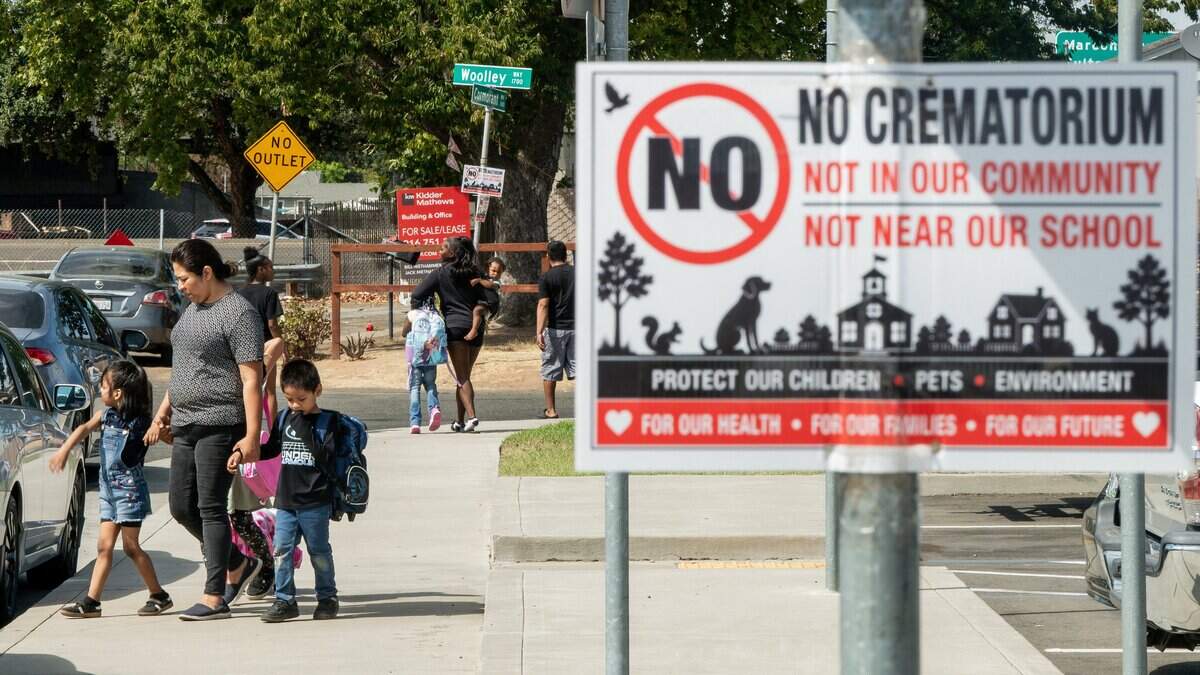
Hundreds of children entered the gates of D.W. Babcock Elementary last week, filling hallways and classrooms with excited chatter on the first day of the new school year. For some families, however, the occasion brought renewed unease.
Read more If you’re a Sacramento-area teacher buying your own supplies, these groups can help
Just down the street, through double doors and inside a dim room, sit two large metal furnaces — machinery for a planned crematorium that has drawn concerns over potential air pollution and health risks. A recent inspection revealed the company, named Sant Sagar Crematory, performed construction without authorization from the local air district.
“This is not the place for this,” said Kim Gibson, a resident of the surrounding Swanston Estates neighborhood in Sacramento. “These children deserve better.”
The Sacramento Metropolitan Air Quality Management District conducted an on-site inspection of the crematorium on July 15 after receiving reports of construction. Inspectors confirmed the reports, finding that exhaust stacks had been partially installed and gas and electrical lines had been connected to the cremation units.
Because the equipment had been installed while a California Environmental Quality Act review was underway and before the company received a permit from the air district, the district issued a notice of violation on July 21.
“We are working with the business to resolve the violation and are requiring that they discontinue any further construction,” wrote Emily Allshouse, a district spokesperson.
The district has specifically directed the company to lock out the gas and electrical lines.
Situated south of El Camino Avenue on Albatross Way within 1,000 feet of the elementary school and nearby homes, the crematorium has faced scrutiny for months. Regulators say the facility is expected to emit air pollutants including nitrogen oxides, volatile organic compounds, particulate matter, various metals and other compounds associated with human cremation.
Sascha Vogt, the Twin Rivers Unified School District board member who represents the neighborhood, described the unauthorized construction as “disheartening and demoralizing.”
“My community deserves answers,” she said. “My parents deserve answers about the air that their children are going to be breathing.”
Reached by phone on Tuesday, crematorium owner Narinderpal Singh said that the company had the necessary permits. He then passed the phone to associate Garry Singh, who said they are taking care of the violation notice but declined to answer further questions. The company’s consultant did not respond to a request for comment.
‘An insult to our community’
Vogt said many families she represents felt “disenfranchised” during the public comment period for the crematorium plans — a feeling that intensified when the company continued construction without a permit.
“Many of them felt that their voices didn’t matter, and that (the project) was going to happen no matter what they said,” she said. “To see the construction continuing after it’s been ordered to stop, I feel like that validates that even more.”
The school board member also voiced distrust of the owners.
“If they’re not following the law now, we question what they’re going to do once … they ever become operational, because it’s a red flag,” she said.
For Vogt, the crematorium represents an environmental justice issue. She argued that the project is placed in an already disadvantaged community, noting that the neighborhood just north of Arden Fair mall is low income, as well as racially and ethnically diverse.
The median household income is about $55,300, roughly half of that of the state overall. About 41% of the population is Hispanic and about 17% is Black, according to education data website Niche, which uses demographic information from the U.S. Census Bureau.
Matthew Shintaku, principal of D.W. Babcock Elementary School, echoed Vogt. He called the violation by the crematorium “an insult to our community.”
One reason he finds the facility especially concerning, he said, is because many children who attend the school also live in the area, including in apartments just down the street from the site. Another reason, he added, is that the transitional kindergarten yard is the closest point of the school to the crematorium.
Parent Erika Flores pointed to the school’s program for students with autism, noting that many of these children, including her son, have sensory issues that could heighten their sensitivity to odors from cremation.
Read more California lawmaker fears ICE officers may ‘jump ship’ to local police after Trump
“Nobody wants that near kids, especially because there are kids with autism,” she said.
CEQA review for crematorium
Sant Sagar Crematory submitted a permit application to the air district late last year. The district evaluated the project and determined it met federal, state and local standards. It then issued a public notice about the project and held a 30-day public comment period as required by law.
Due to the number of comments and requests from community members, the air district extended the period twice to allow for additional public input. It participated in two community meetings to answer questions about the project during this time.
“We went, I would say, above and beyond … to make sure that we heard all the voices of the community and the parents and school teachers and others,” said Amy Roberts, division director at the district.
During the public comment period, the district completed an on-site inspection in April. It found cremation units but no indicators of any substantial construction work, such as gas or electrical lines attached to the units.
Because many families voiced concerns, the air district announced on May 14 it would conduct a CEQA review and pause the issuance of a permit allowing construction — a move Roberts described as unusual.
“We internally assessed, and we felt that it was a good step for us to take to make sure that there wasn’t anything missed in the general plan … and make sure that everything was being taken into account as far as other potential environmental impacts,” she said.
Residents say they observed construction while the permit process was on hold. The company left exhaust stacks in the parking lot outside the building for months, according to Gibson. After Vogt emailed the air district to ask if the activity was authorized, the district conducted July’s on-site inspection.
Confusion over permits?
Sacramento City Councilmember Roger Dickinson, who represents the neighborhood, said the notice of violation is “appropriate.” At the same time, he said the company may have thought it could perform certain construction under a separate permit issued by the city of Sacramento in December.
That permit, called a tenant improvement permit, is required for modifying or renovating the interior space of a commercial property and allowed the company to convert the former church into a crematory. The air district’s permit, called an authority to construct permit, is needed to install the cremation units and make them operational.
“They may have made an assumption about what they were authorized to build, but didn’t realize that they were going further than permitted under the air district requirements,” Dickinson said of the owners.
The council member has not taken a public stance on the project. Under the city’s zoning code, he said, a crematorium is allowed at that location and not subject to City Council vote. Whether the project complies with environmental regulations, however, is not yet determined.
“It’s not really a matter so much of whether I support or oppose the project because the project is permitted,” Dickinson said. “I think what becomes more significant is trying to do what’s possible, if the project is going to proceed, to mitigate or minimize the impacts on the neighborhood.”
He discussed planting trees around the property to absorb some of the emissions as a possible mitigation strategy.
Residents push for relocation
The crematorium owners must pay a fine associated with the notice of violation and notify the air district once they have locked out the gas and electrical lines as directed.
The CEQA review is ongoing, and Roberts estimated it would be completed in October or November. The air district has hired Raney Planning and Management, Inc. as a consultant to prepare environmental review documents.
Gibson said she and other residents won’t stop pushing for answers, as well as for the relocation of the crematorium.
“Nobody really seems to care. They just push the buck from one entity to the next entity to the next entity,” she said. “I guess they thought we were going away, and we’re not. We have been staying on top of it every step of the way.”
Read more California lawmaker fears ICE officers may ‘jump ship’ to local police after Trump
This story was originally published August 24, 2026 at 7:00 AM.