 By admin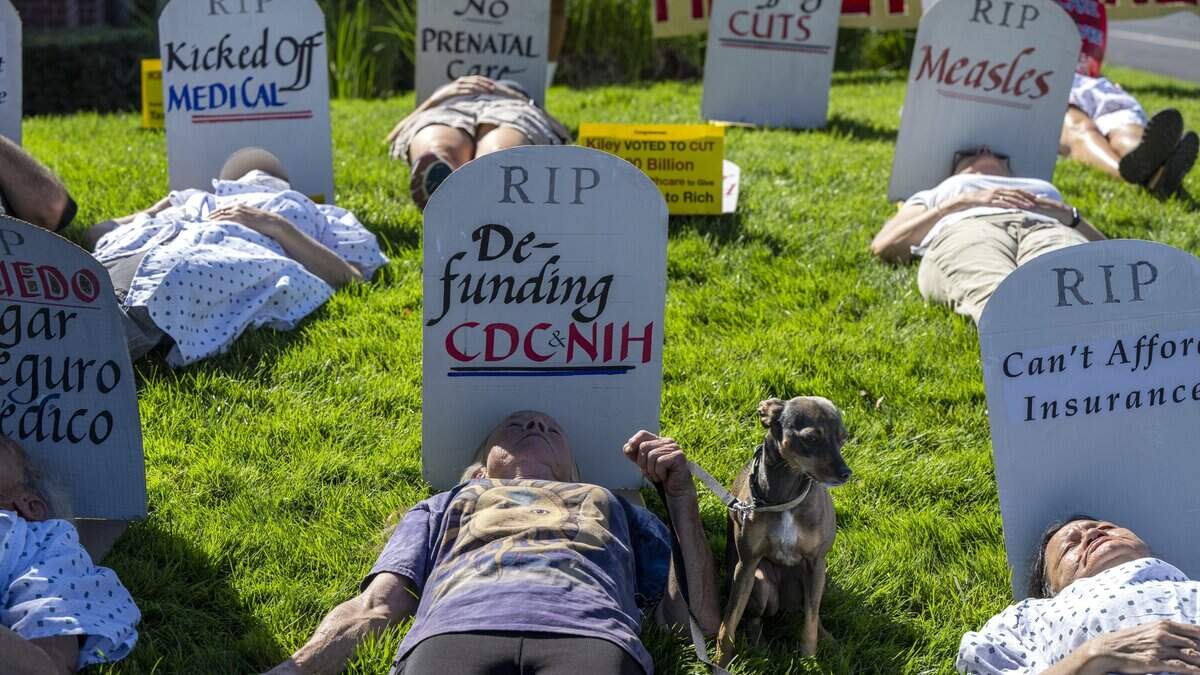
The message was impossible to miss.
“STOP KILLING US PROTECT HEALTHCARE” stretched across Douglas Boulevard near Kaiser Roseville Medical Center. On the grass outside a Wells Fargo, more than 20 protesters lay motionless beside mock tombstones bearing phrases such as death by “mental illness” and “snatched from the E.R. by ICE.”
Read more Sacramento opens cooling centers amid extreme heat. How hot will it get?
The protest, focused on healthcare and federal spending, took aim at Rep. Kevin Kiley’s vote for last year’s HR 1, which organizers said threatens health coverage for Californians who rely on Medi-Cal.
Noelle Filice-Smith, a registered nurse and member of the California Alliance for Retired Americans, said Placer County residents deserved better from Kiley, an independent from Rocklin who has represented the area in Congress since 2023.
“We deserve a government that is of the people, by the people, and for the people, not one that takes from our most vulnerable and gives and enriches those who already have enough,” she said.
Filice-Smith said Medi-Cal provided a critical safety net for people in her community.
“Medi-Cal supports independent living with services such as assistance with daily activities of daily living, like bathing, meal preparation, transportation, shopping, among many other things, but Kevin Kiley voted to cut this health safety net.”
Thousands in Placer could lose Medi-Cal coverage
Placer County officials said changes under the federal law — known as the One Big Beautiful Act signed by President Donald Trump a year ago — and related state policies could have significant local consequences over the next several years. The county estimates more than 7,500 residents could lose Medi-Cal coverage after new work requirements and more frequent eligibility renewals are fully implemented.
Kiley’s campaign disputed the protesters’ characterization of his record as
Campaign staff for Kiley, running for re-election to California’s newly redrawn 6th Congressional District, disputed the protesters’ characterization of his record.
Alex McDonald, a spokesperson for Kiley’s campaign, said the congressman’s record included efforts that increased federal Medicaid spending and Medicare reimbursement rates.
“The non-partisan Kaiser Family Foundation confirms Kiley’s successful effort to increase federal Medicaid spending which has increased from $614 billion in FY23 when Kiley was elected, to $668.1 billion in FY25,” he said. “Not only has federal Medicaid spending increased, but the legislation Kiley voted for also increased Medicare reimbursement rates.”
A California Legislative Analyst’s Office report estimated HR 1 could cause more than 1 million Californians to lose Medi-Cal coverage.
In Placer County, the effects of HR 1 and related state policy changes are expected to unfold over the next several years, with the largest changes beginning in 2027.
Katie Combs Prichard, a spokesperson for Placer County’s Health and Human Services, said some changes were already underway.
“HR 1 and state policy changes bring major shifts to both Medi-Cal and CalFresh that will unfold over the next several years,” Prichard said.
Some adults with what the county describes as “unsatisfactory immigration status” were already facing Medi-Cal enrollment freezes. New CalFresh work-reporting requirements also had taken effect for some adults without children or other dependents.
What changes and how Placer is preparing
Beginning in 2027, many adults ages 19 to 64 who received Medi-Cal would have to show each month that they were working or taking part in an approved activity.
“These new rules will require affected adults to document monthly work or qualifying activities,” Prichard said.
» Roseville news in your inbox: Get our free Roseville email newsletter here
Medi-Cal recipients would also have to renew their eligibility more often, moving from annual renewals to every six months.
The county said the change would increase the workload for employees who process Medi-Cal applications and renewals and could result in people losing coverage if they miss deadlines or do not submit required paperwork.
Placer County estimated that more than 7,500 residents could lose Medi-Cal coverage once the new work requirements and six-month renewals are fully implemented. About 2,000 residents could eventually turn to the County Medical Services Program, or CMSP, for medical care, according to the county.
To prepare, Placer County was entering into a 30-month CMSP agreement worth up to $23.7 million. Services were scheduled to begin in April 2027.
Read more Fair Oaks music teacher arrested on child sexual abuse material possession charge
Prichard said the agreement would help cover initial costs, but the county could face greater financial pressure if the number of uninsured residents seeking county-funded care grows.
The changes could also affect Covered California and CalFresh. County officials estimated up to 6,700 Placer County residents could eventually lose their Covered California insurance because federal premium subsidies expired.
About 28,000 Placer County residents received CalFresh benefits. Expanded federal work requirements could cause some recipients to experience interruptions or reductions in benefits, particularly if they struggle to meet reporting or verification requirements.
“Residents with unsatisfactory immigration status are also at risk, and we are already seeing early signs of slippage in Medi-Cal enrollment among this group,” Prichard said.
Loss of Medi-Cal coverage could also affect access to some behavioral health services and put pressure on health care providers, managed-care organizations and community groups serving those residents, according to the county.
Diane Madoshi of the California Alliance for Retired Americans said seniors had spent years contributing to their communities and faced uncertainty over their healthcare.
“We’re a growing population. We have given a lot to the community, and we’re not takers,” she said. “We’re givers, and now we are being threatened with our healthcare needs being taken away from us.”
She said she is concerned about the funds being withheld from Californians.
“We’re aging and we’re getting older, but we still deserve to have a quality of life,” Madoshi said.
Placer County was working with healthcare providers, government agencies and community organizations to prepare, including developing a Health Planning Workgroup and Enrollment Network to share information, help residents enroll and respond when people lose coverage.
Prichard said the county was expanding outreach through 211 Placer, community organizations, schools and senior centers.
The county also launched a Volunteer Hub through 211 Placer, allowing residents to find volunteer opportunities and track their hours. County officials said the system could help residents document community-service hours that may count toward federal work or community-participation requirements.
County staff were developing guidance to help residents with documentation and improve case tracking.
But key details of the new Medi-Cal requirements remained unsettled. Federal agencies had not yet finalized all the requirements, including what documentation people would need to provide and how the rules would be enforced.
“Several important aspects of HR 1’s impact remain uncertain,” Prichard said.
The county cautioned that its estimates of coverage losses, costs and demand for county-funded medical care could change as federal rules are finalized.
Why protesters staged a ‘die-in’
Those potential consequences brought protesters to Douglas Boulevard, where they sprawled on the grass beneath mock tombstones.
David Tobis, who organized a similar die-in in Oakland, said the idea came from his wife after they learned about the legislation’s health care provisions.
“We ought to have a die-in to show what’s going to happen,” he recalled her saying.
Volma Volcy, chief of staff at the Sacramento Central Labor Council, rejected the idea that the demonstration was simply political theater.
“We are performing. This is not performative,” he explained. “This is real issues with real people with real life.”
Volcy said the decision to protest stems from concerns that, after the cuts from HR 1 take effect, families will have to choose between paying their hospital bills and putting food on the table.
Read more FBI accuses Eastern WA man of providing help to foreign terrorist organization
This story was originally published October 1, 2026 at 5:10 PM.