 By admin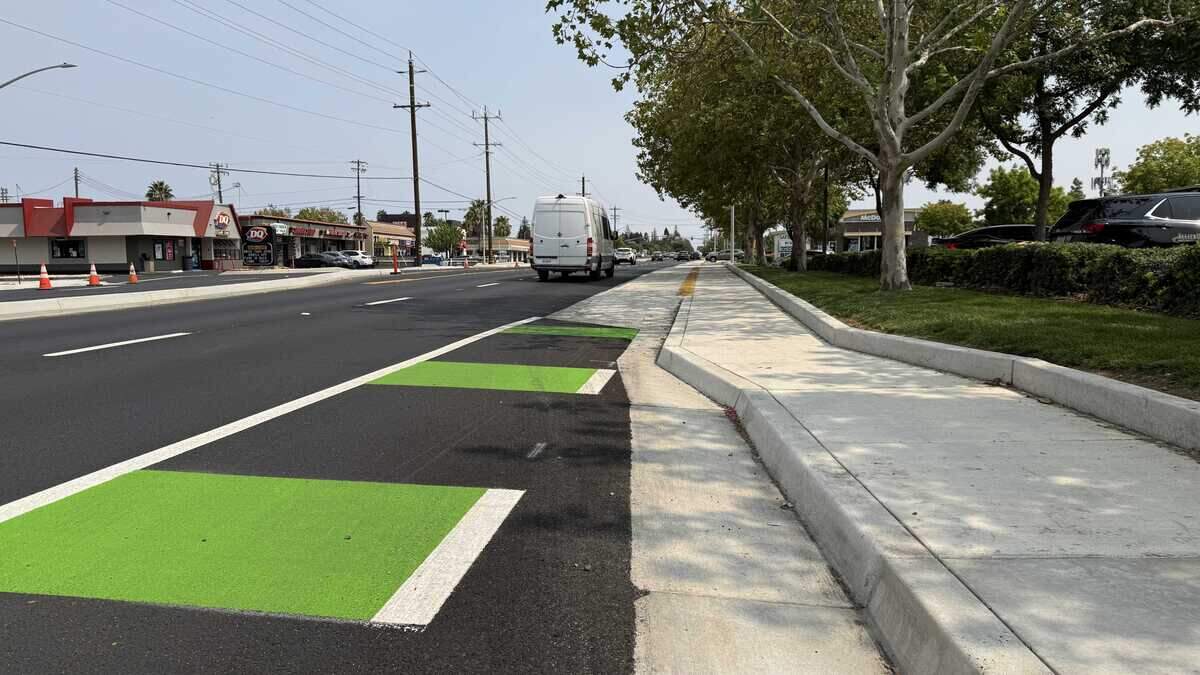
Many of the changes made to a half-mile section of Arden Way in Arden Arcade are new to unincorporated Sacramento County and, depending on feedback, could be an indication of what improvements are made in the future, according to the county’s chief civil engineer.
Read more New Elk Grove program to offer first-time homebuyers up to $60,000 for down payment
Class IV bike lanes — which use physical separations like concrete barriers — raised to sidewalk level, a flashing yellow phase for the traffic light at Professional Drive and raised bumps — known as trapezoidal delineators — between the bike lanes and pedestrian pathways are some of the new features installed on Arden Way between Morse and Watt avenues.
The additions are part of Phase 1 of the Arden Way Complete Street project, for which substantive construction finished last month, said Stephen White, chief civil engineer for the Sacramento County Department of Transportation. The $7.4 million phase also included rehabilitating the deteriorating pavement and adding landscaping and ADA-compliant ramps.
Contractor McGuire and Hester began construction about 18 months ago, but the project began in spring 2021, when the county started developing a master plan for the roadway from Ethan Way to Watt Avenue. The project was approved by the Sacramento County Board of Supervisors in 2023.
The county will celebrate the completion of Phase 1 with a ribbon-cutting ceremony at 9 a.m. Friday at the Safeway parking lot at 3320 Arden Way.
Cyclist and pedestrian safety
The goal of the Arden Way project is to increase safety for all modes of transportation, but particularly for cyclists and pedestrians, White said. The county collaborated with the Sacramento County Bicycle Advisory Committee and Disability Advisory Commission to develop some of the ideas, including expanding portions of the sidewalk to include bike lanes in both directions of travel.
So far, White said, the county has received positive feedback on the changes.
“That Class IV (bike lane) being separated vertically from the roadway is a unique feature on this project,” White said. “Assuming it’s well received, we’ll be looking to incorporate that on the next phase and possibly on other future projects.”
Class II bike lanes — which are on-street lanes indicated by paint and signage — have been part of county road design standards for about 30 years, White said. If the new bike lane continues to see positive results, White said he could see the county adding the Class IV design to its standards.
Read more How to collect your share of $250 million Apple iPhone settlement. What to know
“If we get it into the standards, then it’s not a pilot anymore. Then it’s in the toolbox as something that we can use on a regular basis,” White said, adding that it will likely be about six months to a year before the county will evaluate whether to apply this change and others to future projects.
The flashing yellow phase at the traffic signal is also meant to help with traffic flow and reduce emissions by decreasing wait times at the light. The delineators between the bike lane and sidewalk will help keep cyclists and pedestrians separated. New raised landscaped medians, which were installed in some previous turn lanes that did not directly lead to driveways, contribute to road aesthetics.
Pavement rehabilitation was also a big part of the project, White said. As of 2019, Sacramento County’s average Pavement Condition Index — the standard used to determine road conditions — was 50 out of 100. Arden Way likely would have fallen into that average range.
“Pavement continues to be one of our biggest challenges here at the county,” White said. “The deteriorated pavement out there was at some point going to become a pretty serious issue for us. So, doing the pavement rehabilitation was also very important.”
The second phase of the Arden Way Complete Streets project, which is between Morse Avenue and Hesket Way, has received funding for the design and has some local funds set aside for construction. The county is still seeking state and local grants for the construction, which is expected to begin in spring 2028. The phase is expected to cost about $8.9 million.
Phase 2 of the project will also bury some utilities underground, making it a little more ambitious than Phase 1, White said.
Read more Nearly 70% of California is ‘abnormally dry’ as drought, El Niño strengthens