 By admin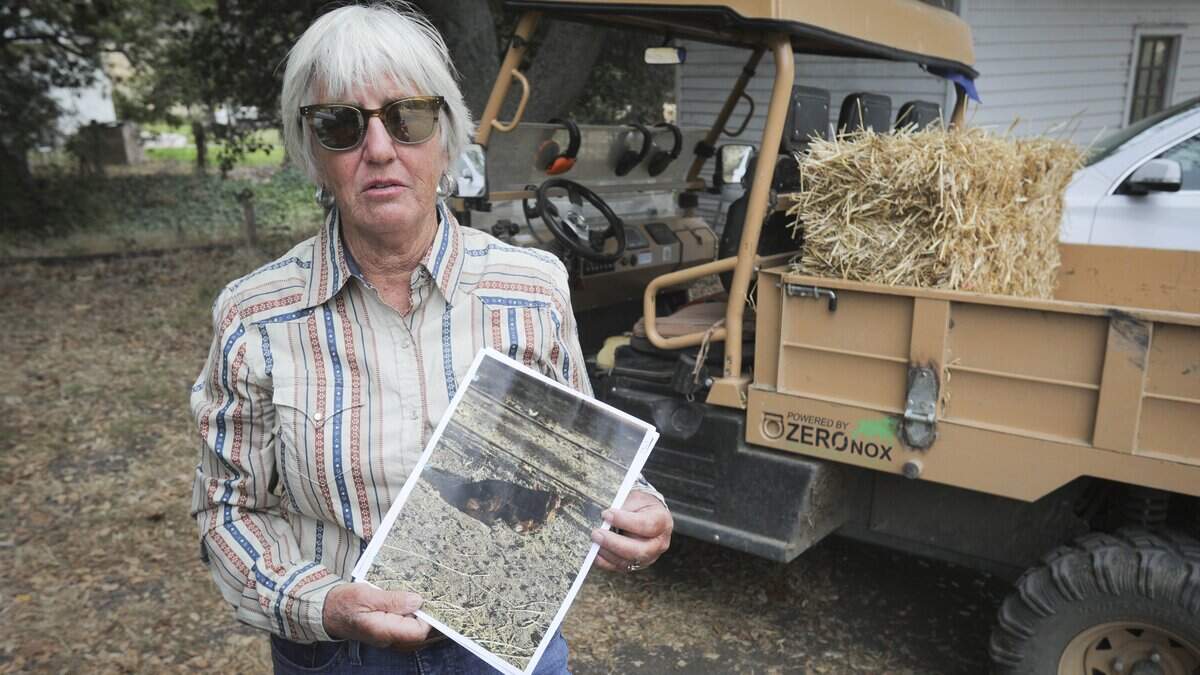
In September 2025, San Luis Obispo cattle rancher Pat Abel heard a high-pitched moo ring out as one of her Angus cows cried for her missing 3-day-old newborn.
Read more Gov. Gavin Newsom signs California bill to include men in suicide prevention efforts
Abel had been tending to the healthy calf the night before, so she was alarmed that the baby was no longer beside its mother. Her mind raced to the three bears she had witnessed hours before playing in the creek on her property and tearing down avocado tree limbs.
She went in search for the missing calf — one of around 200 cattle she raises on the 4,500-acre Reservoir Canyon property just north of San Luis Obispo.
But all that Abel found was the calf’s rib bone and a small piece of its flesh next to a mound of bear scat.
“It was just by chance that I came across the bone,” she told The Tribune. “There was so little, and it was a smell like a butcher shop.”
Later, a biologist from the California Department of Fish and Wildlife came out to the property and confirmed it was bear poop beside the calf’s remnants.
Abel never used to see bears on the ranch a decade ago, but now the animals make weekly appearances on her game cameras, she said as she scrolled through dozens of bear photos saved on her phone.
She blamed the bears for $26,000 in lost product in 2025. In the future, she fears it could be even more.
“When you’re trying to make a living, you know … you want to make improvements and everything. And I think, well, that was my profit,” Abel said.
And she’s not the only cattle rancher in the county losing livestock to bears.
Daniel Willems, who manages cattle at Grieb Ranch in Arroyo Grande, said that over the course of four days in 2025, he lost $40,000 in baby cows after black bears snatched up eight calves. Two years before that, five of his calves were eaten, he said.
Beyond calves being killed, Willems said the bears have wrecked water troughs and broken into grain sacks in the barn.
“Last 10 years, we’ve had a lot of problems,” Willems said.
SLO County agriculture industry struggles with ‘growing’ bear population
Bears are also becoming a notable presence across the Hearst Corp.’s 83,000 acres in San Simeon.
The land surrounding Hearst Castle is more than just a cattle ranch. It’s a wildlife habitat, Ben Higgins, the corporation’s director of agricultural operations, told The Tribune.
It used to be fairly rare to spot a bear roaming around the property, but nowadays, it’s “practically commonplace,” Higgins said.
He said the animals have become bolder too — damaging equipment, vehicles and cabins across the ranch. While he couldn’t provide an exact dollar amount of the losses, he said it’s definitely in the thousands.
Still, he said the bears are more of a nuisance than a major issue.
“We’re pretty well attuned to these kinds of conflicts with wildlife, but nonetheless … it’s more evidence that the population of bears is growing in the region,” Higgins told The Tribune.
A decade ago, avocado farmer Craig Righetti said it would be rare to find a bear track on the Righetti Ranch’s 275 acres in Edna Valley, but now he sees signs of the population practically every day.
“They’ve discovered avocados are kind of a delicacy,” he said, with the animals often climbing trees and breaking branches to get to ripe fruit hanging on the limbs.
According to the California Department of Fish and Wildlife, the “opportunistic” omnivores consume both plant and animal matter and “will eat nearly anything edible.”
Righetti said there’s “no shortage” of black bears in the county, and he’s even started to worry that his four grandkids who live on the ranch could be in danger if they ever wind up between a mother and her cubs.
But for now, he’s continuing business as usual, just with slightly fewer avocados to sell.
“It’s kind of a concern,” Righetti said. “But for the most part they’re just scrounging around trying to get by.”
Other farmers, like Ryan Talley at Talley Farms in Arroyo Grande, said bears haven’t caused any problems at their agricultural operations.
Talley said one bear occasionally climbs over the fence to get its paws on their avocados, but otherwise, the omnivores haven’t caused the farm any trouble.
Is the black bear population growing in SLO County?
In 2010, the California Department of Fish and Wildlife estimated that 1,067 bears lived in San Luis Obispo County.
But five years after that, a landmark genetic study commissioned by the department determined that only 101 black bears resided in the area, according to a 2017 Tribune article. At the time, Fish and Wildlife’s black bear program coordinator said the study was not an authoritative count of the population since the department was denied access to a large portion of land in the county.
Krysten Kellum, an information officer at the California Department of Fish and Wildlife, told The Tribune that there is no current estimate for how many black bears roam around SLO County.
Statewide, the population remains stable at around 49,000 to 71,000 bears, according to the department’s website. About 50% of California’s black bears live along the North Coast and Cascade regions of the state, while another 40% live in and around the Sierra Nevada mountain range.
The Central Coast has a “much lower” density of black bears in comparison, the department said.
Even though the department hasn’t explicitly studied the black bear population in San Luis Obispo County recently, there has been an uptick in bear activity at the Lopez Lake Recreation Area, with more people encountering the animals, resulting in stolen food, trashed campsites and even brushes with cubs and mother bears, The Tribune previously reported.
In response, the county recently approved nearly $1.3 million to go toward more bear mitigation measures at the Lopez Lake campsites.
Read more Where does California stand in the vote-by-mail legal saga now? Here’s what to know
Kellum said black bears have not historically been prevalent in the area, but more development and road infrastructure may be fragmenting their habitat and forcing them to move more.
“Bears are losing their fear of humans,” Kellum said. “They’re learning that there’s easy food sources in the area.”
She said the most effective way to minimize bear activity is get rid of any attractants, such as easy-to-access food.
She advised ranchers to secure their livestock, either by bringing calves in at night or putting them in enclosures that bears can’t get into.
“There’s a whole world of resources to keep bears from accessing food sources,” she said, such as installing electric fences, employing guard dogs or using paintball guns on encroaching bears.
Willems wishes he could legally hunt problem bears to control the population on his property, calling it “a reasonable thing” to put in place.
In the meantime for this calving season, he’s spending more money to put baby cows in a smaller, more protective pasture. That way, it’s easier keep an eye on them and monitor their movements.
It comes with a steeper price tag for feed, but he’s willing to pay if it means fewer deaths this year, Willems told The Tribune.
Kellum said the additional efforts are also extremely beneficial to the bears — helping them avoid humans and stay in their natural environment.
“We need to keep bears wild,” she said.
Should SLO County have a bear hunting season?
Other locals in the agricultural industry also think that the county should legalize bear hunting — not only to protect their product but to create a safer work environment.
A month after her calf was killed last year, Abel got caught between a month-old cow and a black bear on the hunt. She was alone and too far away from her vehicle to make an escape.
“The calf was able to run past me, then the bear realized I was a stationary meal ticket, and so started running towards me,” she told The Tribune. “And at that point, I realized that I could be mauled.”
Manned only with a cattle flag, Abel decided to charge the bear and stick out the flag as if she was jousting with the animal.
Her authoritative position scared the bear enough for it to change direction and climb into a nearby sycamore tree. But that’s when Abel also saw a cub following behind, taking its mother’s cue to climb another close-by tree.
Abel quickly moved all of her cows with calves down the road, so they wouldn’t fall prey to the bears. As she herded the cattle, her adrenaline was spiking.
“I thought all that would be left if I was mauled was going to be my cell phone and my watch, and nobody knew where I was,” she said.
After that experience, she had no doubt that the bears were actively feeding on her livestock.
Abel attempted to get a depredation permit to kill the bear who ate her calf. The California Department of Wildlife tried trapping and hazing techniques, but Abel said they were unsuccessful.
She’s now fighting for San Luis Obispo County to legalize a bear hunting season.
“I don’t think (people) realize that we really have a thriving bear population,” Abel said. “We’re going to start seeing these bears more and more in town if we’re not able to somehow manage that bear population.”
Seventeen years ago, the state Department of Fish and Wildlife proposed expanding black bear hunting into SLO County.
The Fish and Game Commission later postponed the decision after the expansion drew controversy from wildlife advocates in April 2009, Mustang News reported.
In roughly half the state, licensed hunters with bear tags can bag up to two black bears during the general season, which extends from Oct. 10 to Dec. 27, or until 1,700 bears have been taken. Cubs and females cannot be hunted. In 2025, 1,216 bears were harvested in California, according to Fish and Wildlife data.
The path to legalizing bear hunting in SLO County requires a multi-step process, Kellum said.
First, a petition must be submitted to the California Fish and Game Commission, and then there would have to be enough evidence showing the population could be sustained with a hunting season. That would involve a study and evaluation by the Fish and Wildlife.
Once the research and review is complete, the commission would then decide whether to legalize bear hunting in the county.
“We don’t have a hunting season in SLO County because we don’t know the size of the population,” Kellum said.
Higgins and Righetti also supported having a legal method to control the bear population themselves.
“I think they ought to have a bear season to harvest the surplus,” Righetti said, but admitted “to make something like that happen in this day and age might be difficult.”
This story was originally published August 30, 2026 at 5:00 AM with the headline “SLO County ranchers are losing livestock to bears. Now some want a hunting season.”
Read more Without key players, Central East rolls in revenge victory over Grant-Sacramento