 By admin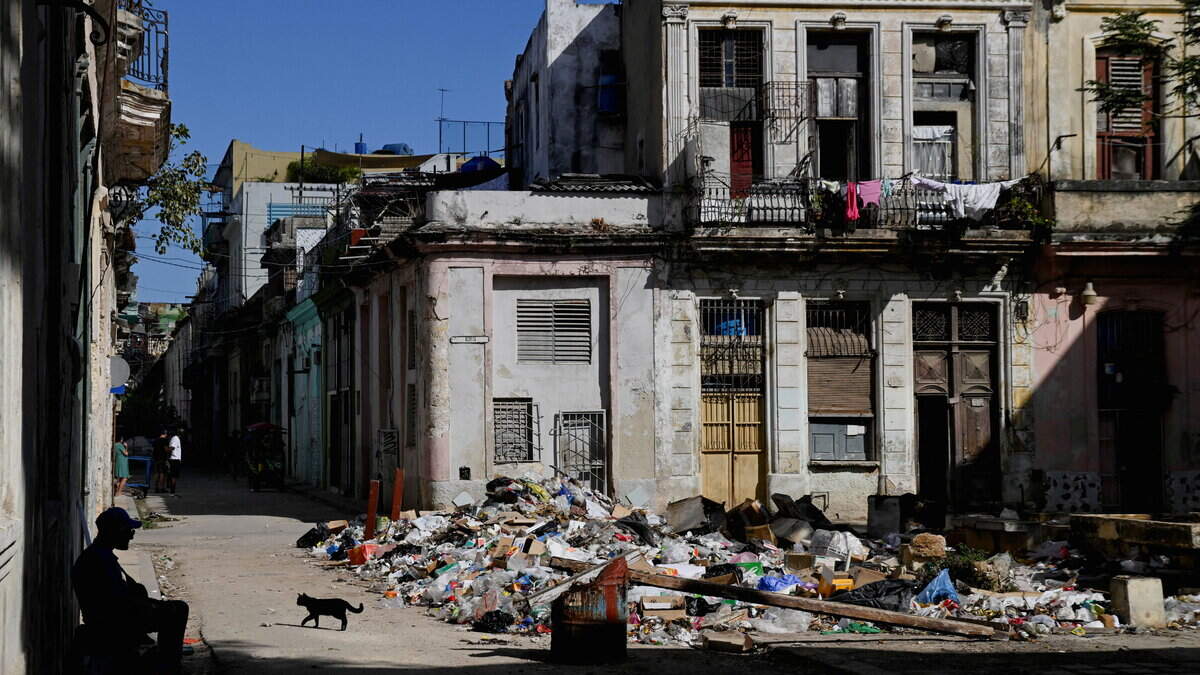
As Cuba’s hot summer nears its end with no sign of regime change on the communist-run island, Cubans continue to suffer miserable living conditions as the country’s humanitarian crisis gets disturbingly worse.
Read more A serious cooldown to end summer — how low will temps slide across California?
Several years into a deep recession, the near-collapse of the country’s entire infrastructure has upended Cubans’ daily lives, directly affecting their physical and mental health.
“The situation is critical,” said a Cuban doctor speaking anonymously to the Miami Herald, fearing retaliation if identified. The physician runs a social media account critical of the communist government. “We spend entire nights without electricity, making it impossible to sleep—an exhausting ordeal for both doctors and patients alike. I have a young child, and my partner and I try to survive on a state salary; consequently, we devote almost everything to ensuring our child gets decent food.”
Most of the time the couple has to borrow money from friends or sell some of their belongings to make ends meet. Doctors in Cuba make about 8,500 pesos a month — the equivalent of $12.50 — not enough to be able to afford even a carton of eggs, at 6,000 pesos or a bottle of cooking oil, 5,000 pesos.
Conditions on the island, the doctor said, “have led to a rise in stress, hunger, anemia and the worsening of chronic conditions.” As temperatures climb into the high 80s and above, he said, there is no water or electricity. “You tell me if that isn’t hell.”
None of this is new in Cuba. The island’s crisis is structural, largely the result of decisions made by Cuban leaders themselves, most notably their reluctance to abandon a centrally planned economic model that has failed everywhere else in the world. In recent years, the government has spent the country’s resources building hotels, to the detriment of everything else. But a new round of U.S. sanctions and a de facto oil blockade imposed by the Trump administration this year have come to intensify what experts already considered the worst humanitarian crisis on the island in recent history.
After becoming a daily fixture in the 1990s, blackouts have worsened since 2024, when Cuba’s ancient power grid began to collapse and Soviet-era electrical stations began failing more frequently.
Then the Trump administration effectively cut oil supplies to the Cuban government from Venezuela and Mexico as part of a pressure campaign to push for economic and political changes. But Cuban leaders have shown no intention of leaving power, and electricity cuts now last for days at a time.
Images on social media show Cubans, including children, sleeping on cots on sidewalks, streets and rooftops to escape the heat during evening blackouts. In Havana, scheduled blackouts can last 20 hours, followed by a few hours of electricity before the lights go out again. Outside the capital, the blackouts may last 48 hours or more before the power returns for another couple of hours.
“Now they cut off the power at 6 in the morning, and you don’t know when it’s coming back,” said Iván García, an independent journalist in Havana who writes for the Miami-based Diario las Américas. “It might come back at 10 the next morning, or sometime in the middle of the night.”
When the power returns, he said, Cubans rush to cook, wash, fill water tanks, charge devices and do other chores that need electricity. The power outages also make it more difficult to store food, García added, forcing people to buy food for the day.
The crisis hits harder for those without family abroad who can send them money, food or medicines to make their lives more tolerable. Even so, food and goods have become increasingly expensive, he said, driven by the fuel shortages, government restrictions and limited supply.
Rampaging inflation
Official government statistics reported a 20.7% annual inflation increase in July compared to July 2025. However, an Inflation Dashboard run by Johns Hopkins University professor Steve Hanke estimates Cuba’s inflation really surged by 72% year over year in July.
“You go one week and buy chicken—all imported from the United States, by the way—and it costs you 6,700 pesos. Now it’s at 7,500 or 8,000 pesos,” García said. “In other words, prices go up by 1,000 pesos from one day to the next.”
Gasoline prices peaked at $10 per liter, and even though they have come down a bit, fuel remains out of reach for most Cubans. With public transport almost paralyzed, a round trip between the Havana neighborhoods of La Víbora and El Vedado in one of the few taxis still moving in Havana can cost 2000 pesos — $3 — or more. The minimum monthly salary for a state worker in Cuba is 3,210 pesos, currently less than $5 in the informal dollar exchange market.
Relatives abroad are sending solar panels and portable power stations to their relatives on the island. EcoFlow power stations have become a hot commodity, according to social media groups, but they sell for $1,000 or more, making them unaffordable for most people on the island.
Even with money, it is hard to find food, García said, as the private sector is also taking a hit. Restaurants and private grocery stores are struggling to stay open because of higher supply costs and lower consumption. In recent days, a renewed government effort to cap prices and fine businesses that fail to comply with onerous regulations has forced several businesses to close, according to the Cuban independent news outlet 14ymedio.
The energy crisis has also made it difficult to cook and has driven up the price of charcoal. A can of charcoal costs 1,000 pesos.
“Each day is more miserable than the last,” the doctor told the Herald. “We’ve been through it all: from using a child’s cologne to heat food to cooking with Styrofoam or charcoal, when we can get it. I can’t get a haircut because they charge too much.”
Collapsed healthcare
The doctor also painted a daunting portrait of the current state of public health services in Cuba.
“Patients requiring daily medication for chronic illnesses—such as hypertension, diabetes, and heart disease—lack continuous access to treatment. This has caused a surge in emergency room visits for heart attacks and strokes,” the doctor said. “Emergency rooms have essentially become places where we simply explain a patient’s condition and tell them what they might try to find on the black market.”
Local clinics lack the most basic medications, like fever-reducing drugs and analgesics. “There is no hydrocortisone for asthmatics and no medication for gastritis,” the physician told the Herald. In a recent interview, the country’s leader, Miguel Díaz-Canel, acknowledged that the government is producing or acquiring abroad only 30% of the basic medications offered in state pharmacies.
“The situation in maternity homes is critical,” the doctor added. “Expectant mothers do not receive the vitamins necessary for healthy fetal development. Pregnant women are admitted for anemia, vaginal infections, or low weight. Yet they receive neither proper treatment nor adequate nutrition—often being fed nothing but water used to boil peas and plantains. Day centers for the elderly are rife with scabies and anemia; the seniors are emaciated, malnourished, and unclean. Children in hospitals are suffering too.”
Read more Jenny Rodriquez finds the ‘win-win’ for Sacramento small businesses, professionals
Images coming from social media show the crisis touches almost every aspect of life in Cuba.
Hospitals, cemeteries and zoos are all in a similar state of disrepair. The government still has not come up with a solution to the mountainous piles of rotting garbage that accumulate on the streets for months.
A Cuban journalist exiled in Mexico, Jose Luis Tan Estrada, has shared images online of an extremely undernourished older man lying naked on a gurney in a state-run senior home in Camagüey, a province in central Cuba, and a patient in a similar condition in one of the province’s hospitals. Video footage he shared also shows a man eating food leftovers from street garbage.
Another social media video recorded in May in El Vedado, a central neighborhood in Havana, shows what the person shooting the video said was the covered dead body of a man lying on the sidewalk. The man had died waiting for the ambulance to arrive, according to witnesses, in an incident covered by Cuba news outlet Cibercuba.
No water service
The lack of fuel has also worsened the water crisis. Aguas de La Habana, the state utilities company in the capital, issues daily updates to clients on service interruptions caused by electricity cuts or burst pipes.
Water has become so scarce that fights break out between neighbors when a water truck arrives, and protests over the lack of water have become common. On Wednesday, a group of women in Havana blocked a street with buckets and tires in protest after several hours without water, according to a video shared by Silverio Portal, a former political prisoner and activist who lives in the capital.
Videos of Cubans exploding in anger and ranting against the government have become frequent despite the severe penalties Cuban law imposes to those who criticize the authorities. A study published this month on the journal Social Science & Medicine found that “prolonged power outages in Cuba are linked to severe depression, anxiety, and stress.”
Increasingly, Cubans question why they have to endure living as if they were in the Middle Ages.
“This is a complete abuse; I have been without water for over five months—as have 300 other people in my community,” a woman denounced in a video shared by Alas Tensas, a non-government group focused on women’s rights. “What Cubans are going through is beyond words. Here we are in 2026, and my children are bathing in a river because there is no water. In 2026, we have to wait for rain to fill up a few containers with water for washing dishes.
“You can’t even live like a human being,” she added.
Growing discontent and resignation
The situation is so bad that economists are speaking of a “spiral of economic destruction” and are calling for a declaration of state of emergency. A group of Cuban economists who released a reform plan to transition Cuba to a market economy said a 176-measure government reform package lacks urgency and a solution to the country’s many problems.
Meanwhile, Cuban leaders blame the United States for it all.
In a feisty recent interview, Díaz-Canel said the root of the country’s problems was not the island’s socialist economic model but U.S. sanctions. He offered one solution: “We have to resist.”
García said frustration with the government is growing.
“The discontent has been increasing because every time the government enacts a measure, the dollar rises—the effect is the opposite,” García noted. “It’s all absurd, and people see the improvisation, the poor administration, and the mismanagement of basic services. It’s not an issue of ideology, nor is it a matter of left versus right. The problem is that nothing works.”
Still, he said street protests are happening less frequently because of government repression.
“There were a great many protests in Havana between December and this year, but they have died down because people feel frustrated and exhausted,” García said. “At the time, you protest, and a water truck shows up, and the power comes back on for three hours—but then, generally, state security arrives, and they tend to exact reprisals.
“I don’t think anyone ever gets used to destitution, but there is a sort of resignation among the people,” he added. “It’s like knowing you’re about to face a firing squad and saying, ‘Well, there’s nothing left for me to do.’”
While dissidents and activists he has talked to reject the idea of a U.S. military strike or losing Cuba’s sovereignty, García said that the capture of leader Nicolás Maduro in Venezuela, President Donald Trump’s frequent comments about communism ending on the island, and the negotiations that followed between the U.S. and members of the Castro family raised expectations among many Cubans that they would see the downfall of the communist regime this year.
So Secretary of State Marco Rubio’s recent comments about envisioning changes on the island happening in the next two and a half years “hit like a bucket of cold water,” García said. “Now the harsh reality has set in: we have to solve our problems here ourselves.”
As the crisis drags on, many Cubans are also trying to leave the country. Some are starting small private businesses solely to afford the tickets to leave.
The Cuban doctor who spoke to the Herald says it’s difficult to save enough to emigrate while living on a state salary, and still holds hope that the United States will help Cuba to be free. “But if the dictatorship does not fall this year, I need to figure out a life change.
“You’d have to live here to truly understand the situation,” the person added. “But this is a slow death.”
This story was originally published August 31, 2026 at 2:30 AM with the headline “‘Slow death’: No end in sight as exhausted Cubans endure country’s near collapse.”
Read more A serious cooldown to end summer — how low will temps slide across California?