 By admin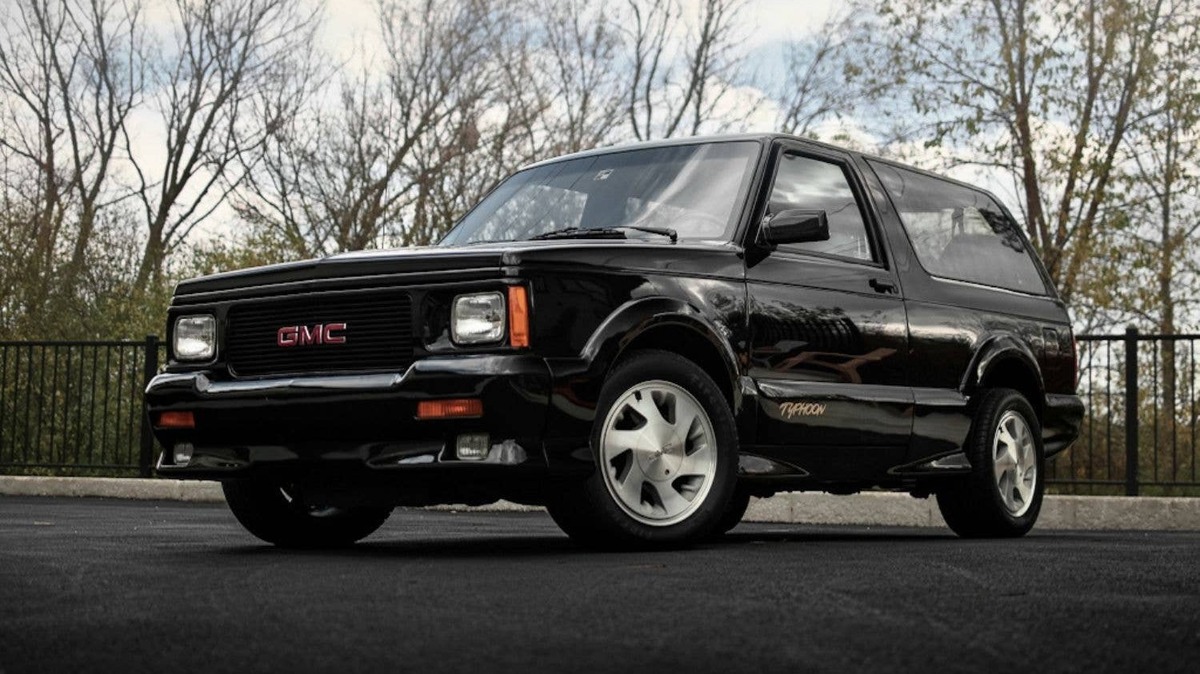
When a Niche Becomes the Norm
One could say that the performance SUV genre really gained legs in the early-2000s. There was a whole slew of go-fast high-riders, namely the BMW X5 4.6is, Mercedes-Benz ML55 AMG, and the Porsche Cayenne. As the years progressed, even more automakers got in on the act, and these days, nearly every luxury automaker has a crossover or SUV that can hit 60 mph in 4.5 seconds or less. Such is the world we live in these days.
Read more 1968 Chevrolet Chevelle SS 396 For Sale With 2,000 Miles on the Build
But wind back the clock nearly 35 years ago, there was one special SUV that got the ball rolling in many ways. It wasn’t from Europe, but in fact from America. Gen-Xers and older millennials probably already know the answer to this, and if you missed the headline, it was none other than the GMC Typhoon.
How it Started
In 1991, GMC took the truck market by storm when it rolled out the Syclone. Based on the Sonoma, it was made to defy convention and take an out-of-the-box approach in building a performance pickup. Instead of a big-block V8, it took the same approach as the Turbo Trans Am, replacing displacement by boosting a 4.3-liter LB4 V6 engine. It then got a unique permanent all-wheel drive system and suspension goodies.
GMC then reckoned the formula it applied for the Syclone would apply for its S-15 Jimmy SUV. See, the Syclone wasn’t a sales triumph, but it was a successful proof of concept: Truck-based vehicles can have sports car-baiting performance. The subsequent hot-rodded S-15 Jimmy was then called the Typhoon, and GMC hoped its more practical and family-friendly body would see more customers.
The Right Stuff
Like the Syclone before it, the Typhoon was a co-developed project with GM and Production Automotive Services, or PAS. PAS was also credited with the building and development work for the aforementioned Pontiac Turbo Trans Am, so the project was in pretty good hands.
The Typhoon also used a 4.3-liter LB4 V6 as a starting basis, but 160 hp simply wasn’t going to cut it. The GMC Typhoon engine (among other things) was massaged by PAS, slapping on a Mitsubishi TD06 turbocharger with 14 psi of boost, a Garrett Water/Air intercooler, and some goodies from the small-block 350 V8. The part-time four-wheel drive system for off-roading was chucked out, and an all-wheel drive system with 35:65 power split (more rear bias) was put in place.
Never intended as an off-roader, the suspension was lowered and got a beefier arrangement to make it go through corners, not barrel through them. The Typhoon then benefitted from a rear air-suspension arrangement, although the live axle remained. Bigger brakes were also applied, along with a limited-slip diff at the back.
Read more Breaking: Rogers Fire reported in Butte County on Sep. 13
Shock and Awe
GMC Typhoon specs? Well, the result of the engine tuning was 280 hp and 360 lb-ft of torque. It was 120 horses and 130 lb-ft more than the standard 4.3 TBI V6, and 80 hp and 100 lb-ft punchier than the upgraded CPI Vortec V6. It doesn’t sound like much today, but the Typhoon weighed around 3,822 lbs, which was pretty lean for an SUV even by early-’90s standards.
Combined with the traction advantage of the all-wheel drive system, the Typhoon laid down hugely impressive numbers in instrumented testing. The GMC Typhoon 0-60 times were clocked at 5.3 seconds by Car and Driver. The publication also got a 0 to 100 time of 16.2 seconds, 0 to 120 in 40 seconds, and did the quarter-mile in 14.1 at 95 mph. Even the skidpad rating of 0.79 was praiseworthy, especially considering the standard model could barely hold 0.70g.
It was, indeed, shock and awe, and it was easily the fastest SUV of its time. To put things into perspective, not only could it out-drag contemporary Mustangs and Camaros, but it could also reach 60 faster than a Ferrari 348ts, an E34 BMW M5, and a Porsche 968. Put that in modern context, and that’s the equivalent of a GMC Acadia showing its tail lights to a Ferrari 296, a modern G90 M5, and a Panamera. Other cars it could keep pace with include the original Acura NSX, Chevrolet Corvette LT1, and Nissan 300ZX Turbo. At $29,530, it was much cheaper than the sports cars it could threaten.
Lasting Legacy
Here’s the thing about the Typhoon today: its numbers still hold up. While many are spoiled by instant power delivered from EVs and performance hybrids, the 34-year-old Typhoon can still go toe-to-toe with modern hot hatches and sport sedans. 5.2 seconds to 60 mph is still quick by today’s standards, and it must’ve been eye-bogglingly quick in 1992.
Despite the strong performance, the Typhoon didn’t find a whole lot of buyers with just 4,697 built. At least it was slightly more successful than the Syclone, which only saw 2,998 owners. But while it didn’t win in sales, it won the hearts of many by simply being an insane concept that reached production. Like it or not, it slowly opened up the idea of hot SUVs such as the Saleen XP8, Jeep Grand Cherokee 5.9 Limited, and Mercedes-Benz ML55 AMG.
Super SUVs are now everywhere these days. Even Ferrari and Lamborghini have jumped into the genre, something unimaginable about 30 years ago. Whether you like it or not, the Typhoon kicked off an SUV class that can be called pointless, but everyone will have to admit that GMC’s rocket was a great way to get it started despite the lack of sales success. Now that there’s a new Jimmy on the cards, here’s to hoping a Typhoon-like model stages a comeback.
Read more Man dies after south Sacramento stabbing Saturday night, sheriff says
Copyright 2026 The Arena Group, Inc. All Rights Reserved.
This story was originally published September 13, 2026 at 1:00 PM.