 By admin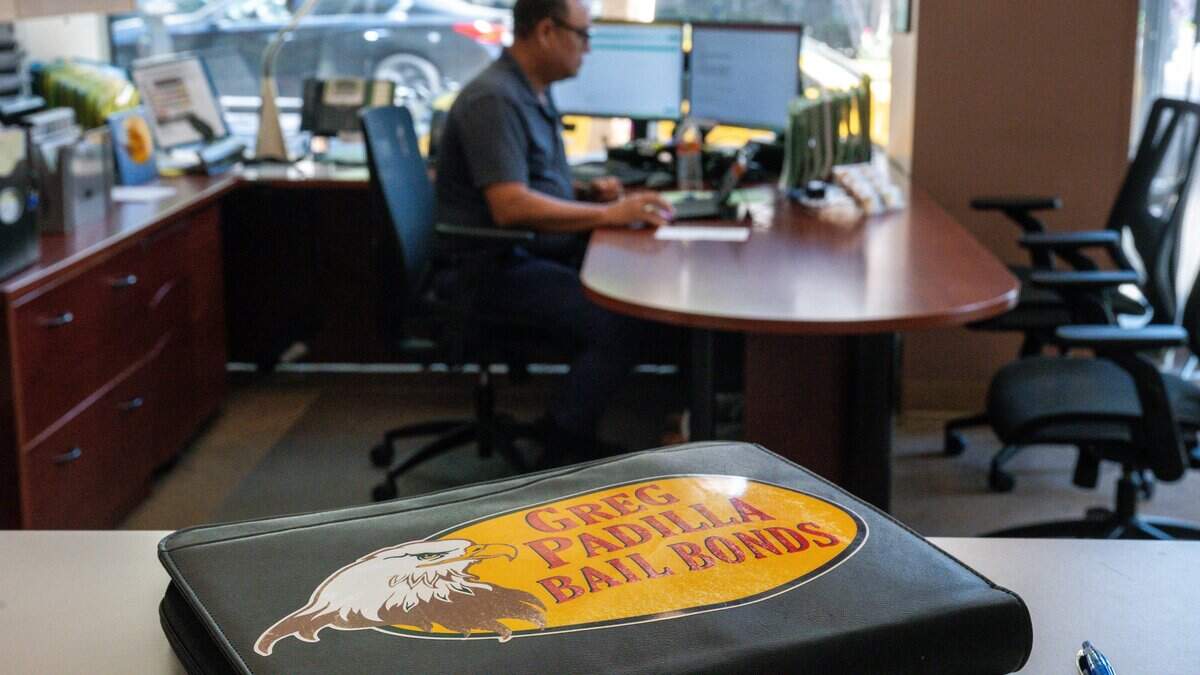
If you visit the Sacramento County courthouse, chances are you will see at least one member of the Padilla family in a freshly-pressed suit, watching arraignment court.
Read more The California Supreme Court said it eliminated unaffordable money bail. Did it?
The Padilla family — through their company, Greg Padilla Bail Bonds — have been selling bail bonds for 40 years. It’s a legacy that might come to a screeching halt in light of a new California Supreme Court decision that mandates judges set bail at an amount that is “reasonably attainable” for defendants.
“As a young kid and teenager, I watched my parents in this business because they used to let us come around and hang out at the office. I watched them help people that were in a very difficult time,” said Topo Padilla. “The fact that they had somebody incarcerated or the incarcerated person was reaching out for help. And I watched my parents set aside judgment of who these people were and just look at the fact that they were in jail; they had a constitutional right to bail out of jail.”
Padilla said a recent California Supreme Court decision could be “the beginning of the end,” for the bail bonds industry.
Defendants who are accused of crimes in the state of California have two options. They could pay the posted bail amount for their charge, wait for it to settle and be refunded. Or they can contract with a private bail bondsman to pay a set premium, typically 10% of the total bail amount, and then pay the rest off in installments.
The commercial bail industry’s business model relies almost entirely on collecting these non-refundable 7% to 10% premiums from their clients, who are often family members or partners of people facing charges.
The payment plan model that has been carrying California’s multi-million-dollar bail industry may collapse as a result of a recent state Supreme Court decision.
In April, courts re-reviewed Gerald Kowalczyk’s arraignment for petty theft, where he was given a $75,000 bail amount for buying a hamburger with a stranger’s credit card. The court ruled that assigning an egregiously high bail, despite a defendant’s income declaration, was just a way of detaining them.
The Kowalczyk decision reset the status quo for money bail, ruling that judges must consider other non-monetary alternatives before assigning bail. And if bail is necessary to ensure a return to court, the amount must be attainable and based on an assessment of the defendant’s financial circumstances.
Making money bail ‘obsolete’
According to the Public Policy Institute of California, 79% of the state’s jail population are unsentenced often sitting in detention for months waiting for the court to hear their case or for their attorney to argue their detention is financially discriminatory through a writ.
Organizations like the San Francisco Public Defender’s Office have hailed the ruling as a much-needed shift in court culture and noted that similar shifts in other states have prevented the criminalization of poverty.
Danica Rodmarel, an attorney who has litigated against bail bond corporations in the past, said the decision portends a difficult future for the industry.
“They would become obsolete. If you can’t set bail at an amount somebody cannot pay. There’s no need for a bond,” she said.
Rodarmel worked on a lawsuit against Sacramento-based bail bond corporation Bad Boys Bail Bonds, which was found to have excluded a key consumer protection agreement from its contracts. The clause would have informed co-signers they are liable for their loved ones’ full bail amount, not just the initial premium. The company was barred from collecting $38 million in illegal debt from bond co-signers between 2017 and 2022.
“It’s an industry that is profiting entirely on the failings of our court system,” Rodarmel said. “I’ve heard stories of people who did have the ability to post their full bond amounts and the courts just didn’t even know how to handle that payment because they’re so used to bail bonds companies handling all of (it).”
Read more California lawmaker seeks DHS records after ICE visits law firm in Sacramento
The California Department of Insurance, which imposes regulations and consumer protection guardrails on bail bonds agents, said it “has not seen significant changes in California’s bail market following the Kowalczyk decision.”
The number of individual bail agents has slightly increased by less than 2% since the ruling in April. Three registered bail agencies have shuttered in that timeframe.
Bail bond companies frequently place liens on bond co-signers’ water, property or vehicles to finance the bond. Since the Kowalczyk ruling, the CDI has not seen an increase in complaints against bail bonds companies for unreturned collateral or failing to release liens, or complaints about an uptick in fees or latent charges
Ensuring a return to court
Bail bonds organizations have hailed money bail as the most reliable way to bring a defendant back to court after their arraignment.
“We need to give the incentive for the defendant to go to court and it’s going to have enough incentive for me as a bail bondsman to be able to say, ‘I’m going to charge this much so I can stay in business,’” said Padilla.
Salil Dudani is an attorney with the Civil Rights Corps, the nonprofit that represented Kowalczyk in the re-review of his case. He said the idea that money bail brings people back to court is largely outdated.
“People aren’t fleeing justice. In the 21st century, you’re going to get picked up,” Dudani said. “You can’t ride a horse with a fake mustache and make a new life.”
Dudani said there are inexpensive alternatives to money bail that could reduce failures to appear in court after arraignment, like an automated court reminder system. He also said that reasons for defendants missing court dates can be extraneous to their arrest, like not being able to find childcare or take time off work.
Wealth as ‘safety calculus’
Padilla said he is concerned about judges interpreting Kowalczyk in a way that leads to releasing defendants who pose a danger to the community — which he said has become “very evident in the last few weeks as I’ve been sitting in court watching the inconsistencies of judges.”
The Kowalczyk ruling said the only bail-ineligible charges are those that involve credible threats of bodily harm and capital offenses.
Dan Dow, San Luis Obispo district attorney and president of the California District Attorneys Association, said DAs are concerned about Kowalczyk narrowing judges’ ability to properly prosecute offenders.
“Although our California Constitution includes the Crime Victims’ Bill of Rights, victims’ rights are given less importance than an accused’s rights are given,” Dow said. “When bail can no longer serve as a real deterrent against violating release terms, we believe it is likely — not just possible — that more victims will be harmed in ways that could have been prevented.”
Madeline Bailey, a researcher at Vera Institute of Justice who studies the link between incarceration and homelessness, said concerns about violent offenders being released pre-trial under Kowalczyk does not account for violent offenders that bail agents sell bonds to.
“It simply does not compute that certain people who have the ability to pay their way out can bypass those sort of de facto defense detention rulings that judges are making,” she said, “Someone’s wealth is not a safety calculus.”
Read more With climate risks looming, Lake Tahoe summit marks 30 years of progress
This story was originally published August 20, 2026 at 4:30 AM.