 By admin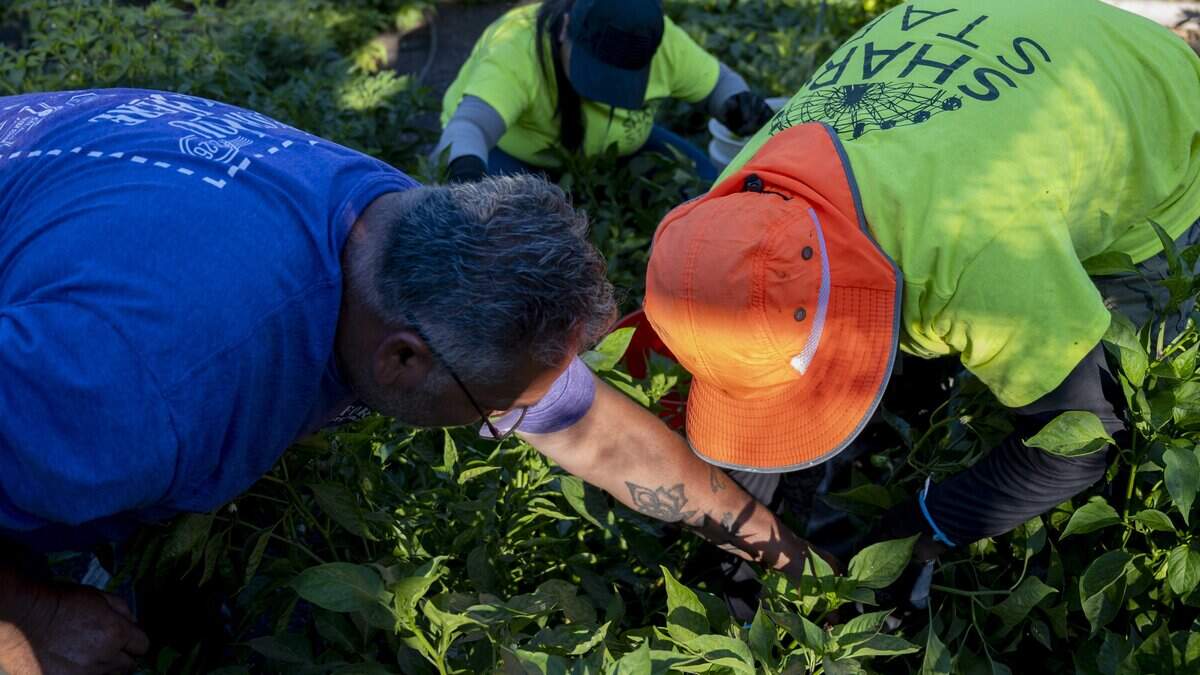
During California State Fair season, the grounds at Cal Expo in Sacramento are bustling even in the early morning.
Read more CA State Fair celebrates LGBTQ+ Pride this weekend. Here’s what’s on the schedule
Trucks drop off supplies, and staff are getting the fair ready for the crowds. The California State Fair Farm, located behind Building B, is also full of activity.
On Thursday morning, fat bees perched on black-and-blue sage flowers, and doves loudly fluttered from fruit tree to fruit tree. Amid the garden beds, Cal Expo staff were busy harvesting vegetables and melons, loading them into the back of a white pickup truck.
The harvest is destined for the Sacramento Food Bank. But not all the plants will be picked clean. “I need something on the plant for people to see,” explained farm supervisor Santos Perez. “If there’s no pepper, they can’t see it.”
There’s been a farm at Cal Expo since 1984. Though it’s only 2.5 acres, its purpose is to teach fairgoers about the size and importance of California’s agricultural industry.
“We do the majority of crops that are grown in California,” said Jaime Ramirez, the programs and competitions director for Cal Expo and the State Fair. For fruits, there’s “nectarines, plums, figs, oranges, limes, lemons, pomegranates, everything.” In the white pickup sat buckets of tomatillos, crates of green bell peppers, and enormous watermelons.
Visitors are often dazzled by the fruits and vegetables they see at the small farm, says Ramirez. They see corn growing on the tall stalks, and “surprisingly enough,” Ramirez said, “they’re shocked that they don’t know where it comes from.”
Some people even try to take the fruits and vegetables home with them, despite signs asking visitors not to pick anything. Both Ramirez and Perez want the crops to stay on the plants for as long as possible, to give fair visitors and school groups throughout a chance to see them throughout the year.
Not only that, but the farm, as small as it is, also grows a significant amount of food for the Sacramento Food Bank. According to Ramirez, they’ve harvested 3,000 pounds of food this year alone. In 2025, they grew and donated 11,000 pounds of produce.
Read more Yosemite using AI to give parking, road status, wait time updates. How it works
Not all the “shrinkage,” as Ramirez called it, is caused by humans. Over by the chicken coops, a large wild turkey pecked away at some fallen feed.
According to Cal Expo employee Jacoba Felipe, around 10 wild turkeys roam the farm when there are fewer visitors. They especially enjoy eating the green tops of the onions, the tender small peppers, and pumpkin shoots.
The farm also has a small rice paddy to demonstrate how the grain is grown. However, turkeys “come in, they feed on it, and we’ve never had the opportunity to even harvest this,” Ramirez said.
The farm, he said, is meant to “entertain people and teach them at the same time.” However, he hopes to expand the farm’s footprint and its community impact in the near future.
“We also have a greenhouse. Currently, it’s non-operational. We’re looking for sponsors to try to revitalize it,” he said. With food insecurity on the rise, “we want to establish something a little more stable” to provide a continuous supply of certain crops to food banks.
That’s not the only change on the horizon, either. In 2027, the California State Fair will take place from Sept. 17 to Oct. 3., instead of in the summer. That, Ramirez said, will change what the farm will showcase next year.
“We’re definitely going to be looking forward to fall crops,” Ramirez said. “So maybe a lot more pumpkins, a lot more squash.”
Read more ‘Sacramento is very tough’: Recently opened American-style eatery in midtown closes