 By admin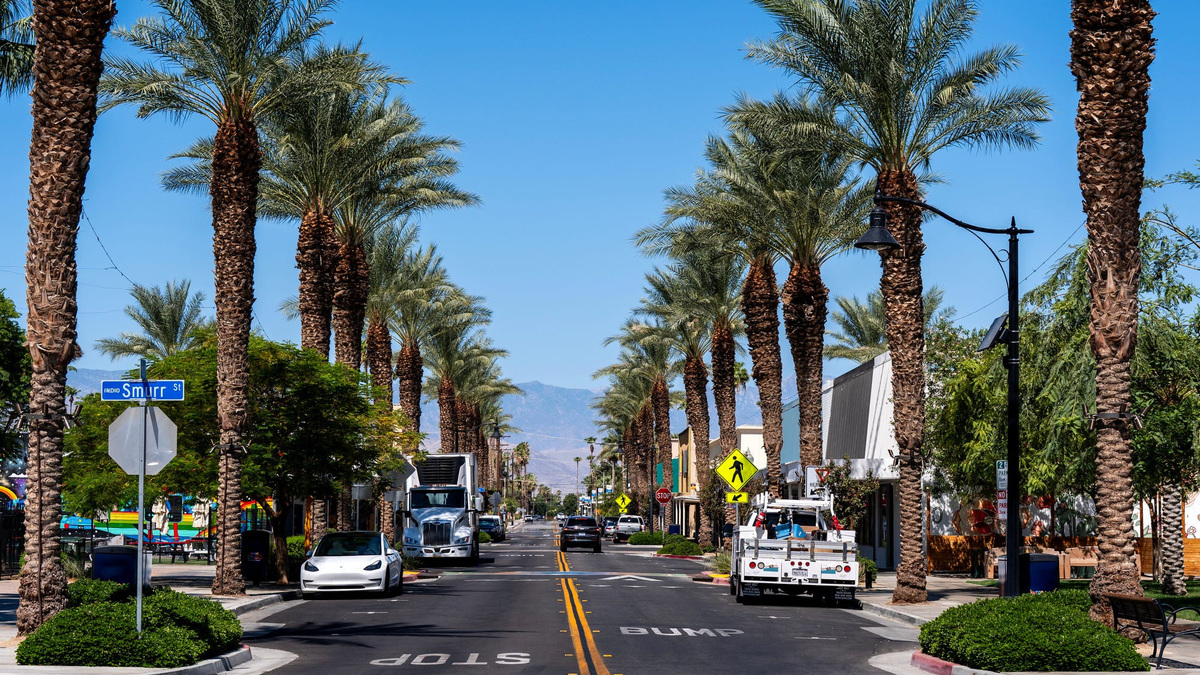
Downtown Indio is in the middle of a comeback, with new restaurants, music venues and, most notably, crowds on a Friday night where there used to be empty sidewalks.
Read more You won’t want to miss these 10 greater Palm Springs events this week
But it was a long road to get the city where it is now. Over 50 years ago, Highway 111 pulled traffic away from downtown Indio and many storefronts went empty, leaving mostly small family-owned businesses that knew customers by name.
That small business spirit perseveres today, as two local businesses in particular continue to honor the heritage of Miles Avenue. One is among Indio’s longest operating businesses. The other is a new venue paying tribute to what a family built before in the same spot.
Downtown Indio’s history is rooted in commerce
Even though new businesses have popped up all over downtown Indio in the past few years, it’s not the area’s first boom.
A recent trip to the Coachella Valley History Museum pinpointed the origins of Indio in the central-southern region of the current city limits. That’s where the city began supplying water needed for a steam engine, which could not operate without the water drawn from beneath the desert floor. The Cahuilla people had been using the wells for centuries before the arrival of the railroad in 1876. Southern Pacific drilled its own wells and utilized windmills to extract the water.
When the Southern Pacific Railroad arrived in the city of Indio, it established a southern route that ran from Texas through Yuma, Arizona, and continued past the Salton Sea, with a stop at the Indio depot before reaching Los Angeles. The rail yard, nearly a mile long and located along what is now Indio Boulevard, included machine shops, garages, and housing for workers. Cafes and a small hotel were built for overnight visitors.
Another chapter of Indio’s past is on display next door to the Coachella Valley History Museum. The Date Museum tells the story of how water supplied by the depot helped sustain gardens filled with fruit trees, bushes, roses and citrus trees. Indio was proof to travelers that the desert could support plant life. Southern Pacific began selling parcels of land that it owned, which eventually became some of the valley’s first farms known for growing dates, citrus, and other produce.
The railroad was great for the city, but like all towns that boomed during the rise of train travel, it didn’t last. Amtrak service was suspended after the station closed in 1998, according to a 2026 article by the Coachella Valley Independent, and for the next couple decades, the city’s downtown core suffered. But one business with a big yellow sign remained.
Yellow Mart stands strong on Miles Avenue
Yellow Mart opened in 1946, and in the eight decades since, the sporting goods store has passed between three families. Its two founders, World War II veterans Donald Clark and Raymond Brockman, started out selling khaki pants and jackets out of the trunk of a car, then out of an abandoned Indio card room, before eventually settling into a location on Miles Avenue.
Mark Jernigan, who runs the store now, has heard countless stories from longtime customers over the years. Regulars, he said, often bring their children into the store and he gets to tell them what their parent got into as a teenager.
Not much has changed since those regulars were teenagers – including Yellow Mart’s offerings. Jernigan described the store’s eclectic inventory, from hunting rifles to sporting goods, as “antique-ish,” adding to the time machine-like experience of walking through its doors.
“We don’t have a website, we don’t do internet sales, and we still have a working fax machine. The most modern thing we have is a Clover machine,” Jernigan said.
The Dune Room was once a pharmacy/soda fountain
A few doors down, The Dune Room, a coffee shop and music venue that opened in December 2025, occupies a storefront that was once McIntosh Pharmacy, a family-run store remembered less for prescriptions than for its soda fountain and tuna sandwiches. Sherman McIntosh purchased what was then Norman’s Pharmacy in 1946, located further up Miles Avenue near Smurr Street, before moving the business in 1964 to the space where The Dune Room sits today.
While researching the building’s past, owner Ron Mesh found old menus and photographs that gave him an idea. He designed the new music venue’s menu to echo the look of an old McIntosh menu, recreating its font and colors. Although Mesh never visited the pharmacy during its years of operation, he was able to capture its spirit by spending time researching archives and speaking with members of the McIntosh family.
The venue’s bar now sits where the soda fountain once stood, and the tuna sandwich remains on the menu, albeit served on a bagel rather than sliced bread.
According to Sherman’s son Tom McIntosh, his father sold the business in 1976.
“(McIntosh Pharmacy) was kind of a meeting place. The stories you hear about small-town drugstores and soda fountains meet that criteria,” McIntosh said. “The tuna fish sandwich was a big hit. There was a lady there by the name of Evelyn Land, and Evelyn ran the whole fountain thing. That was her purview, and there were lots of different kids through the years that worked for Evelyn … she was kind of an institution there.”
Some of the pharmacy’s original features remain intact. The original stairs are still in the building, and the office upstairs includes the small, enclosed lookout perches with two-way glass where security staff once watched the sales floor below – a feature Mesh’s own father warned him about as a kid shopping in his native New York. The mid-century modern architecture, which Mesh believes may bear the influence of Palm Springs architect Donald Wexler, has also been preserved.
“I like that the building remained the same. Nobody ripped out the overhangs, and nobody ripped out the original design. That’s also the original ceiling,” Mesh said.
But when Mesh acquired a soda fountain and hoped to install it, he discovered modern health regulations would not allow it.
“It was a really cool piece and obtained inexpensively, and then you can’t use it,” Mesh said. “We’re probably going to start doing pop-ups soon, and I think we’re talking about (doing it) during the city’s anniversary, maybe have the McIntoshes here, and maybe get them to scoop some sodas again. But we’re definitely going to bring it back at some point.”
McIntosh said he never worked at the fountain like his older brother did, but he did visit The Dune Room recently with his surviving siblings and a couple of nephews. He described it as a “nice gathering” spot and said Mesh has incorporated his family’s menu items in a “high-quality way.”
Read more Lemon Grove Mayor Alysson Snow tapped to head county’s new consumer protection unit
“(Mesh) allowed me to snoop around upstairs in the old haunts and things, because I obviously worked there during high school as a delivery boy, a stock boy, and then front register,” McIntosh said.
Yellow Mart had multiple locations and different names
Yellow Mart was originally established as an Army-Navy store, known as Indio War Surplus and then Surplus Department Stores, until the early 1960s, when it rebranded as Yellow Mart. At one point, there were additional locations in Blythe and El Centro.
Clark and Brockman also opened the first paint store in Indio, along with a Florsheim Shoe Store, both of which were later sold to local business owners. They also operated a wholesale division called Indio Mercantile, which supplied products to the agricultural industry in the Imperial and Coachella valleys.
As the popularity of surplus products began to decline, Clark decided to rename the store Yellow Mart and diversify its offerings to include a wider range of products. Clark sold his equity in the business to the Friestad family during the 1970s; the Jernigan family later purchased it.
The store also moved once, from the corner of Miles Avenue and Smurr Street to its current location in 1984 after outgrowing its original location. The building was purchased from the now-defunct Aztec Furniture. Its history also includes operating as a former A&P grocery, a Western Auto and a J.C. Penney’s.
Longtime customers frequently share memories of visiting those businesses. Some recall running up the staircase and hiding among clothing racks at the J.C. Penney’s while their mothers shopped, while others can vividly remember how each section of the store was laid out.
“We wanted to maintain that original look,” Jernigan said. “We haven’t changed the front façade, and kept it the original color that, as far as I know, J.C. Penney’s originally had on the building, kind of that light desert sand color. Downtown is about being a little bit of an older look, an older presentation, and we try to maintain that look.”
‘The same thing that happened to all small towns’
Larger retailers moved in around the 1970s, and business started to shift toward Highway 111 and other parts of Indio. McIntosh said it was “the same thing that happened to all small towns.”
His father faced competition from corporations such as Thrifty, which arrived in the city, and Sontag Drug Store before that in the 1960s. Men’s stores on the street such as Squires, with their limited selections, couldn’t compete with retailers that offered more, like Kmart and S.S. Kresge.
“He saw the handwriting on the wall, what was happening to downtown Indio and the small drugstore business overall. He said, ‘I think it’s time to make a change,'” McIntosh said. “I think it was more difficult to get pharmacists, and they were gravitating toward bigger stores. My dad wasn’t a pharmacist; his brother was, and I think that’s one of the reasons my dad originally bought it.”
Although several other businesses and department stores in both Indio and elsewhere in the Coachella Valley could have driven Yellow Mart out of business, Jernigan believes the store has survived because of its strong reputation and customer relationships. Over the past 35 years, he has watched customers who once visited as children bring their own kids into the store, often teasing them about their childhood experiences.
“That’s what makes a great family business a great locally owned business,” Jernigan said. “We’ve been lucky to continue to grow only because we have an incredible customer base. Without that customer base, this business would have been like many other businesses – a flash in the pan, and then just disappeared out of sight.”
Miles Avenue is now filling up with the kind of businesses that built it
When Jernigan looks across the street at Rock’s Records, Indio Tap House and The Dune Room, and thinks about the other family-owned and independent businesses nearby, he said it’s been “phenomenal to watch.” He remembers Miles Avenue before the revitalization, when Yellow Mart was one of the only businesses left standing on a stretch of the street that had emptied out, and people experiencing homelessness would be sleeping in front of the store each morning when he arrived to open.
“The street has continued to grow, and it’s a fun street to be on,” Jernigan said. “I joked with the city manager; they said, ‘We’re going to make downtown a destination.’ Well, Yellow Mart has always been a destination. I said, ‘Hopefully, all these newer businesses will have the longevity that we’ve been fortunate enough to have,’ and once again, it doesn’t happen without great customers.”
The Dune Room is among several local cafes found on the historic block and its intersecting streets. And Miles Avenue isn’t just filling back up – it’s filling back up with the same kind of single-owner, family-run businesses that built it in the first place.
“There’s not a Starbucks on the street,” Mesh said. “We have seven coffee shops here. Every one is uniquely different.”
As for the future of Miles Avenue and downtown Indio, McIntosh said it has a good chance of succeeding this time.
“It seems to have a little more gravity to it,” McIntosh said. “Before, it seemed a little more haphazard. Now, it’s like the timing is right and people are a little better at it.”
Brian Blueskye covers arts and entertainment for the Desert Sun. He can be reached at [email protected]
This article originally appeared on Palm Springs Desert Sun: Downtown Indio is booming. These businesses remember when it wasn’t
Read more Bruin Breakdown: One-Dimensional Offense Could Be Worrisome
Reporting by Brian Blueskye, Palm Springs Desert Sun / Palm Springs Desert Sun
USA TODAY Network via Reuters Connect
Copyright Reuters or USA Today Network via Reuters Connect
This story was originally published September 13, 2026 at 5:01 AM.