 By admin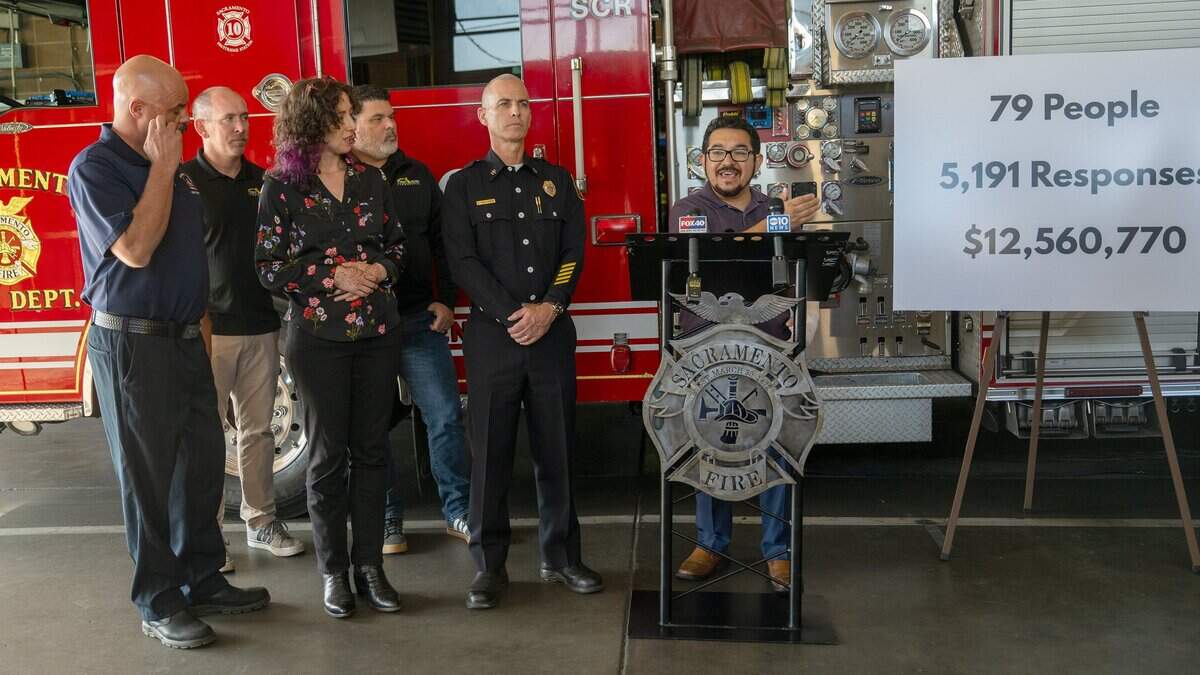
Fewer than 80 “high utilizers” of emergency services have cost the Sacramento Fire Department $12.5 million in less than five years.
Read more Tropical Storm Nolo forms, threatens Hawaii with feet of rain
In the years 2021-2025, 79 people were responsible for 5,191 responses from emergency medical services, costing the already financially strained department significant time and money. These calls took up an average of 12% of the city’s EMS time per year, for what amounts to 0.014% the city’s population.
Many of these frequent 911 users are unhoused people with physical health, mental health and substance use issues who lack access to care and frequent emergency rooms for treatment — or sometimes just basic necessities or shelter. Several more are housed seniors with mental health issues who lack support networks.
“We know this situation is unsustainable,” Councilmember Eric Guerra said Wednesday. “It is also terrible and inhumane for the people who are suffering.”
Fire Department officials say that the disproportionate time and money spent repeatedly responding to a small number of people impairs their ability to serve the rest of the city.
Budget issues have put as many as eight fire trucks out of operation in the past several months, Guerra said. Responding to these calls also jams up staff and vehicles, increasing emergency response times for the rest of the city.
“True emergencies are delayed because of the time we’re taking to respond to these high utilizers, so when fire engines and ambulances are committed to low acuity repeat calls, they’re unavailable to respond quickly to timed critical incidents such as cardiac arrest and strokes,” Assistant Chief Ryan Tweltridge said.
An individual case study showed that one individual consumed 287 hours of emergency responder time over 15 months, causing more than 200 other 911 callers to experience response delays of more than one minute.
Shelters not equipped for medical care
The problem of concentrated 911 overutilization is not a moral failing on the part of the callers, but instead represents their victimization in a system that has failed to keep them safe, city officials and local advocates say.
Read more Roseville executive pleads guilty to $2.3 million wire fraud scheme
“They’re not intentionally spending this money — these are people that are too sick for our shelters,” said Sonia Mogilner, a local emergency room social worker. “We don’t really have any shelters that can take individuals with wounds, with severe and persistent mental illness, with untreated substance use.”
In Sacramento, there are no shelters equipped to receive homeless people released from the hospital system.
The data is historical, and Tweltridge said several of the 79 “frequent flyers” are now in stable environments due to the Fire Department’s developing alternative response program, which takes a proactive approach to coordinating medical care, behavioral health support and connections to social services to address underlying issues.
“The strategy is compassionate, data-driven and focused on improving outcomes for both high utilizers and the broader community,” Tweltridge said. “Reducing repeat 911 calls frees up emergency units. It shortens response times and creates a more resilient system, and ensures residents receive the right care for the right provider at the right time.”
Could CARE Court law be amended?
Guerra is pursuing further change on a city level.
He is advocating to update the city and county’s partnership agreement which governs the role each locality has in addressing the local homelessness crisis. The agreement, signed in 2022, is set to expire in December 2027, but Guerra said it needs updating now to allow for better utilization of recently enacted state legislation and to address high 911 utilizers specifically.
The partnership was signed before two key pieces of state legislation were enacted. One is the CARE court program, a civil court process meant to connect individuals struggling with psychotic disorders to voluntary treatment. Another allows for the involuntary commitment of a person who is a danger to themselves or is “gravely disabled.” Later legislation expanded that definition to include people who are unable to provide for their personal safety as a result of a severe substance use disorder.
Recent Sacramento Bee reporting has shown that the Legislature’s elimination of enforcement mechanisms have rendered CARE Court powerless to provide treatment to the people it is meant to serve.
Guerra hopes to convince the city and the county to jointly sponsor legislation amending CARE court so that it can require compulsory treatment and require medical and other relevant information be a part of the judge’s decision. Locally, he wants to establish a uniform data system so that the city, county and local providers can share information rapidly to better keep track of individuals and their trajectories.
Read more Sacramento standoff on Howe Avenue ends with woman’s arrest after 3 assaulted
This story was originally published September 23, 2026 at 1:51 PM.