 By admin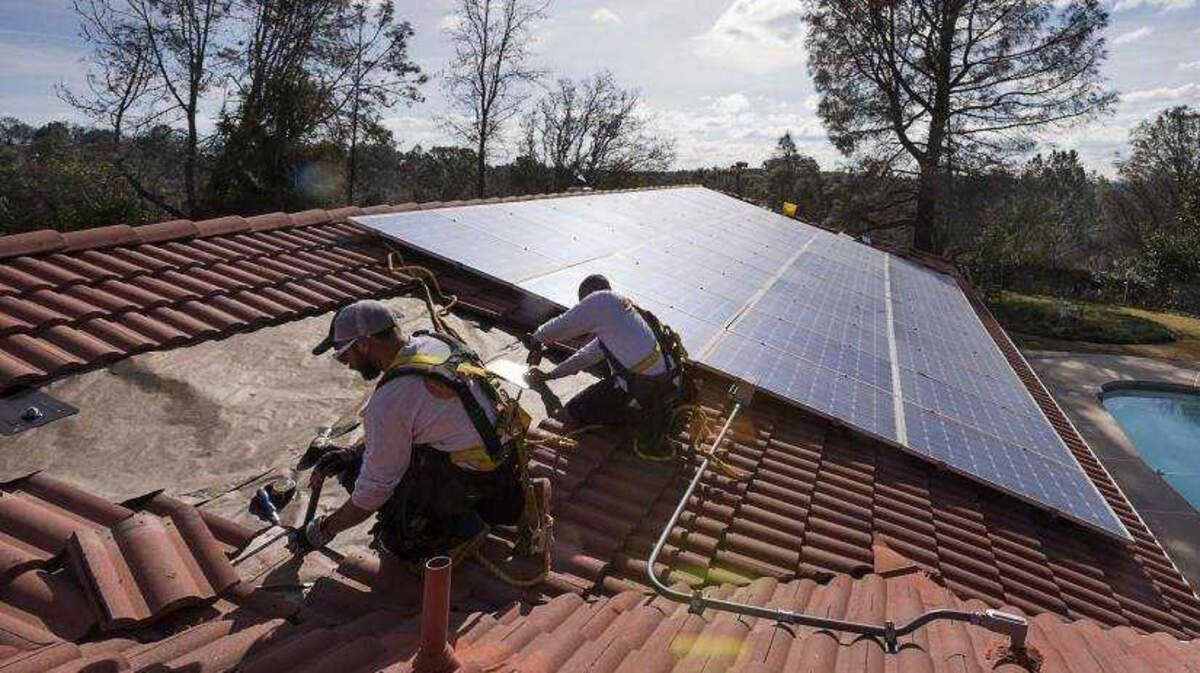
Just a couple of months after the third anniversary of California’s controversial Net Billing Tariff, Pacific Gas and Electric Co. reached a key milestone on June 4, connecting one million households with solar systems to its electric grid, according to a news release by the company.
Read more Measles cases surge, 49ers coach injured in crash. Your Sacramento weekend wrap
“It’s definitely a major milestone, not just for PG&E, but for California’s clean energy transition,” said Paul Doherty, a spokesperson for the company. “What was once considered sort of a niche technology in the ’90s is now part of a core part of how electricity is now produced and used across Northern and Central California.”
The Oakland-based utility serves about 5.6 million electric customer accounts across Northern and Central California, meaning nearly one in five ratepayers is connected to a rooftop solar system.
California leads the nation in residential solar power capacity — 25.9% of California homes have solar systems, making up a total 55.5 gigawatts of power across the state, according to the Solar Energy Industries Association. California’s solar market is valued at $122.4 billion as of June, and continues to grow.
Despite its success, however, the state’s renewable energy goals have not always aligned with utility customers’ cost-saving goals.
A complicated past
Californians with residential solar systems are now compensated for the energy they export to the grid under the Net Billing Tariff. Under NBT, electricity generated by residential solar systems is first used to offset on-site electricity use, reducing the amount of energy a household draws from the grid and lowering energy bills.
Compensation for surplus electricity exported to the grid is then applied to energy bills at rates based on the wholesale value of the electricity. The wholesale rate is typically much lower than the retail rate except during summer peak-demand periods.
The California Public Utilities Commission officially adopted the NBT, also known as NEM 3.0, as the successor to NEM 2.0 on Dec. 15, 2022, after a years-long battle over how much households with solar systems should be compensated for the electricity they generate.
“We had a long fight about the value of an exported electron that goes out to the grid and goes to my neighbor,” said Walker Wright, vice president of public policy for Sunrun, a San Francisco-based home solar and energy storage company.
Before the Net Billing Tariff, solar customers were compensated for exported electricity under Net Energy Metering. One of the most-discussed problems with NEM was the solar-cost shift.
Under NEM 1.0, which took effect in 1996, solar customers could export electricity to the grid and be compensated at the full retail price, allowing households to reduce their energy bills dollar for dollar.
But, because residential solar customers bought less from utilities, they also contributed less towards the fixed costs of maintaining an electricity grid — costs for things such as grid hardening, vegetation management, and infrastructure installation and maintenance. As a result, those expenses , according to a 2020 report by the California Environmental Protection Agency’s Independent Emissions Market Advisory Committee.
Further complicating the solar-cost shift debate was the issue of equity. Many supporters of reducing NEM compensation argued that low-income households, which were less able to afford residential solar systems, were disproportionately affected by the solar-cost shift.
The policy expired between 2016 and 2017, depending on the utility company, but ushered in NEM 2.0.
The new metering policy required households with rooftop solar systems to continue paying certain non-bypassable charges built into electricity rates that fund energy efficiency, low-income assistance and other related programs. However, residential solar customers continued to receive full retail rates for exported electricity, which could offset the remainder of their bills.
“It has been well documented – and surprises no one – that households with solar are disproportionately wealthy (as well as disproportionately white),” wrote Severin Borenstein, a UC Berkeley professor who studies renewable energy economics, in a 2021 blog post. “So, when a customer installs solar, their share of the fixed costs are shifted to other ratepayers who are poorer on average. Net Energy Metering hurts the poor. It’s that simple.”
A battle of statistics
At the same time researchers pointed out the inequitable consequences of NEM, proponents of solar incentives blamed utility companies for pushing a false narrative and cited studies, including one from Berkeley Lab, showing that 36.2% of California solar adopters in 2022 had household incomes of less than $100,000 a year.
“The push for rooftop solar reforms has nothing to do with ideology or classism or systemic inequities,” The Sacramento Bee’s Editorial Board wrote in 2021. “It is about companies trying to manipulate the public into believing that democratized clean energy production is bad for the state.”
In 2023, the Berkeley Lab figure rose to 38.3%. Debate has continued over how those statistics should be interpreted.
“Those numbers are drastically misleading,” Borenstein said.
He said the relevant comparison is the distribution of households in each income bracket with the distribution of solar adopters in those same income brackets. “It is true that there are many households below 100,000 or 75,000 who have solar, but the share of households in those categories, the lower income categories, is much smaller.”
Wright acknowledged that solar was largely unaffordable a few decades ago: “15 and 20 years ago solar was only a product that those with means could afford.”
However, he said, the situation changed after solar power purchase agreements (PPAs) were introduced, allowing households to buy power generated from solar systems, usually at lower costs than buying from utilities, without paying the upfront cost of installing equipment.
“Once the PPA was introduced we began to see the important trend over time of more comparative adoption from lower-income populations,” he wrote. The same Berkeley Lab study found solar adoption continued shifting toward lower-income households.
Wright said that the argument blaming solar power for raising electricity bills doesn’t make much sense.
Read more Sacramento Bee home delivery hampered by press production issue
“What they’re trying to say is because these three people or these people here in this neighborhood or that neighborhood are buying less electrons from us, we must raise rates on everyone else, and we need to blame those people,” he said.
Wright also disputed the characterization of rooftop solar as a subsidy for energy bills.
“I’m simply buying less power from the monopoly compared to what I otherwise would,” he said.
NBT went into effect on April 15, 2023.
What comes next
Now that California has shifted to Net Billing, the battle over solar has continued. Residential solar customers who installed systems before the end of NEM 1.0 or NEM 2.0 are protected by a grandfathering rule that allows them to export electricity under their original NEM policy rather than NBT for 20 years.
The rule has allowed the solar-cost shift to continue for non-solar customers, even as new solar customers export electricity at much lower rates. In 2025, a study commissioned by the California Chamber of Commerce found rooftop solar incentives made up . Another 16.3% go to wildfire mitigation and other public purpose programs.
“It’s definitely the case that going forward, the solar cost shift is much diminished,” said Matt Newman, co-founder of Bluesky Consulting, which produced the study. “However, because of the large installed base under the net energy metering system, there is still an ongoing and large solar cost shift.”
A different analysis by the California Public Advocates Office found that by the end of 2024, rooftop solar incentives would cost customers without solar an estimated $8.5 billion.
“Working families, renters and low-income households are footing the bill while wealthier homeowners get steep discounts,” wrote Hunter Stern, assistant business manager for IBEW Local 1245, which represents more than 28,000 utility workers across Northern and Central California and parts of Nevada, in a 2025 op-ed for The Bee.
“Generally speaking, we continue to have the same concerns regarding cost shift from the existing NEM rate structure,” Stern wrote in an email.
A new player has also entered the debate: battery storage. When paired with home solar systems, batteries can store excess electricity generated during the day for use in the evening, reducing the need to buy electricity from the grid.
California’s battery storage capacity exceeded 15,700 megawatts in May 2025, according to Gov. Gavin Newsom’s office, up from 770 megawatts in 2019. State officials say the growth has made battery storage an increasingly important resource for shifting solar energy generated during the day to periods of peak demand.
The shift has accelerated battery adoption among rooftop solar customers. According to GridStatus.io, 37% of new behind-the-meter solar systems installed after the transition to NEM 3.0 included battery storage, bringing California’s behind-the-meter battery capacity to 1,628 megawatts by the end of 2025.
Batteries can also export electricity during peak hours, when compensation rates are highest.
“The NBT significantly changes the compensation, and so for rooftop solar customers, that creates an incentive for battery storage,” said Newman. “I do think we’ll see more battery storage systems in the future.”
Battery storage further complicates the solar incentives battle.
“Solar homes can now “self-NEM” by storing their power on-site and keeping it behind the meter,” wrote Borenstein in a 2021 blog post. “That’s a problem, because storing electricity in order to avoid paying the retail price for later consumption isn’t creating value; it’s just shifting fixed costs to other customers.”
To Wright, one of the most important questions remains whether generating solar power should be considered a subsidy at all.
“What’s the subsidy for an electron that I just produce on my roof, and goes into my toaster?” he asked. “Is buying less from the monopoly a subsidy?”
“Are you going to label someone who turns off their light taking a subsidy? Are you going to label the person who decides to only run his dishwasher at two in the morning as getting a subsidy?” he continued.
Newman said that, regardless of the cause, high electricity prices work against California’s clean energy goals.
“The higher the price of electricity, the less incentive someone has to buy an electric car or install a heat pump to cool their house,” he said. “The state is not achieving its goal as effectively as it could if it worked to lower electricity bills.”
Despite the conflict between utility and solar companies, Doherty said PG&E remains committed to helping customers invest in home solar systems.
“The main point that I want to get across with that is that we’re a strong advocate for solar energy for all our customers,” he said. “We believe solar will remain an important part of California’s clean energy mix.”
Read more Mitch McConnell continuing recovery, not yet cleared to return to Senate