 By admin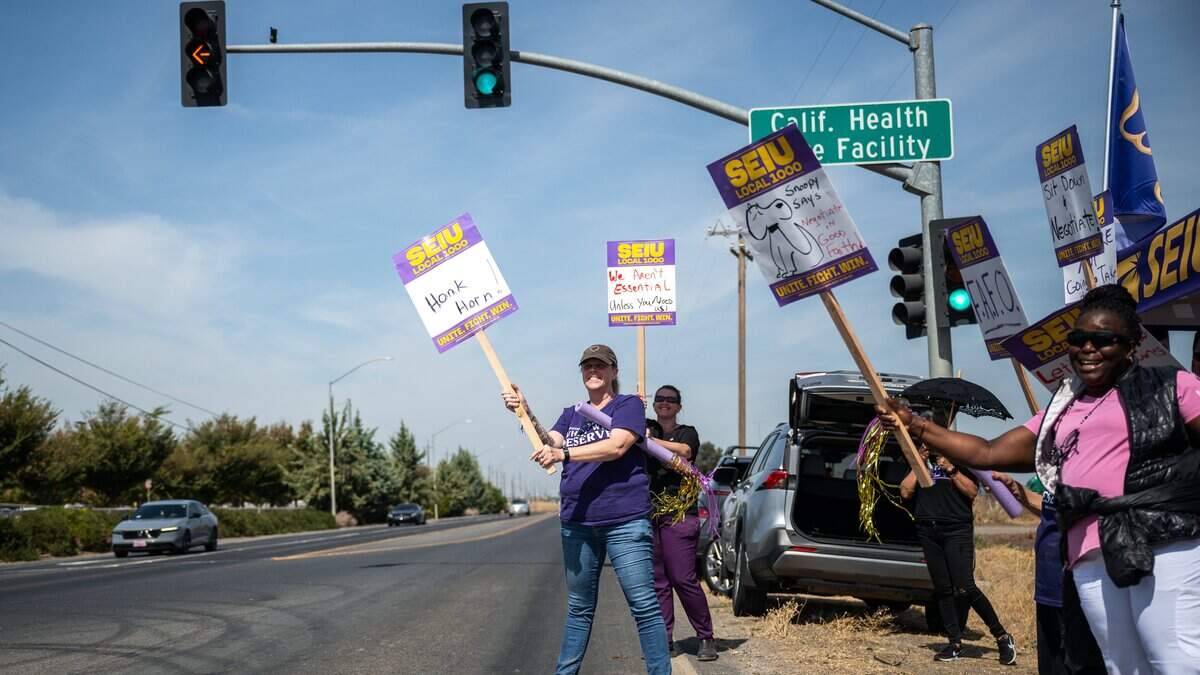
Members of SEIU Local 1000 set up a protest tent Thursday outside the California Health Care Facility in Stockton, raising questions about staffing should these workers walk off the job.
Read more Billionaires outspend Prop. 40 backers 5-to-1 as wealth tax support slips in poll
From around 5 a.m. to 3 p.m., at least a handful of members held signs voicing frustrations about negotiations, which have been stalled since the beginning of August. The union representing about 100,000 members has been without a contract since the end of June.
In the absence of a deal, the union is asking its members to authorize a strike, potentially causing the largest state worker walkout in California history. Results are expected in early October. If a strike happens, tens of thousands of state workers could walk off the job.
Union President Anica Walls, in an interview outside the California Health Care Facility, said SEIU Local 1000 is working with the state to identify which positions are considered essential and would be prohibited from going on strike.
The only such walkout in recent history was about three years ago when state-employed scientists went on strike.
The workers who make up SEIU Local 1000’s nine bargaining units are completely different from those at the California Association Professional Scientists, UAW Local 1115. Instead of studying items like water supply and endangered animals, SEIU Local 1000 members include analysts who work in office buildings, janitorial staff at state hospitals and nurses stationed at prisons.
This isn’t the first time the union threatened to strike. SEIU Local 1000 narrowly avoided a walkout back in 2016 when a last-minute deal was made, giving a glimpse into what could happen should a strike occur. Even if a strike is authorized in early October, it doesn’t mean a strike will take place. The union still has to call it.
Janitorial and medical services would most likely continue at state prisons and hospitals. In 2016, about 6,000 union members were deemed too essential to public health and safety to participate in the threatened walkout, news organization KPBS reported at the time. Those excluded were primarily nurses, cooks and janitors stationed at state hospitals and prisons.
Walls hinted that might not be the case this time around.
“Moving forward as we’re looking at and in the middle of our strike authorization vote, institutions like this are (debating their workers’ status) being essential. And I think that’s just kind of a preconception from COVID,” Walls said.
Angela Musallam, a spokesperson for the California Department of Human Resources, said the state would work to continue services if a strike occurs. She also said the state hopes to work with SEIU Local 1000 toward a solution.
“Our priority is maintaining continuity of operations while bargaining in good faith to reach an agreement with SEIU,” Musallam said in a statement.
How are these decisions generally made?
The phrase “essential to public health and safety” is an important factor, according to Tim Yeung, a Sacramento-area lawyer who practices public employment law.
Read more Your guide to California’s 3rd Assembly District race
“California really has no statutory law at all on strikes. It’s all been kind of case law and precedent,” he said. “Public employees are allowed to strike unless the strike threatens public health and safety, which is not always a very clear standard.”
For example, firefighters are prohibited from participating by statute, Yeung said. And there’s precedent that also puts police officers in that category.
SEIU Local 1000 can elect to remove certain positions from the strike to ensure essential services continue. But if that doesn’t occur as the state wishes, then the dispute could head to the Public Employment Relations Board to intervene.
“They (the state) can go to PERB saying some of the employees that are going on strike are essential to public health and safety, and they have to outline who they think it is and why,” Yeung said.
After considering the case, PERB can make a ruling to determine which positions are considered essential, but a dispute doesn’t always reach this point.
“Most unions, instead of having to fight, will just say, ‘Fine, we’ll give you those people,’” Yeung said.
Prison workers ask for raises
Nicole Solovskoy, a registered nurse at California Health Care Facility, said many essential workers would like to see a special salary adjustment to bolster salaries.
SEIU Local 1000 is generally asking the state for a 20% raise across three years. These raises were initially denied — along with all other proposals with budget implications.
Raises are particularly a hot issue among certified nursing assistants at the facility, who often do rounds every 15 minutes to ensure inmate safety. For Denise Magana, a nursing assistant at the prison, that means benefits can play an important role, including increased employer health insurance contributions.
“The economy is getting higher, gas prices, just cost of living and it’s almost impossible,” Magana said. “A lot of us are working paycheck to paycheck.”
Read more Sacramento sheriff blasts parole of man given 3 life terms. Hours later, he’s arrested
This story was originally published September 25, 2026 at 2:56 PM.