 By admin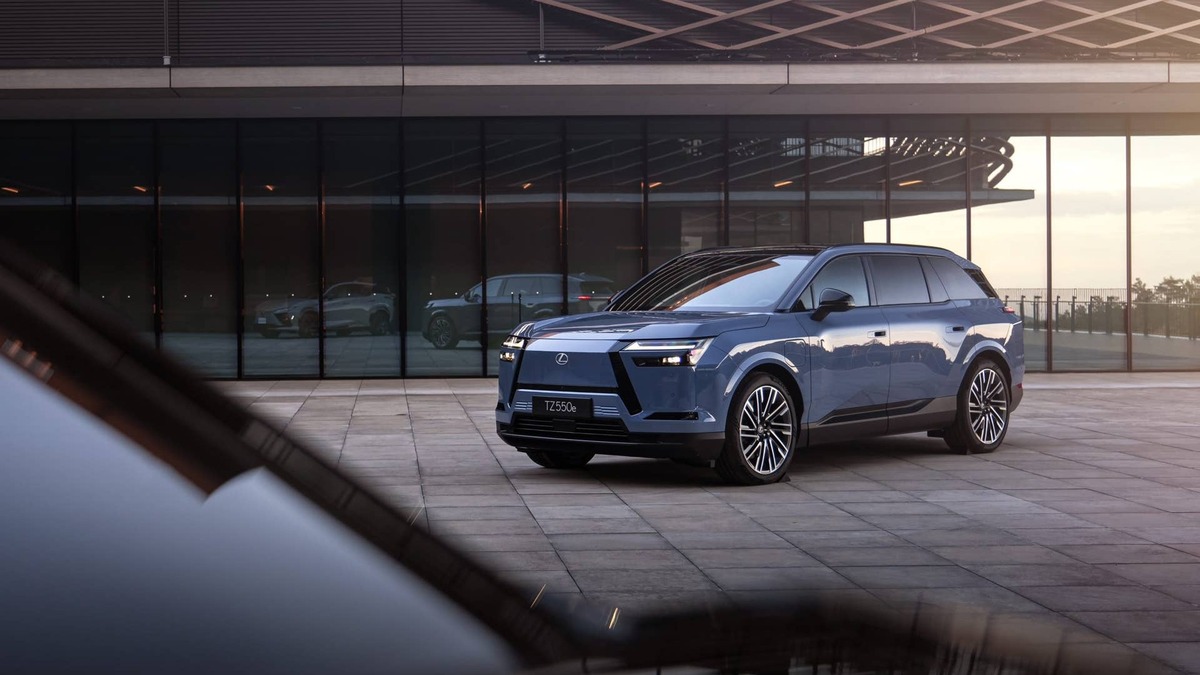
Lexus posted a five-item summary of its first three-row electric SUV on August 21, 2026, three months after revealing the car. It is worth reading for what it chooses to lead with. One of the five things to know is that the TZ has a panoramic roof. Another is that the front passenger and second-row seats have power ottomans. There is no price, no range, no horsepower, no charging figure and no delivery date in the entire piece. With the car due on sale before the end of this year, that is a striking amount of blank space. Here is what has been confirmed, what has not, and what other sources have established.
Read more Iran is set to unveil Hormuz pact to Gulf nations on Monday
What Lexus has confirmed
The TZ is the brand’s first three-row all-electric all-wheel-drive SUV, built on what Lexus calls its Toyota New Global Architecture (TNGA) platform. Two lithium-ion batteries are offered, at 76.96 kWh and 95.82 kWh, and DIRECT4 all-wheel drive is standard on every grade.
The chassis detail is the most substantive part of the release. DIRECT4 shifts torque between the front and rear motors from 60:40 to 0:100 under acceleration and from 80:20 to 0:100 through a corner. Drive modes are NORMAL, SPORT, ECO, RANGE and a REAR COMFORT setting that coordinates Dynamic Rear Steering, brake force and drive force distribution to reduce pitch and lateral motion for passengers.
Regenerative braking has five levels on the paddles, with coasting deceleration up to 0.2 G. Dynamic Rear Steering turns the rear wheels up to 4 degrees. The body uses high-rigidity adhesives, laser screw welding and aluminum components, and Lexus says it tuned the car across more than 40 performance themes.
The comfort content is the pitch. Power ottomans for the front passenger and second row are a Lexus SUV first. The third row gets what Lexus describes as sofa-like cushions. There is hand-crafted Shikoku Island Forged Bamboo trim, a standard panoramic roof with a wire-driven sunshade that preserves headroom, and standard ambient light-emitting diode (LED) illumination cycling through six Japanese-inspired themes. Lexus Safety System+ 4.0 is fitted.
What Lexus has not confirmed
Everything a buyer would use to make a decision. There is no manufacturer’s suggested retail price. There is no power or torque output. There is no range estimate, no Environmental Protection Agency (EPA) rating, no charging curve and no direct current (DC) fast-charging time. There is no curb weight, no cargo volume, no towing figure, no seating capacity, no grade or trim level names, and no on-sale date beyond late 2026.
There is also no statement of where the TZ is built, and no mention of whether it uses a North American Charging Standard port or an adapter. For a car whose whole proposition is family road trips, charging hardware is not a detail.
What we know from elsewhere
The TZ was revealed on May 6, 2026 in Plano, Texas, and shares its mechanical package with the Toyota Highlander EV and the Subaru Getaway, though many body panels are unique to the Lexus.
Lexus’ global division lists 402 hp for the range-topping version, which Lexus USA has not confirmed. Range is estimated at up to 300 miles and is explicitly not an EPA-certified figure. The car runs a 400-volt architecture, and reporting puts a 10% to 80% charge on the larger battery near 35 minutes at peak DC speed. Vehicle-to-load is included through a rear alternating current outlet. Zero to 60 mph is expected a touch over 5.0 seconds.
Read more Veteran fund manager’s Fed interest rate hike prediction will frustrate consumers
On packaging, the TZ measures 200.8 inches long, close to the gas TX, with 14 cubic feet of cargo space behind the third row. It is reported as a six-seat layout, which the second-row ottomans imply, and Lexus has not addressed whether a seven-seat version exists. Wheels are 20 or 22 inches on low-rolling-resistance tires. The drag coefficient is 0.27, helped by flush door handles, reworked mirrors and underbody fins. Inside there is a 12.3-inch instrument cluster, a 14-inch touchscreen and a 21-speaker Mark Levinson system.
On price, estimates cluster rather than agree. Autoblog expects a start near $65,000, Edmunds near $70,000, and Consumer Reports puts the range at $65,000 to $75,000. None of those is a Lexus number.
The Subaru version makes more power
The comparison worth sitting with is inside Toyota’s own alliance. The Subaru Getaway, which shares the TZ’s mechanical package, is rated at 420 hp with all-wheel drive and more than 300 miles of range. Lexus’ global listing for the TZ’s top version is 402 hp. The Toyota Highlander EV is 221 hp with one motor and 338 hp with two, and Toyota plans to sell it with front-wheel drive in the US, while the TZ is all-wheel drive only.
If the 402 hp figure holds, the luxury flagship of the three would sit below the Subaru on output. That may not matter to the buyer Lexus is targeting, who is being sold ottomans and quiet rather than acceleration, and Lexus USA has confirmed nothing either way. But it is the sort of gap a manufacturer usually gets ahead of, and holding the power figure back does not make it go away.
The market it is arriving into
Context matters here more than usual. The TZ becomes Lexus’ third electric model, joining the RZ and the electric ES. Lexus withdrew the UX 300e, its first battery electric car, from European sale in late 2025, and Toyota scrapped the LF-ZC electric sedan. In the US, the $7,500 federal clean vehicle credit expired at the end of September 2025, and luxury battery electric share fell from 22% to 14% year over year.
That is the segment a $70,000 six-seat electric SUV is launching into, against the Hyundai Ioniq 9, Kia EV9, Volvo EX90, Rivian R1S and Mercedes-Benz EQS SUV, most of which have been on sale long enough to have discounts. Lexus is competing on interior quality and passenger comfort rather than range or price, which is a defensible strategy for the brand and a hard one to prove in a press release with no numbers in it.
What to watch
The pricing announcement is the whole story from here. Late 2026 means it is close, and the gap between $65,000 and $75,000 is the difference between undercutting an Ioniq 9 Calligraphy and sitting alongside an EX90. Watch also for the EPA range certification, because 300 miles is currently a Lexus estimate on a car with two battery sizes and a 22-inch wheel option, and certified numbers on three-row electric SUVs have a habit of landing below the estimate.
The third thing is the power figure. Lexus USA has been quiet on 402 hp for three months while its Subaru sibling advertises 420 hp. Whichever number is right, publishing it would be a start.
Read more Trump downplays AI concerns as CEOs call for slowing pace
Lexus
Lexus USA Newsroom
Copyright 2026 The Arena Group, Inc. All Rights Reserved
This story was originally published September 13, 2026 at 9:30 AM.