 By admin
Staircases play a huge role in the evolution of human beings, both physically and metaphorically. The idea of stairs emerged around 10,000 years ago through carved terrain, notches in logs, soil, and stacked stones that helped humans reach different levels in early villages.
Read more Should California tax billionaires? How McClatchy Editorial Board sees Props. 40, 41 & 42
Later, they became massively important features in the pyramids, Machu Picchu, India’s Chand Baori and the Roman Colloseum.
Last month, I found myself in appreciation of the form as I ran the stairs across the street from my house at University of Puget Sound’s Baker Stadium. It was a gorgeous day, and the Loggers were working out on the lower field below.
I wondered how much more laborious the expansive Stadium High School Bowl steps might feel, and remembered Heath Ledger dancing across them in “Ten Things I Hate About You.”
The Stadium Bowl steps are famous, and a massively important Pierce County location; presidents (and Heath Ledger) have stood on them.
What other famous steps does Pierce County have, and are Stadium Bowl’s the most prominent?
The Spanish Steps downtown are modeled after Rome’s Piazza di Spagna. The Chutes and Ladders-style slide stairs across from the Vashon Ferry Terminal, and the bleacher-style Grand Plaza Stairs at Point Ruston, are also notable. The crazy vertical Murray Morgan Bridge stairs and the precariously perched staircase to Salmon Beach are worth mentioning, too.
But if we were to include all of Pierce County in this grand staircase list, not just Tacoma, I personally believe a frontrunner for most prominent staircase steps forward:
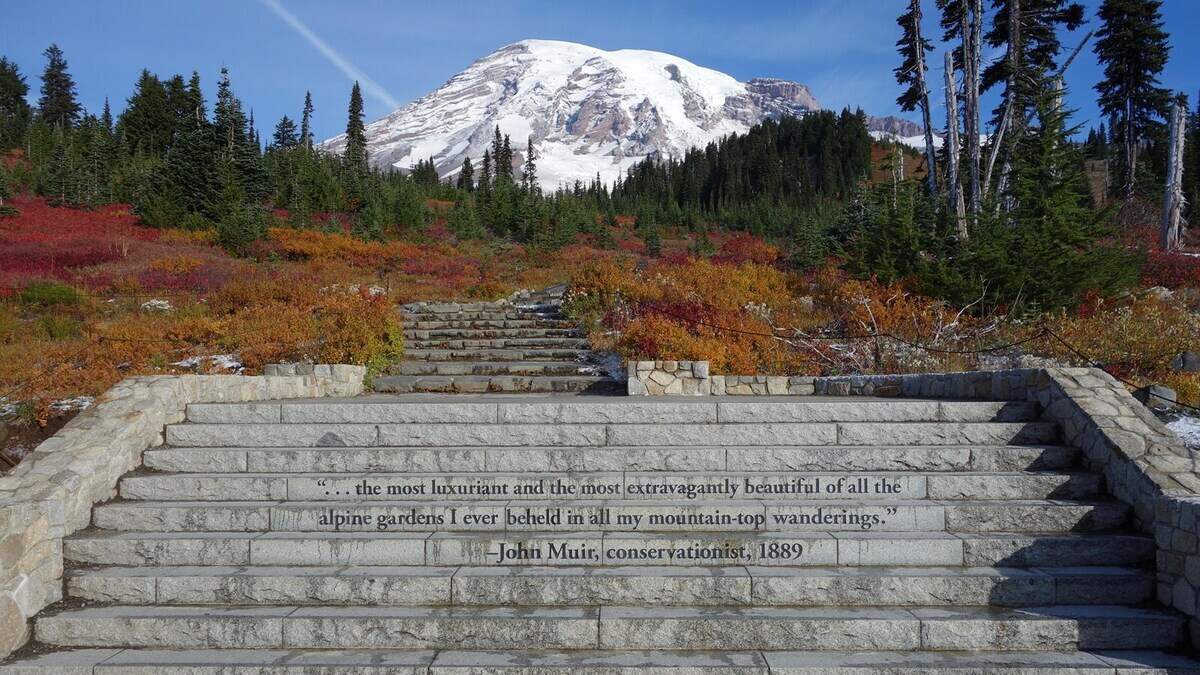
Mount Rainier National Park’s Muir Steps.
The “mystery” of the Muir Steps
As a boy who grew up in Seattle with a view of Mount Rainier straight out his window (in the summer), I’ve always found our mountain mesmerizing. I’ve yet to summit Rainier; I became more of a rock climber (who prefers solid granite) than a mountaineer, but I hope 2027 is my year.
The most recent version of the Muir Steps, or the stairs at the beginning of the Skyline Trail as you leave the Paradise Parking Lot, debuted in 2008, at the same time as the new Henry M. Jackson Visitor Center. On the stairs is an inscribed quote by famed mountaineer, naturalist and writer John Muir: “… the most luxuriant and the most extravagantly beautiful of all the alpine gardens I ever beheld in all my mountain-top wanderings,” Muir’s quote reads.
I’ve crossed over the “Muir Steps” many times, but I can’t for the life of me remember when I started calling them the “Muir Steps.” As for when the NPS started calling them the “Muir Steps,” they can’t remember either.
“Historically, park publications referred to the area as the Skyline and Alta Vista trailhead, using descriptions such as ‘stairs leading into meadows from the visitor center plaza,’ ‘trailhead on the north side of the parking lot,’ or ‘trailhub beginning in the upper Paradise parking lot,’ ” an NPS curator told The News Tribune via email last week.
The earliest reference the NPS curator could find calling the stairs “Muir Steps” appeared in a 2016 NPS publication, “Harmonizing Paradise.”
When asked whether the staircase at the beginning of the Skyline Trail at Paradise was referred to as the “Muir Steps” before 2008, the NPS said they likely weren’t, officially, as far as they could determine.
“The name appears to be informal, as even recent editions of the park newspaper do not use it,” the curator said. “We have found no evidence that the earlier stairs were officially known as the Muir Steps.”
The curator refers to an earlier set of stairs, a stone staircase that occupied the same spot as the current Muir Steps throughout the 1900s. Before that, the NPS said the Skyline Trailhead at Paradise Parking Lot was landscaped and paved but had no staircase.
The NPS sent archived photos showing the earlier stairs and paved area, but said the photos were undated, so they couldn’t confirm when the original stairs were built.
So when did the Muir Steps officially become the “Muir Steps?” And who was the first person to use that phrase? Neither the Mount Rainier NPS curator nor the public affairs office could say.
Over time, things take on their own personality, thanks to humans making them their own. As the NPS isn’t sure when their famous stairs received their name, I thought I’d call up a guy who’s walked over them more times than most: Jonathan Spitzer, director of operations at Alpine Ascents, one of three guide companies permitted to guide clients up Mount Rainier, and a guy who has summited Mount Rainier almost 200 times.
Read more FBI searches home of Stephen Cloobeck, ex-Rep. Eric Swalwell donor
When I asked Spitzer if he was familiar with the Muir Steps, he chuckled and said: “Of course, I walk over them all the time.”
When I asked him if he remembered when he started calling them the “Muir Steps,” he paused before saying: “No, but I have a terrible memory.” Spitzer remembers passing over them many times, before and after 2008, but he does not recall when he started calling them the “Muir Steps.”
Muir image
Muir never crossed his own steps; he died in Los Angeles in 1914, and no record shows him visiting Mount Rainier NP in the 1900s. And, as mentioned above, we don’t know when the original steps were built.
“John Muir’s historical connection to Mount Rainier is well documented,” the NPS told The News Tribune. “Muir climbed the mountain in 1888, and the steps are located near the route of his ascent. His contributions to the park’s history are described in the Camp Muir Cultural Landscape Inventory and an NPS article about his efforts to preserve Mount Rainier. While this historical connection provides context for the use of his name and quotation, we have not been able to confirm the specific rationale for incorporating the quotation into the steps during construction of the new Jackson Visitor Center in 2008.”
The Muir Steps mark the route of Muir’s ascent of Mount Rainier, and anyone else who has summited Mount Rainier from the Paradise side (Ingraham Direct and Disappointment Cleaver begin here).
In the climbing world, Jim and Lou Whittaker have crossed the Muir Steps numerous times; Conrad Anker and Alex Honnold have, too. Seattle Seahawks legends Steve Largent and Jim Zorn have crossed the Muir Steps, as have Jim Mora Jr., Roger Goodell and Paul Silvi.
Al Gore and his son crossed the steps on their way to their successful summit in 1999. Presidents Taft and Truman visited Mount Rainier in the early 1900s, but it can’t be said for certain whether the steps were there or not. Walt Disney and his wife, Lillian, hiked the Skyline Trail on their honeymoon in 1925 (were the stairs there?).
Anyone who has come to Rainier and hiked or skied Paradise in the past 75 years (likely) has crossed the steps at the beginning of the Skyline Trail, whether those stone steps were then referred to as the “Muir Steps” or not.
A case for stairs (see what I did there?)
Stairs enable us to reach other levels. In the Bible, Jacob’s Ladder (long before the Tim Robbins movie or Led Zeppelin song) is a stairway to heaven, representing a spiritual journey, or progression of faith. Climbing stairs represents hope, growth and enlightenment.
In literature, descending stairs represents the opposite: despair, solitude and decay, like Dostoevsky’s protagonist in Notes from Underground. Carl Jung saw descending a staircase as a metaphor for moving away from our ego and into our unconscious mind.
Physically and spiritually, stairs lift and lower us to other levels through our own power and decisions, working our muscles and minds to get us there.
In the outdoor world, steps make it possible for hikers to reach the top of Half Dome, thru-hike the Pacific Crest Trail, and trek around the Thorung La Circuit in Nepal.
Stairs are a thing, and there are magazine articles, blogs and Facebook Groups dedicated to the appreciation of stairs all across the world.
The Muir Steps are a gateway of sorts, a paradigm shift for those prepared to leave roads, parking lots and urban ways behind. Those who ascend the steps find themselves in Mount Rainier’s backcountry, standing in footprints on a highway that leads directly to the rooftop of the Northwest.
The mystery continues surrounding the steps at the beginning of the Skyline Trail at Mount Rainier’s Paradise. Why did Mount Rainier NP add the John Muir quote to its famous steps? When were the original steps built, when did everyone start calling them the “Muir Steps,” and who came up with the name?
We all seem to be suffering from a kind of collective amnesia surrounding Pierce County’s most important staircase.
This story was originally published October 27, 2026 at 5:00 AM with the headline “The mystery of Mount Rainier’s Muir Steps.”
Read more California state workers crash CalHR event over strike ‘intimidation’ efforts