 By admin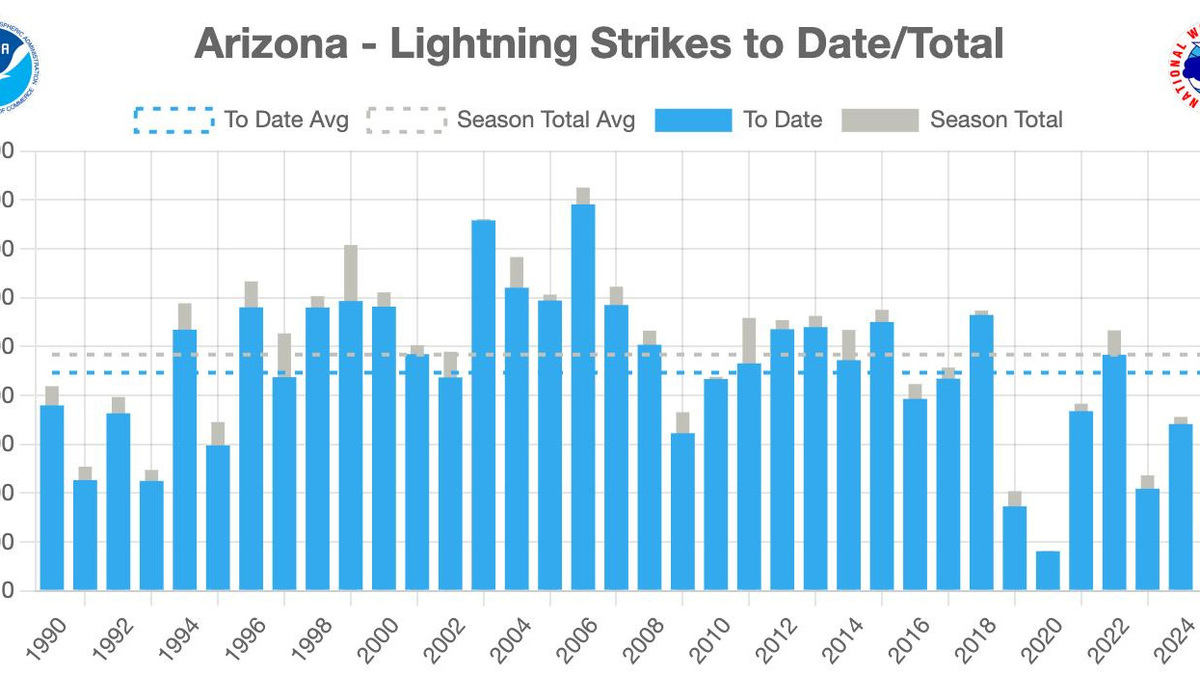
Clifford Kinney lives by a maxim that would make any mother’s toes curl: When a lightning storm brews, head outdoors.
That’s because he’s a storm chaser, and in the summer he’s abuzz over the promise of a lightning show (taking a necessary amount of caution, of course).
“There are years when you get a drier monsoon and it just sucks, because you want to go out and you can’t do anything,” the Mesa resident said. “I always make jokes, like, ‘you all got any of that monsoon? You got any more of that lightning?'”
On average, Arizona sees as many as 600,000 lightning strikes every year, most of them during the monsoon. Kinney has ventured south and east and occasionally out of state up north in pursuit of sizzling skies.
So far, the 2026 monsoon is shaping up to be an eventful one, though it has fallen short of the drama of the past decade.
This season’s fitful activity is reflected in the roller coaster of emotions among storm chasers, who follow where weather models project lightning to strike, but don’t always succeed in capturing it.
Arizona’s monsoons hold special allure because of the diversity of the state’s landscapes: sparkling metropolitan, ruddy canyons, sweeping plains, charismatic saguaros. All frame a lightning bolt such that they emphasize the earth-shattering power of nature against the puniness of Man.
As the summer-parched landscape soaks in much needed moisture to quell the heat, storm chasers soak in the terrifying beauty of the roiling skies that bring it, fearsome and dangerous as the storms can be.
“It’s an incredibly beautiful state,” said Phoenix-based storm chaser Bryan Snider. Other states might have snow and balmier summers, but Arizona has monsoons. “I’ve lived in multiple states, but I think Arizona is probably my favorite so far.”
What makes the monsoon?
Come every summer, change is in the air. The landmass of North America heats up and the winds shift, carrying moisture from southern bodies of water like the Pacific Ocean and the Gulf of California up to the Southwest. The air turns muggy, the skies electric. So begins the monsoon.
No two seasons have been ever the same in Michael Crimmins’ 25-year experience studying the monsoon. They can differ in their timing, intensity, direction, duration and rhythm. Crimmins, a University of Arizona climatologist, summed up this year’s in one word: “frustrating.”
One reason is the monsoon’s spotty showing. His home in Tucson has remained woefully dry, while his neighbors’ were drenched.
By August’s end, Phoenix Sky Harbor Airport received slightly below its average summer precipitation, while higher elevation areas such as the Mogollon Rim have already been pelted with up to three times their normal summer moisture.
Higher elevation regions, including Tucson, tend to receive more storms as the neighboring mountains provide a leg-up for water vapor to rise into towering thunderheads.
Last year’s monsoon was a letdown in terms of storm activity, and the two years before that were even more uneventful, landing as two of Arizona’s driest seasons on record.
Although 2026’s monsoon rains have improved, they still haven’t lived up to their previous gusto, Crimmins said. The season opened with a bang mid-June, then quieted.
“It has been pretty up-and-down since then,” he said, highlighting its sporadic return in mid-July, then in early August. If previous years are any indication, Crimmins expects that tropical storms that come in from the Southeast will stir up additional activity for the Southwest in September, so monsoon enthusiasts still have something to look forward to.
This year, another variable is stirring the pot: a so-called “super” El Niño. El Niño stems from changing circulatory patterns in the Pacific Ocean that affect entire regional weather patterns.
“El Niños tend to make the monsoon a little bit weaker up front, not always, not consistently, but certainly could,” Crimmins said, which matches the patterns of Arizona’s monsoon so far.
The correlations between El Niño and the monsoon’s behavior are still not well understood, as meteorologists have only a few strong El Niño cycles on the books for reference.
While El Niño typically amplifies rains in the Southwest in the winter months, already the planet has felt its impact earlier.
This summer, Hawaii was lashed by back-to-back hurricanes that skimmed the archipelago.
Meteorologists say the heightened storm activity in Hawaii’s waters is a signature of a strong El Niño.
Closer to home, the Aug. 29 flash floods in the Grand Canyon that killed at least two visitors and stranded 80 may carry El Niño’s fingerprints. According to hydroclimatologist Park Williams, El Niño can load the atmosphere with more water vapor that fell as heavier rains.
What Crimmins is certain about is that El Niño will only gain momentum as the year progresses. It will likely intensify late summer’s storms as it continues to funnel warm water to the eastern tropical Pacific, providing the moisture that fuels rainfall inland.
That’s all the more exciting for the Southwest’s storm chasers to close out the season on a high note.
Bedeviled by dust
Storm chasers have already been kept busy, though despite their most educated guesses, the planning doesn’t always pay off.
Jim Tang started one early August evening with high hopes. He had driven 14 hours from Oklahoma City simply on the chance of several flashy evenings, brought to Phoenix by the monsoon.
Tang is a computer programmer by day and a storm chaser at all other times. And when he’s not chasing tornadoes in the Great Plains, he’s chasing monsoon storms in the Southwest.
On the night of Aug. 10, from a hotel room in Surprise, Tang watched excitedly as weather maps on his phone portended lightning across the Valley. The afternoon had soared to 115 degrees, injecting a good dose of heat needed for hoisting massive clouds into the stratosphere.
Despite the high chance of storms, choosing where to go was no easy task, a delicate juggling act of meteorological judgment, gambling and guesswork. Weather models might not be accurate, so chasers rely on their own eyes and learned experience.
Timing is everything. Tang wanted to get up close, and he wanted to beat the storms so his camera could snap the first dry bolts before rain veiled over. And he wanted the best-looking shots – a bolt fanning out against a classic Southwestern backdrop like an electric net, weather and landscape clashing as if in heated dialogue.
Clouds gathered above the West Valley. After grappling with a moment of decision paralysis, he decided to hedge his bets on Gila Bend. It was in the center of action but not the busiest spot, and he would be ready to pivot if one storm cell broke off and headed north or west, or if another straggled in from the east. During his drive, the first bolts lit up the horizon, a stroboscopic display in a disco club.
But later that night, he found himself only in the thick of another meteorological phenomenon, an unseemly one at that: dust.
Dust has long menaced residents in the Valley. Now, as Arizona experiences the effects of a 30-year megadrought, the lack of moisture that would glue topsoil down means particles can shake loose when they are disturbed, such as by cold downdrafts from adjacent storms.
Monsoon storms are drivers of dust, with all of the rains they bring. While experts haven’t studied dust storms for long enough to pinpoint trends, they have noted that the last two years have been particularly hazy. In August, Phoenix experienced two highest-category dust storms in a single week. The previous 10 years had seen only two storms of such fervor.
Dust storms can be a contributor to valley fever. In the last few years, infection rates have doubled in Arizona since the mid-2010s.
Hazy skies complicate how storm chasers decide where to go. While bigger storms bring better chances of lightning, they also tend to kick up more dust. Most standard weather apps don’t predict dust conditions, leaving storm chasers to balance their storm chances against visibility.
At peak storm projection that night, Tang found himself along a road in the middle of agricultural fields, an oasis of clarity and stillness surrounded by faraway lightning storms all around. The distance rendered the lightning flashes into mere flickers.
Scrolling on his phone, he saw storm chasers who headed south were greatly rewarded.
“Dammit, Tucson!” he railed into the wind. “The south goes nuts because I said that we are not going south.”
His weather apps had incorrectly predicted that a storm would have arrived here by now. So Tang decided to keep moving, unwilling to linger for more than 30 minutes for the tardy squall. The next day, he would head for Sedona or the Grand Canyon.
Read more NRFI, YRFI MLB Bets Today: Best First-Inning Predictions for Monday, Sept. 14
He’s a storm chaser, after all, not a storm waiter.
Phoenix airport: Low risk, high reward
Dust was also a problem when Kinney headed out the night before Tang’s failed chase. But where he went had the advantage of elevation, soaring above the worst of the dust.
He was in perhaps the safest and most accessible location known to storm chasers: Phoenix Sky Harbor International Airport.
From the covered eighth floor of the Terminal 4 parking lot, Kinney trained two cameras toward the impending storms. They didn’t show up on Kinney’s weather apps until the last minute, but he predicted that they would hit beforehand, relying on his 15-year experience of reading the tea leaves of the weather.
Lightning fell like jagged knives, at one point throwing green sparks as it hit the ground.
“That means the transformer just blew,” he said. “Somebody’s out of power now.”
Every 11 seconds, his camera shutter opened to catch a long glimpse of the night sky, briefly illuminated by nature’s fireworks. Kinney can collect over 1,000 photos in a single night.
The photography conditions were still far from perfect. In between storms, a haboob erased the mountains and smeared out the pinpricks of city lights into fuzzballs.
Since he started watching the weather, Kinney has noticed that dust storms are on the rise. He attributes that to the drought – the elusive rains would have knocked haze particles down before they spread across the city.
Another factor is making storm chasing more difficult in the Valley: Phoenix’s excessive heat, which can suppress storms. A mass of hot air often parks itself above the city, putting a lid of high pressure over Phoenix that strangles storm development.
Meteorologists call it a heat dome. When temperatures are too high, water vapor that enters the stratosphere can’t condense into water droplets, let alone freeze into ice particles that rub off one another to build a static charge. As such, clouds that accumulate throughout the day tend to fizzle out by the evening.
“As a kid, I remember a lot of the storms just coming through,” he said. Now, the city stays bone dry most of the summer while southern Arizona’s skies riot.
Phoenix’s extensively made-over façade is partly to blame for its muted summer storms. The abundant pavement bakes faster than does vegetation, trapping heat in the city.
Like the rest of the country, climate change is also driving temperatures up. This summer was Phoenix’s second warmest on record – following the warmest winter and spring for the books.
Scientists still haven’t established a clear link between climate change and the overall monsoon. Higher temperatures can intensify individual storms, but they can also stifle storms, as does the heat lid above Phoenix.
Weather is chaos theory in action. Even during a seasonal mainstay like the monsoon, the details of how it unfolds can be unpredictable.
“The climate projections are pretty much all over the place,” Crimmins said. “Weaker, stronger, earlier, later. So, we just hang on every year and see how (the monsoon) is going to shake.”
Successful storm chasing – capturing a crisp lightning shot before dust and sheets of rain settle in – requires a good dose of luck. Storm chasers can’t help but drum up a head of superstition when they get ready for the season.
“If you get into this hobby and you end up traveling during the summer, then typically storms will happen while you travel,” Snider said. “Somebody always has to make the sacrifice. My buddy was in San Diego and missed all the weather. I was like, ‘Thanks Chris, appreciate it!'”
Human-added chaos
The National Weather Service leans on the storm-chasing community to sharpen its predictions and issue more accurate alerts.
Radar readings that guide meteorological predictions can be scattered by topography. And weather forecasts are less accurate the earlier they lie ahead of their target date.
Storm chasers are the eyes and ears on the ground that complement technology, said Tom Frieders, a meteorologist at the National Weather Service. Storm chasers rely on weather models to know where to go, and meteorologists use their field observations to verify forecasts and shore up the next one.
Many of the storm chasers are severe-weather spotters, regularly sharing live observations with the National Weather Service through the Skywarn community science program. Their data allows the agency to sound the alarm on extreme weather that’s heading to neighborhoods downstream.
“There are a lot of things we can do as a community to help, and for the most part I think it works really, really well,” Snider said.
The visuals from the field are a powerful form of messaging. “People are going to respond more to an observed severe weather event, like a tornado, versus our radar indicating a tornado,” Frieders said.
The information that storm chasers gather can also serve a broader educational purpose beyond weather alerts.
In September 2023, Tang captured the rare spectacle of upward lightning in Shiprock, New Mexico. His photos and description of the phenomenon allowed researchers to parse how lightning was coaxed from the tip of the 1,583-foot-tall mountain. The investigation pegged it to horizontal bolts – “crawlers” – inside the clouds that cleared a path for electricity to climb out of terra firma rather than hurl from the sky.
Snider’s photos went viral in 2016 when he caught a timelapse of a microburst, sharp downdrafts that plunge from a thundercloud, like air rushing out of a popped balloon. His footage has been licensed for pilot training, as such events can cause planes to stall or crash.
Now, the work of storm chasers to inform weather patterns might be needed more than ever.
Storm predictions start from data collection by weather balloons, released twice daily. A sprawling network of them gathers vertical information on temperature, humidity, wind and air pressure across the country where they soar. Then this data gets fed into meteorological models to drum up the latest forecast.
But last year, President Donald Trump ordered cuts to scores of federal agencies, including the government’s weather forecasting arm. The National Weather Service lost hundreds of staff. And those staff shortages have caused 11 sites to cut back on their balloon releases, putting communities at risk for severe weather they didn’t know to prepare for.
In April, the National Weather Service forecasts missed two tornadoes in Kansas that also brought baseball-sized hail, instead projecting clear skies.
While experts stop short of pinning the blame on rolled-back balloon releases, they say that the quality of the forecasts has dropped.
In response to questions from The Arizona Republic, the National Weather Service didn’t confirm the number or locations of the sites with reduced balloon releases. “Our observing system has many redundancies, and we continue to expand by including more observations from the commercial sector,” an agency spokesperson wrote in an email.
Even storm chasers are having a hard time making the right call from the forecasts. “This is the worst the models have done,” Tang said as he hopped from target to target that August evening. “I’m a little surprised that it is this bad.”
So, enthusiasts like him rely on their own wits to tell what will unfold later from weather patterns in the now.
In the meantime, they are not stopping, rain or shine or bleak model.
“Storm chasing is choosing the weather that you experience. We’re not just letting the weather happen to us,” Tang said.
Lightning and rain are no hindrance to these thrill seekers, let alone the lack of such events in the forecast. As many as 600,000 lightning bolts hit in a season – storm chasers just have to go out and find them.
Shi En Kim covers environmental issues for The Arizona Republic and azcentral. Send tips or questions to [email protected].
Environmental coverage on azcentral.com and in The Arizona Republic is supported by a grant from the Nina Mason Pulliam Charitable Trust.
Follow The Republic environmental reporting team at environment.azcentral.com and @azcenvironment on Facebook and Instagram.
This article originally appeared on Arizona Republic: Storm chasers capture thrill, frustration of erratic Arizona monsoon | Exclusive
Read more MLB Home Run Predictions Today: Best HR Prop Bets for Monday, Sept. 14
Reporting by Shi En Kim, Arizona Republic / Arizona Republic
USA TODAY Network via Reuters Connect
Copyright Reuters or USA Today via Reuters Connect
This story was originally published September 14, 2026 at 5:01 AM.