 By admin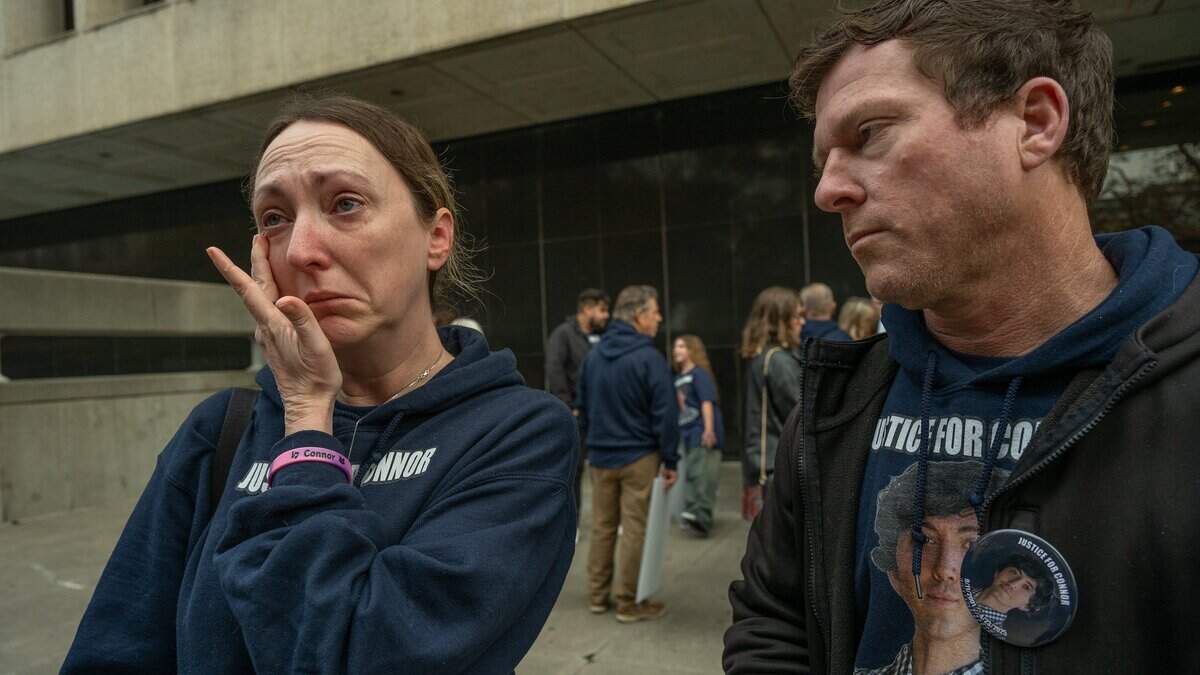
The judge ran through 17 other misdemeanor crimes before he got to the crash on Sheldon Road, and some of the allegations sounded serious: Embezzlement, violating a restraining order, child molestation. But the 18th case, the one about the tricky left turn — that one stood out because a man was dead.
Read more How did homicide by car become a special type of manslaughter in California?
The driver who hit him and then sat in her car while bystanders rushed to his side — “in shock,” her attorney would later explain, though the man’s family would use the word “remorseless” — wasn’t under the harsh lights of Department 1. Under California law, Harjit Kaur didn’t have to attend her arraignment.
On the right side of the courtroom that day in December, however, about 30 people crowded in, most of them wearing T-shirts, sweatshirts or buttons with the smiling face of the victim: Connor Lopez, 23. The family had the memorial gear made up not long after the April 2025 crash. “JUSTICE FOR CONNOR,” the shirts and the buttons all said.
Lopez’s mother, Allison Lyman, watched as Kaur’s defense attorney fielded the criminal complaint for his absent client. Lyman’s two youngest daughters, then 11 and 12, were just tall enough to peer over the benches in the courtroom.
The judge, Jerome Price, said Kaur was charged with “unlawfully killing Connor Lopez.” The dead man’s mother let out a sob. The judge and the attorneys, unfazed, quickly agreed on the next court date, in February, and that was it. Lyman and her family stood to leave, and although none of them spoke, the sound of more than 30 mourners shuffling out of a quiet room was enough to halt the court proceedings for a moment.
Outside the Gordon D. Schaber Courthouse under a layer of tule fog that had blocked the sun in Sacramento for weeks, Lyman — a 43-year-old suburban mother and state worker with big, pale blue eyes — addressed a small crowd of reporters.
Gesturing to more than two dozen people standing behind her in support, she said the one death that Kaur was charged with didn’t reflect the full loss. Each of the people who loved Lopez had seen a version of themselves disappear forever.
“They should report it as 100 fatalities,” Lyman said. “I know I died with Connor that day.”
And yet, she said, “His life is a misdemeanor.”
She was furious that Kaur did not have to appear in court because the state considers the case a low-level offense. If it had been a felony, the driver would have to be there.
The rage Lyman felt during the police investigation and the criminal court process had inspired a political crusade. She wanted California to treat fatal car crashes like they were actually significant crimes. Lawmakers could start, she thought, by requiring people accused of homicide by car to attend more of their court dates, and by automatically adding fatal crashes to someone’s driving record. To these ends, she had become an informal lobbyist.
Lyman thought that if you killed someone, even if it was with your car and even if it was unintentional, a negligent homicide should be prosecuted as a felony. She had already begun researching lawmakers and planning her campaign at the Capitol.
Unfortunately, no state legislator could give her what she really wanted: a son who was still alive.
As she had learned, the crash on Sheldon Road was part of a much larger problem: Between 3,000 and 4,000 people die in collisions in the Golden State each year. Officials have acknowledged that with changes to infrastructure and policy.
“Death and serious injuries are unacceptable,” the says. “Roads and vehicles can be designed around the physical limits of the human body.”
With this in mind, state officials set a goal of ending fatal crashes by 2050. But roadway safety and public transportation are chronically underfunded, and the death toll has continued to rise. Only a minority of car crash deaths lead to criminal charges, but for those that do, the outcomes are quite unlike many other homicides.
“They’re hard cases for the courts, they’re hard cases for the prosecutors to deal with,” said Harjit Kaur’s defense attorney, Michael Wise. “On one side, you have this horrible loss. And you have a person sitting on the other side who’s not a homicidal maniac, right? She’s just a soccer mom who was headed to the grocery store.”
The almost mundane nature of these deaths put Lopez’s family and thousands of others like them in a bind: More often than not, the end of their loved ones’ lives are considered mere accidents. Because until the state follows through and remakes all streets around the limits of the human body, fallible people will remain primarily responsible for road users’ safety. At the same time, with a transportation system largely dependent on personal vehicles that are permitted to move with deadly force, California has carved out special protections for drivers who kill. Without those considerations, the system would cease to function.
In this grim status quo, a certain amount of grief becomes collateral damage.
Lyman clung to the hope that her son’s case would be different, and that Kaur would serve time behind bars for the collision. The criminal case would pit one middle-aged mother against another in a bitter fight over a 30-day jail sentence. For Lyman, it signified whether a fatal crash matters in California.
Because although it was just a left turn, it cost her son his life.
Three lanes in California
April 23, 2025, was a sunny day. Shortly before 4 p.m., Lopez was riding his motorcycle east on Sheldon Road, a major thoroughfare at the line between the cities of Elk Grove and Sacramento. He was headed home from the gym.
Kaur, who has pleaded not guilty and referred an interview request to her lawyer, was driving west on Sheldon, headed toward the WinCo Foods parking lot. She slowed to pull into the left-turn lane that’s separated from traffic on either side by a concrete median. Video of the crash shows that after the driver in front of her pulled out of the turn pocket and into the shopping center, Kaur slowly followed, without stopping. She was just around the corner from her house.
As she made that left, she cut off Lopez. Timestamped security camera footage shows that at 3:48 and 54.5 seconds, she was in the turn lane, and at 3:48 and 57.9 seconds, Lopez slammed into the side of her car. Just under three and a half seconds.
Based on the footage and crash data from Kaur’s vehicle, investigators estimated that Lopez was traveling between 37 and 56 mph; one witness said he’d reached “a moderate speed.” At the moment the pair collided, police said she was traveling about 16 mph. Still, everything happened so fast that police could not find skid marks indicating that Lopez braked hard to avoid her. Another witness told police that Lopez tried to swerve. Regardless, he was unable to get around the midsize SUV.
“That’s when I heard a sonic boom,” a third witness told police.
The impact killed him in front of two suburban drive-throughs, a Carl’s Jr. and a Taco Bell. Officers from the Elk Grove Police Department arrived at the scene and found Lopez was face-down in his helmet. Bystanders held up blankets to shield his body from onlookers.
The speed limit on that part of the road is 45 mph. In the immediate area of the crash, Sheldon Road has six general-purpose lanes plus the center turn lanes. It’s wide and fairly straight, with clear sightlines and few reasons to slow down.
Kaur, then 49, had her 17-year-old son in the back seat. The driver in the left-turn lane behind her had seen the motorcyclist, but Kaur told police that she did not see Lopez coming, and that the crash was a terrible accident. According to the report, she said the young man “came out of nowhere.” Her son said the same thing: He didn’t see Lopez.
The collision quickly hit local media, but the victim’s name wasn’t immediately made public. When a news channel broadcast a segment about why Sheldon Road was closed that afternoon, Lyman happened to catch it. She texted and called her son to make sure he wasn’t involved in the crash.
The longer his silence, the more she began to panic.
Later, although she rushed to the hospital and spent hours holding Lopez’s hands as they grew cold, Lyman would be seized by an irrational guilt that she hadn’t been present at the crash site. Another person — one of his cousins — would say in court that by coincidence, she had driven right past the scene that afternoon, and she regretted not stopping.
But until the family arrived at the hospital and spoke to the doctors, they could not have begun to understand that, for them, this fatal California crash was different from the other 3,000 that killed people in 2025. This one killed a young man they loved.
Pattern of collisions on high-speed road
The block of Sheldon Road where Kaur turned in front of Lopez appears safer than the intersections that bookend it, where clusters of crashes have occurred. Still, according to data compiled by UC Berkeley’s Transportation Injury Mapping System, other collisions have hurt people on the straightaway where Lopez was fatally hit.
East of Lewis Stein Road and west of West Stockton Boulevard, the map shows that at least six people other than Lopez have been injured and, in one case, killed in the past five years.
In 2022, a 21-year-old driver headed east sustained minor injuries when another driver turned left in front of him headed toward the WinCo shopping center. In 2024, a driver sustained minor injuries when another westbound driver rear-ended her; another rear-end crash with minor injuries occurred in 2022. In 2025, a 14-year-old cyclist headed east on the wrong side of the road sustained minor injuries when a westbound driver turned right and broadsided him. In 2022, a 13-year-old cyclist going the wrong way had been injured in a similar broadside crash.
And, at about 6 a.m. on Aug. 5, 2025 — just before the sunrise, three and a half months after Lopez’s death — a pedestrian crossed Sheldon Road and was fatally struck by a westbound driver.
Despite these collisions, Sheldon is not considered dangerous by local authorities. With westbound traffic volumes of around 20,000 vehicles a day, Elk Grove considered the injury crash rate low.
No one else has been killed at that particular left-hand pocket. A spokesperson for the city of Elk Grove, Sydney Robertson, said that after Lopez was killed, the Public Works Department reviewed the site and “concluded that the intersection was properly constructed to applicable standards. Although not required, a yield sign was installed.”
The roadway, the city determined, had nothing to do with his death.
Other than the location and the involvement of personal cars, all the recent injury crashes on the block had something in common: One of the people involved did something plainly illegal under California law. The pedestrian who died had crossed illegally; the two kids on bikes were riding the wrong way; one of the rear-end culprits was under the influence. And Kaur, police said, turned left in front of Lopez when she should have waited.
That baseline assumption — that individual choices lead to crashes, and that the infrastructure and vehicles involved are a secondary factor at most — was not an inevitable conclusion. Strategic campaigns by the car industry promoted that line of reasoning as automobiles took over the U.S. in the 20th century.
As the historian Peter D. Norton wrote in “Fighting Traffic,” in the early 1920s, 42,000 Cincinnati voters signed a petition to place “speed governors” in cars that would force them to travel slower than 25 mph. Thousands more protested pedestrian deaths in cities across the nation.
In response, Norton wrote, the nascent but powerful automotive industry marshalled a vast propaganda and lobbying arm to shift the “fault” in fatal crashes away from vehicles and onto individual reckless drivers, pedestrians and cyclists. The industry recruited legions of transportation planners and politicians; by the mid-20th century, these new allies had agreed to rebuild their cities to accommodate cars. Many public officials came to believe that the future was car-centric, necessitating expanded roadways for more efficient auto throughput.
But “efficient” is often a euphemism for “fast,” and research shows that wide streets like Sheldon allow and even encourage drivers to travel at higher and riskier speeds. While a collision at 20 mph is unlikely to kill anyone, the AAA Foundation for Traffic Safety has found a 40 mph crash is very likely to be fatal in the event of a collision with a pedestrian or cyclist.
And a motorcyclist — even with protective gear — is similarly vulnerable, with no metal around them to absorb the impact and no airbags to cushion the blow. A witness to the crash on Sheldon Road later told the court that Lopez’s body “crumpled.”
Who was responsible for this death?
Lyman was fixated on Lopez’s body, especially his hands. Her son had been a piano teacher, and his hands had made beautiful music. The young man had a lifelong gift; even as a toddler, he was babbling melodies in perfect pitch before he could really talk. As he grew up, it seemed he could play just about any song by ear.
Although it hadn’t saved his life, the helmet had provided Lopez’s face with some protection, and the funeral home was able to make him look much like himself. But the mortician told Lyman they couldn’t fix up those mangled hands, and so they were covered.
The city of Elk Grove had absolved itself and the street design, and California had collectively accepted the inherent danger of automobiles. Who could Lyman hold responsible for her son’s broken body? When she thought about the twisted hands she held in the hospital, who would she blame?
The only option left was Kaur.
She wanted Kaur to pay with jail time. And as she advocated for that unusual outcome, she was savvy. Lyman was raised by a Sacramento County public defender and had multiple attorneys in the family to help her navigate the criminal proceedings. And she had an extraordinary ability to mobilize dozens of friends and family to attend almost every court date, ensuring that the judge and the attorneys felt the weight of public scrutiny.
But despite all that — and despite the fact that many less serious crimes than “vehicular manslaughter” in the U.S. are followed by very harsh punishment — the odds in this case were stacked against a jail sentence.
When you kill someone with your vehicle in California, most of the time, the police and the death investigators and even the local news will call it an “accident.” And when adjudicating this kind of accident, the courts tend to favor lenience.
Unless the crash was a hit-and-run or the circumstances met the high bar for “gross negligence,” a prosecutor will generally file a misdemeanor charge “without gross negligence,” and the maximum sentence will be one year in jail, if charges are filed at all.
In a misdemeanor case, the driver may be eligible for diversion and could have the manslaughter charges erased from their record entirely.
Lopez’s family disputed the level of negligence in the crash that killed Lopez, but prosecutors didn’t seem to agree. The evidence showed that Kaur hadn’t been drinking and wasn’t speeding. By her account, she just hadn’t seen the motorcyclist in the number three lane — a mistake. And so the homicide became a misdemeanor, lumped alongside petty theft and drug possession cases.
Lyman couldn’t believe it.
On the anniversary of her son’s death, she told a crowd outside the Capitol, “To get away with murder in California, do it with your car.”
How did vehicular manslaughter become a misdemeanor?
Under the California Penal Code’s chapter on “Homicide,” in Section 192, the state recognizes three distinct types of manslaughter: voluntary, involuntary and vehicular.
Initially, deaths caused by vehicle collisions could simply be prosecuted as voluntary or involuntary manslaughter. In the 1920s, as Norton wrote, people — and juries — tended to sympathize with the victims of fatal crashes. But as automobiles came to dominate cities, lawmakers worked toward a special type of homicide just for drivers.
Read more After fighting leukemia, Greg Papa sadly loses the job he hoped to regain | Opinion
By the end of 1945, Senate Bill 504 moved “vehicular manslaughter” to its own separate category in the Penal Code, where it had its own separate sentencing. A story published in the Richmond Independent that summer explained that juror sympathies had shifted in California: “Enforcement officials contend that juries are reluctant at present to recommend a manslaughter conviction, which now almost automatically sends the convicted person to state prison.” To secure convictions, prosecutors needed a less severe manslaughter option.
Kaur was charged under the lightest type of vehicular manslaughter. Prosecutors said she killed someone with a car “without gross negligence.” It was an ordinary amount of negligence: She didn’t see the guy coming. If she were guilty, her crime could only be punished with a sentence of up to one year in the county jail. In practice, even that sentence has become rare in the state.
Although carveouts for vehicular manslaughter became the law in California more than half a century ago, Lyman and her family were stunned by it, and would beg the court for just a 30-day sentence.
After hours of pleading, they’d find out that 30 days in jail might have been too much to ask for Lopez’s death.
Two agonizing days in court
To confront Kaur, Lyman and her family made their victim impact statements in court twice.
The first time, on April 17, Kaur wasn’t in the room — the third court date she hadn’t attended.
Over the course of nearly 20 minutes, Lyman told the judge about her son and her thoughts on Kaur. She spoke in a mostly clear voice, though her hands shook. When she was finished, John Lyman — her husband and Lopez’s stepfather — stood up and spoke about the young man he called his son. They were followed by 15 more speakers, including Lopez’s oldest sister, Ella Lopez, 21, and their father, Vidal Lopez. All together, they spoke for more than an hour and a half.
They described an adoring older brother who was the charismatic center of every family gathering.
“Connor was a bright, shining spot on this world,” his father said. Vidal was angry about all that the family had lost — he felt as though Kaur had taken not just his son’s present and future, but also their shared past.
He talked about a time not long before Lopez died. The two men were in the sun together, sweating as they did some hard work on the house. Like Lyman, he’d looked at his son’s hands. He thought about all that those hands were capable of: both exquisite music and manual labor. It was the best feeling, to be together, to see his son as a young man.
Along with all his other memories of his son, that memory was now laced with grief.
“I’m not as strong as Connor’s mom,” he said. “I have absolute, complete terror dealing with his death.” He began to cry. He asked the judge to send Kaur to jail.
The courtroom forum offered a certain release, and the family knew it was important for the judge to understand who Lopez was. But they wanted Kaur to understand the same thing, and many of the speakers criticized her for not being present to hear them that day.
On May 15, however, the defendant made her first appearance, and for a second time, eight of the previous 17 speakers made very similar statements. This time, Kaur would have to listen.
The family explicitly called for her to serve jail time.
Lyman directly addressed Kaur. She criticized the woman for not crying when she called 911, and for never asking about Lopez’s condition. After the arraignment in December, Lyman said that she wanted “an apology, or any recognition” from Kaur. But because Kaur had repeatedly stayed home from court, Lyman took a harsher tone when she actually faced the woman. She rejected Kaur’s words before hearing them.
“You have no remorse,” Lyman said to Kaur. “If you speak today and say something else, it will have no meaning.”
For more than an hour, Lyman, Vidal, John and five more members of the family spoke. They alternated between describing the young man they loved and telling Kaur she didn’t seem to care that her left turn had killed him. Vidal said he prayed to God that no other parent would experience their pain.
Then, a grieving 25-year-old cousin made an ugly statement: She said she wished Kaur’s son would die in a crash, too. The judge interrupted to warn her that she needed to direct her comments to the court.
When the family was done speaking, the assistant district attorney played a five-minute slideshow with photos and two short videos of Lopez, set to music he performed — the Moonlight Sonata.
Through all the anger and assumptions, Kaur sat there silently.
At 11:13 a.m., the defendant stood to give her own statement.
Kaur spoke directly to Lopez, mother-to-mother. Reading aloud, she began, “Dear Allison.” She said her message was long overdue. She said that, as a mother, she grieved for Lyman’s “unimaginable loss.” She also said that she had a daughter who was the same age as Lopez — suggesting that perhaps she had imagined what it would be like to lose her own child after all.
Kaur told Lyman that she knew Lopez had been a kind, talented and deeply loved young man. She didn’t claim the same level of grief as Lopez’s mourners, but she said that her life had been changed by the crash, too.
“My heart has been heavy for your family,” she said. “Please accept my deepest and most heartfelt condolences.”
Although Kaur did not get into the details of her own experience after the collision, her attorney at the time, Robert Carroll, did. When Kaur was finished speaking, he told the judge that Kaur had lost 20 pounds in a month, that she at one point stopped showering and that she didn’t call 911 immediately after the impact because she was “in shock.” He said she was traumatized, and that she had suffered from headaches, flashbacks, insomnia and nightmares.
Lopez’s family audibly scoffed. They had nightmares, too.
The judge sent everyone out of the room on a midday break, and the young assistant district attorney with a deep voice, Emmanuel Okwuone, told the family that Kaur was preparing to accept a plea deal that included a 30-day jail sentence. To Lyman, the sentence seemed too short, but she knew at least Kaur would spend time behind bars — and the criminal case would be over.
However, something changed during the break. After the court reconvened at 1:30 p.m., Kaur’s attorney said his client pleaded not guilty and demanded a trial.
The judge and the attorneys set the next date — which would assess whether both sides were ready for a trial — for June 10. Lopez’s family drifted out of the room.
In the hallway, Okwuone huddled with Lyman and her relatives. The demand for a trial had surprised him, too. He told them, “I’m so sorry this is being dragged out.”
The prosecutor had been admitted to the bar just under a month before Kaur’s December arraignment, and he had the determination of a novice. He assured the family, “I am not gonna stop until I get justice for Connor.”
The family believed that Kaur’s rejection of the plea deal was another sign she didn’t care about their pain.
Kaur’s current attorney, Wise, said he wasn’t sure exactly what occurred the day of the plea deal because he was hired after the decision was made. However, he said he believed that Lopez’s family had assumed the worst about his client due to their own staggering pain.
“I really feel for them,” he said, “and I know she does too.” He said that “she wishes she could convey how sorry she is.”
Wise said that as a defense attorney, he frequently advises his clients not to contact a victim’s family because their words could be “misconstrued.”
That very same silence, he said, can then be misconstrued as indifference.
In June, when Lopez’s family returned to the courthouse for the trial readiness conference, their numbers had been whittled down again. This was the fifth day they’d been to court, and they came with about half as many supporters as the previous four times.
Once again, Kaur wasn’t there. Since demanding a trial, she had hired Wise; because she had changed representation, the judge agreed that she could not be ready for a trial in late June, and so the matter was bumped to Aug. 4. The decision only took a few minutes.
On Aug. 4, Kaur’s attorney reiterated to the judge that his client was seeking a trial; Kaur was not in the courtroom. The court set a trial readiness conference for Oct. 1 and a trial for Nov. 2, close to a year after the arraignment.
Lyman and her husband, John, gave brief statements to the judge. They were frustrated that a resolution was, once again, delayed.
“Every time we’re here, we have to relive Connor’s death and the lack of consequences for taking his life,” Lyman told the judge. She would keep showing up, she said. “But I’m tired.”
A young man’s apartment
The grief of losing a child is shattering. To keep her shards together, Lyman had imposed a new organizing principle on her life.
“Connor is one of 4,000,” Lyman said — a number of lives snuffed out in crashes that, for her, conjured up the countless bereaved.
She has gone to the site of the crash almost every Wednesday afternoon since April 23, 2025, with signs and sometimes little offerings for Lopez — a can of Red Bull, a Slim Jim. Standing outside the Carl’s Jr. on April 29, she said she kept this vigil because “I wanted everyone to know this is where my child was killed.”
Beyond her weekly public vigil, Lyman planned news conferences. She mobilized crowds to show up at Lopez’s court dates in coordinated memorial T-shirts and made sure local reporters showed up, too. She lobbied state lawmakers and spoke before state Senate and Assembly committees. She lambasted state officials for allowing vehicular manslaughter cases to be tried as misdemeanors. Instead of quietly mourning the one-year anniversary of Lopez’s death, she convened a group of other women grieving loved ones killed in vehicle collisions to speak at a rally on the West Steps of the California Capitol.
If she kept noisily insisting that her son’s life had mattered, perhaps the government would treat his death that way, too.
But the loudest grief has its quiet moments, and for those, Lyman goes to a messy one-bedroom in Land Park.
About 11 months before he died, Lopez had moved out of Lyman’s home and into an apartment near Sacramento City College. He was taking classes and planning on transferring; he hoped he would one day go to law school. Because of his talent, his mother urged him to consider a career in music, but the young man told her he wanted to be an attorney.
She just wanted him to be happy. He had been adrift for a few years after high school, unmoored by the sudden death of a close friend. She’d been so glad to see him finally thriving, excited about the future and his budding independence and his new little home.
By his old kitchen door on June 17, she said, “Everything is how he left it.”
After all the glowing testaments to his character, the apartment was startlingly nondescript. It might have belonged to just about any 23-year-old male college student: big tub of protein powder in the kitchen, brown couch, beige rug, gray curtains, a single kitchen chair near a kitchen table that was covered in promotional mailers and nine half-empty water bottles. Slip-on Vans and two socks kicked off in the middle of the living room. A video game console and a TV. Blank walls. Two more kitchen chairs pulled into the bedroom to hold piles of unfolded clothes. A partially assembled cat tree for the cat, Benny, who hated everyone but Lopez. A moderately-priced vacuum still full of dust and hair.
Although Lopez hadn’t hung a single piece of art, Lyman pointed out that he left up the Christmas lights she and her daughters insisted on stringing over his bedroom window for the holidays. On his dresser, he had placed a novelty trophy that looked like a small Oscar statuette. He’d won the “best brother” award.
Lyman likes to sit on the brown couch and play music for Lopez.
By this point, Lyman has paid the rent on the place for longer than her son actually lived there. It’s expensive, and she can’t bear to stop.
“I don’t know how to pack it up,” she said. “It feels like he’s really never coming back, if I pack this up.”
When she walked in that day, more than a year after the crash that killed him, she leaned toward a denim jacket with a faux fur collar hanging in the front hall and took a deep breath. She could still smell her son.
Read more 49ers practice overshadowed by big-name absences, but Brock Purdy shines